

DID JESUS JUST TURN WATER INTO WINE?
What to Know
What It Is – The First Miracle of Jesus Christ - The account of Jesus turning water into wine in John 2 is the first recorded miracle of Jesus Christ and marks the official beginning of His public ministry (John 2:11). Unique to the Gospel of John — called the “spiritual gospel”— this miracle stands apart from the other gospel accounts and is intentionally placed early to reveal Christ’s divine identity and mission.
A Miracle Rooted in Ritual Purification - John emphasizes that the six stone water jars used in the miracle were mikvoth — large stone vessels used for Jewish rites of purification and, specifically, pre-wedding cleansing. Archaeology confirms that stone jars of this size (20–30 gallons each) match those used for ritual immersion during the Second Temple period. Their presence means this wedding had undergone the traditional mikveh purification performed days prior.
Why the Stone Jars Matter - These stone jars represent the old system of ceremonial cleansing, essential in Jewish life but temporary in effect. When Jesus transforms the water of purification into wine, He symbolically replaces the old covenant — centered on repeated washings and sacrifices — with the new covenant sealed in His blood (Luke 22:20). The act reveals Jesus as the true source of cleansing, hope, and spiritual renewal.
Wine as Covenant Symbolism - Throughout Scripture, wine symbolizes joy, blessing, sacrifice, and covenant. In the Old Testament, wine accompanied offerings and holy days; In the New Testament, Jesus identifies wine as representing His blood poured out for the forgiveness of sins. By turning water used for ritual cleansing into wine, Jesus foreshadows His role as the ultimate purification, accomplishing eternally what water and sacrifices could only temporarily provide (Hebrews 9:14–15; 10:1–4).
The “Third Day” and Prophetic Imagery - John notes that the miracle occurred on the third day (John 2:1), a detail rich with biblical symbolism. The third day often signifies divine presence, preparation, or resurrection—seen in Exodus 19, the sign of Jonah, and Christ’s own resurrection. That Jesus performs His first miracle on the third day at a wedding highlights the prophetic trajectory toward the future marriage of the Lamb (Revelation 19:7).
A Revelation of Jesus’ Purpose - This miracle is far more than a display of supernatural power or compassion for a family. It reveals Jesus’ true character and mission — He is the fulfillment of the mikveh, the Hope of Israel, and the source of cleansing; He transforms the old into the new; He inaugurates His ministry with a symbolic act pointing to His sacrificial blood; He sets the stage for the New Covenant and the future wedding between Christ and His Bride.
Jesus’ first miracle is not merely a moment of provision — it is the unveiling of God’s plan, the transition from ritual purification to eternal redemption, and a preview of the ultimate wedding to come.
The Book of John is written from the perspective of showing Jesus Christ as both the Son of God and a human, someone who, like us, had to resist sin and the same temptations while in a mortal body. The symbolism and themes throughout the Book of John, such as John’s contrast of light and darkness to belief and unbelief are distinct from the other gospels, whose primary focus is on Jesus Christ’s teachings, parables, and life. As a result of these distinct and differing perspectives, the early church referred to the Gospel of John as “the spiritual gospel.” This distinction makes it noteworthy that an account of Jesus Christ is given in John, which is not referenced in other gospels. The account is significant because it happens near the beginning of Jesus Christ’s ministry. According to many scholars and even the Bible, as stated in John 2:11, this event marks the beginning of Jesus Christ’s public ministry. The account is recorded in John 2 when Jesus turns water into wine.
A typical mikveh pool that would be used for the pre-wedding cleansing in the Jewish faith.

A typical mikveh pool that would be used for the pre-wedding cleansing in the Jewish faith.
Many online sources and scholars explain the meaning of this miracle as Jesus Christ showing His power over all things down to the atomic level. Others think this miracle is included to show Jesus Christ’s personal side, where He takes an interest in the honor of the family and acts to prevent any shame from happening to them. While both explanations hold some weight and are true to an extent, the miracle’s actual meaning and distinction of being Jesus Christ’s first publicly may be far more profound. You are now familiar with the importance of mikvoth in ancient Israel, and their widespread use for the ritualistic cleansing of sin and the hope of physical healing. There was another important use for mikvoth, and in fact, it is still used in the Jewish faith today. According to the publication Jewish Rhode Island, mikvoth were and still are used before weddings to symbolize the washing away of the bride or groom’s previous sins so both can enter the marriage cleansed. Like other ritual cleansings that mikvoth were used for during the intertestamental period, this pre-wedding mikvothwashing also dates back to roughly the 2nd century B.C., with its roots going back to the Old Testament, as previously reviewed. With mikvoth being important to even Jewish weddings, it should not be surprising to learn that modern archaeology believes the six waterpots described in John 2:7 were actually mikvoth. This is further demonstrated within Scripture since the preceding verse, John 2:6, records these six stone water jars as being there “for the Jewish rites of purification, each holding twenty or thirty gallons.”
These six water jars, discovered during recent archaeological excavations, provide you with an idea of what the water jars would have looked like. These water jars would be a similar shape and size to the ones described in John 2:6.
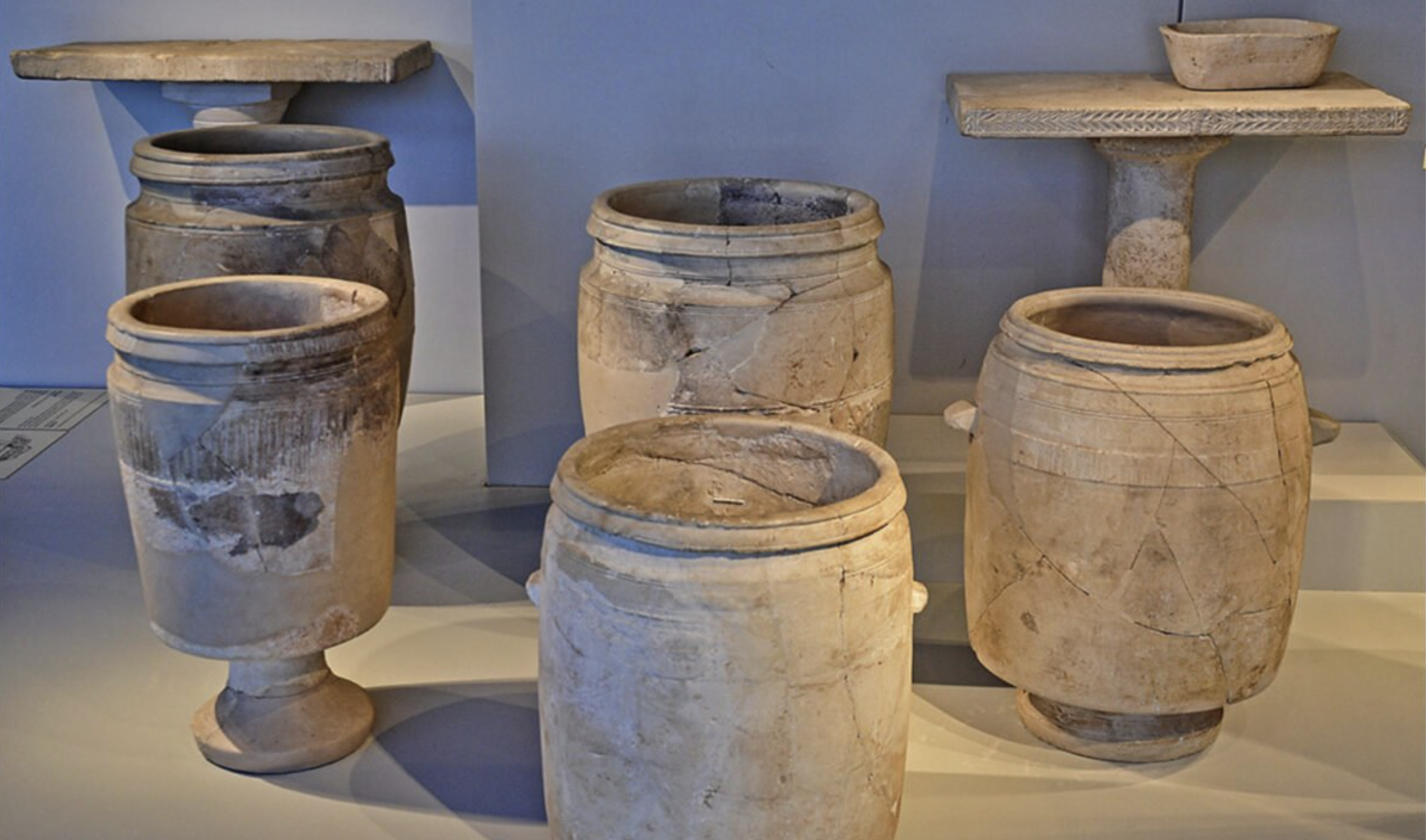
These six water jars, discovered during recent archaeological excavations, provide you with an idea of what the water jars would have looked like. These water jars would be a similar shape and size to the ones described in John 2:6.
The jars would have had to be present for the pre-marital cleansing, which would have occurred within four days prior to the wedding. Interestingly, the amount of water that each jar holds (twenty or thirty gallons) is also recorded in John. This is important because these jars would have had to be large enough for total immersion according to the Jewish ritual practices, but they would also have to hold enough water to satisfy the guests for the remainder of the wedding. Considering that Jewish weddings during Jesus’s time could last up to 7 days, a large amount of water, and thus wine, would be needed.
The implications and symbolism of this miracle are remarkable to our understanding. From what we now know, mikveh was originally associated with water and was later used to mean “hope” and to represent Jesus Christ as our hope, as we have seen recorded in the prophets of the Old Testament. With this understanding, do we see the entirety of God’s plan present in this first miracle, which began Jesus Christ’s public ministry? When Jesus Christ turned the ritually cleansing, purifying water from the stone jars into wine, which would represent His blood?
Throughout the Bible, wine is used to symbolize various things and plays a significant role. In the Old Testament, wine is used in the sacrificial system through drink offerings (where wine was poured out on the altar with the sacrifice) and was required on most annual holy days. In the New Testament, we learn what wine represents and why it is integral to the sacrificial system. Jesus plainly states in Luke 22:20,
“This cup is the new covenant in My blood, which is shed for you.”
No longer is the water of the Old Testament needed, which merely covered sin temporarily. Through Jesus Christ’s blood, we now have access to something far greater as the author of Hebrew states,
“How much more will the blood of Christ, who through the eternal Spirit offered Himself without blemish to God, purify our conscience from dead works to serve the living God. Therefore, He is the Mediator of a new covenant, so that those who are called may receive the promised eternal inheritance, since a death has occurred that redeems them from the transgressions committed under the first covenant.” (Hebrews 9:14-15)
Another noteworthy detail is mentioned within John's account. That is the miracle of turning water into wine happened on the third day (John 2:1). With this miracle happening on the third day and at a wedding, the parallels are once again striking and show us the tremendous symbolism to both Jesus Christ and the Father’s plan. Three days is prominent throughout Jesus's parables and the Old Testament. We reviewed an example of this earlier in Exodus 19:10 when the children of Israel had to wash their clothes and prepare to be in the presence of God for three days. However, the most well-known example of this third day is the sign of Jonah that Jesus gave to the Pharisees as Him being the Messiah (Matthew 12:40).
Through Jesus Christ's first miracle, the plan of God and Jesus's total purpose is revealed to us. Even though the ancient Israelites did not fully understand the mikveh’s (or mikvoth) purpose and usage in their language, they were practicing their hope in God and the One who would come as Jesus Christ. The sacrifices and water purification rituals of the Old Testament could only temporarily cleanse them from their sin, as alluded to in Hebrew 10:14. Jesus Christ's coming, and willful shedding of His blood for us turned the old purification rituals of the Old Testament into an everlasting covenant, symbolized to us through mikveh and thus baptism. We should also remember that all of this happened at a wedding. This miracle symbolizes the whole of God's plan, including its ending, eventually leading to and culminating in the marriage of the Lamb to His Bride as Revelations shows us:
"Let us rejoice and exult and give Him the glory, for the marriage of the Lamb has come, and His Bride has made herself ready…" (Revelation 19:7)
So, was Jesus turning water into wine merely a miracle to show His authority over everything down to the atomic level, or to show compassion on a family and to preserve their honor in the community? Of course, it was both, but God wants us to learn much more from this first miracle. It is fitting that Jesus’s first miracle is not of healing but of His true character and purpose.
——————————————————————————————————————————————————————————————————————————————————
Discover the Deeper Meaning Behind Baptism and the Hope We Have in Christ
1. Baptism: Where Our Hope Begins - Discover why Jesus Christ’s baptism is recorded in all four gospels and how baptism becomes the starting point of the believer’s transformation, symbolizing repentance, cleansing, and new life in Christ.
2. Ritual Cleansing in the Old Testament - Explore how ancient Israel used water for purification — from Sinai preparation to priestly consecration — and how these rituals foreshadowed the spiritual cleansing God desires for His people.
3. The Meaning of Mikveh — From Water to Hope - Learn how the Hebrew word mikveh evolves from “a collection of waters” to “hope,” and how prophets like Jeremiah reveal that God Himself is our Mikveh — the true Hope of Israel.
4. Mikveh Pools & Jewish Life Before Christ - Archaeology uncovers hundreds of ancient mikveh pools across Israel. See how mikvoth shaped Jewish purification practices and prepared the world for the Messiah and His message.
5. Jesus’ Miracles at the Mikveh Pools - The healings at Bethesda and Siloam were not random — both pools were mikvoth. Understand how Jesus showed that He, not the water, is the source of healing and hope.
6. Did Jesus Simply Turn Water Into Wine? - A deeper look at His first miracle reveals the entire plan of God: the transformation of Old Covenant purification water into wine representing Christ’s blood, the New Covenant, and the hope of eternal life.
7. The Fulfillment of Mikveh — Jesus Christ as Our Living Hope - Trace how the apostles understood Jesus as the fulfillment of mikveh and the One through whom God’s promise of eternal life is made possible.