

Saturday Sabbath vs. Sunday Sacredness
“And to the angel of the church of the Laodiceans write, “These things says the Amen, the Faithful and True Witness, the Beginning of the creation of God:
I know your works, that you are neither cold nor hot. I could wish you were cold or hot.
So then, because you are lukewarm, and neither cold nor hot, I will vomit you out of My mouth.” (Revelation 3:14-16)
The warning to the church in Laodicea was a stark indictment of "lukewarm" faith, a call for urgent repentance. While we often wonder if these biblical churches heeded such warnings, history suggests that Laodicea did not change. Instead, its influence evolved, sowing a "bad seed" that has taken root in much of modern Christianity.
Historically, the church in Laodicea outlasted most of its neighbors in Asia Minor. In approximately A.D. 336, it became the site of a pivotal governing body: The Council of Laodicea. Among its 60 rulings, or "canons," was a decision that would fundamentally alter the course and rhythm of Christian worship: the official mandate to shift the Sabbath from Saturday to Sunday.
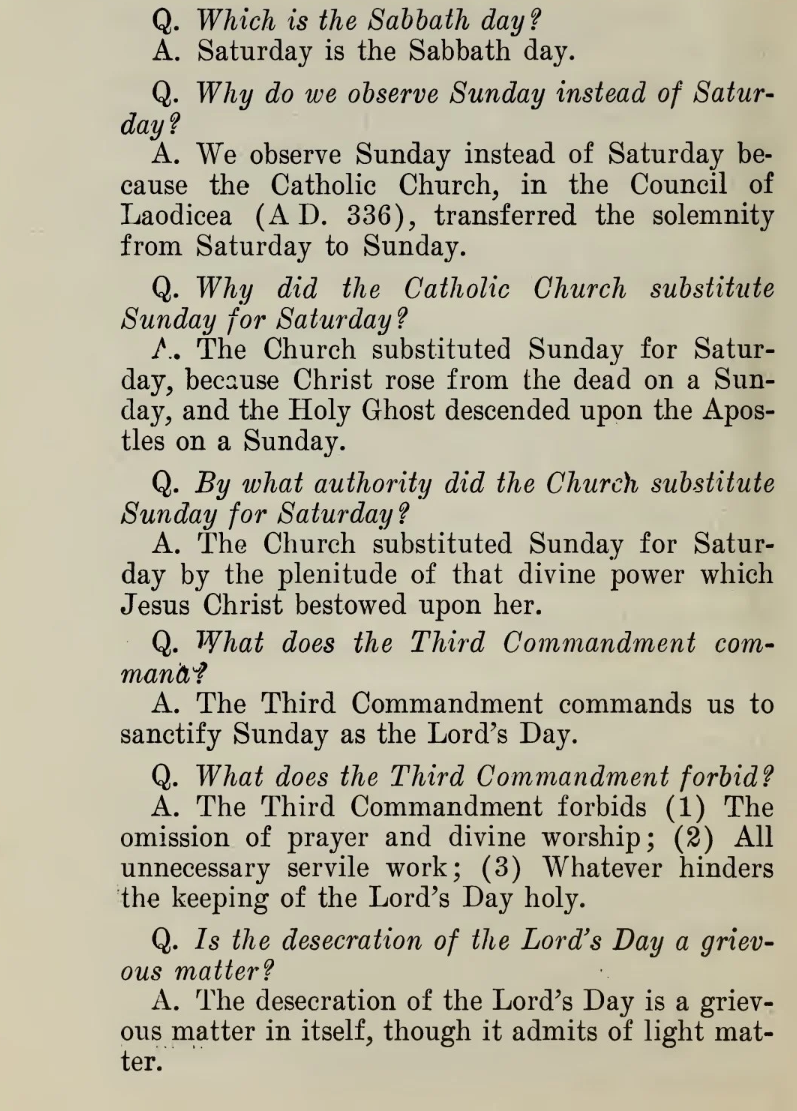
An excerpt from The Convert’s Catechism of Catholic Doctrine explicitly admitting transferring the seventh-day Sabbath to Sunday.
This shift was not a scriptural evolution, but a calculated ecclesiastical change. Even The Convert’s Catechism of Catholic Doctrine explicitly admits this transition, stating that the church exercised its own authority to move the solemnity from the seventh day to the first.
Key Takeaways from the Council of Laodicea
(c. A.D. 336)
Canon 29: This specific ruling explicitly forbade Christians from "Judaizing" by resting on the Sabbath (Saturday), commanding them instead to work on that day and honor the Lord’s Day (Sunday) if possible.
The Legacy: Rather than repenting of its lukewarm nature, Laodicea used its influence to codify a departure from the "blueprint" of the early Church.
The Admission: Catholic doctrine openly acknowledges that the change from the seventh-day Sabbath to Sunday was an act of the Church, not a command found in Scripture.
The Catholic Church is transparent about its role in shifting the Sabbath from Saturday to Sunday, asserting that it exercised its own ecclesiastical authority to make the change. This admission underscores a vital historical reality: for centuries after the resurrection, the followers of Jesus Christ continued to honor the seventh-day Sabbath, right up until this institutional shift.
When Protestant churches later branched off during the Reformation, they broke away from many doctrines but chose to retain this specific tradition of "the Lord’s Day" (Sunday) rather than returning to the biblical Sabbath. This creates a significant conflict, as it prioritizes a man-made tradition over a divine decree. Jesus spoke directly to this tendency, reserving some of His harshest warnings for those who elevate human tradition above the commandments of God:
“He answered and said to them,
”Well did Isaiah prophesy of you hypocrites, as it is written: 'This people honors Me with their lips, But their heart is far from Me. And in vain they worship Me, teaching as doctrines the commandments of men.'"For laying aside the commandment of God, you hold the tradition of men making the word of God of no effect through your tradition which you have handed down. And many such things you do." (Mark 7:16 & Mark 7:13)
Jesus was vehemently opposed to changing God's commandments and elevating man's doctrine above God’s word.