


STUDY ALL TOPICS
The Sign of The Cut: Is the Sabbath Optional?
Discover why the Sabbath isn't a mere tradition, but a perpetual sign of God's covenant. By examining the biblical concept of kareth (divine severance) across both the Old and New Testaments, this study explores how honoring the Fourth Commandment demonstrates covenant loyalty and divine mercy.
How Do We Show love to God?
If you asked a hundred Christians today, answers would most likely focus on prayer, worship songs, or being kind to neighbors. These are all vital, but Jesus Christ gave us the definitive answer when tested by the Pharisees in Matthew 22:37-40. He identified the two great commandments:
"You shall love the Lord your God with all your heart, with all your soul, and with all your mind. This is the first and great commandment. And the second is like it: You shall love your neighbor as yourself. On these two commandments hang all the Law and the Prophets."
The Law of Love
How the Ten Commandments carry out the two greatest commandments
- 1. No Other Gods
- 2. No Idols / Graven Images
- 3. Respect God's Name
- 4. Remember the Sabbath Sign of Covenant
- 5. Honor Parents
- 6. Do Not Murder
- 7. Do Not Commit Adultery
- 8. Do Not Steal
- 9. No False Testimony
- 10. Do Not Covet
Traditionally, we can view the Ten Commandments as the practical blueprint for these two goals. The final six commandments protect our neighbor’s life, family, and property. But the first four? Those are God’s specific instructions on how He desires to be loved.
If the first three commandments identify Who we worship and how we respect His Name, then the fourth commandment – the Sabbath – stands as a unique, divine appointment to declare the When. It isn’t a mere suggestion, but an established rhythm instituted by God at creation.
This leads us to a challenging, perhaps even sobering question: If the Sabbath is a core part of how God asks us to show our love, what happens when we decide to skip the appointment?
The Sabbath: A Sign of Covenant, Love, and Mercy
To understand why the Sabbath holds such a central place in how we love God, we have to look at how Scripture explicitly defines it. In Exodus 31:13, God calls the Sabbath a sacred "sign" ( ot in Hebrew) between Himself and His people:
"Surely My Sabbaths you shall keep, for it is a sign between Me and you throughout your generations, that you may know that I am the Lord who sanctifies you."
A covenant sign is a tangible marker of a relationship — much like a wedding ring. It isn't just an arbitrary rule, but a public declaration of mutual loyalty. In the Old Testament, this covenant loyalty is bound up in the Hebrew word chesed, meaning steadfast love, covenant loyalty, and mercy. This is where our primary understanding of God’s Law, His love, and His mercy converge. When Jesus confronted the religious leaders in Matthew 12 over their rigid Sabbath traditions, He quoted Hosea 6:6: "I desire mercy and not sacrifice."
Jesus was not dismantling the Fourth Commandment. He was restoring its true intent. The Pharisees had turned God’s covenant sign into a cold, legalistic obligation — a burdensome "sacrifice." But Jesus revealed that the Sabbath was instituted as a divine act of mercy ( eleos ). It was created for humanity as a weekly sanctuary in time where God reaches down to weak, weary human beings to offer physical rest and spiritual restoration.
If the Law reflects God's nature, and God’s nature is love and mercy, then the Sabbath is not a ritualistic hurdle to clear. Rather, it is the appointed time where God’s mercy meets human need, and where our observance declares our loyal love in return. But if the Sabbath is both a sacred sign of the covenant and an appointed time for God’s mercy, then what happens when we treat it as common, optional, or irrelevant?
Two Categories of Judgment
To answer what happens when a covenant sign is ignored, we have to look at how covenants were established in the ancient world. In Hebrew, covenants were not merely written or signed — they were "cut" (using the Hebrew verb karat). Animals were divided, and the parties walked between them, pledging their very lives to the agreement. Because the covenant itself was cut ( karat ), the penalty for violating its sacred boundary directly mirrored the act of its creation: the offender was subjected to kareth — literally, being “cut off.”
In the Old Testament, there are two distinct "tiers" of punishment for sin. We are all familiar with the physical penalties, which are the civil laws that involved restitution or, in severe cases, capital execution. But there is another category often translated as being “cut off from among His people.”
At a glance, it’s easy to assume kareth refers to simple social exile, sort of like being kicked out of the camp. But a deeper look at the legal structure reveals something much heavier. Certain sins carried both a physical penalty (civil execution) and the judgment of kareth. This distinction leads to an unavoidable conclusion — kareth cannot mean mere human banishment or exile. If it did, placing it alongside a death sentence would be completely redundant. You cannot exile someone who has already been executed.
Instead, kareth represents a deeper form of judgement reserved exclusively for God. While civil authorities carried out physical capital execution on earth, God reserved kareth for Himself — a direct, spritiual severence that cuts a soul off from the source of life and the promises of His covenant.
How does this deeper reality of kareth transform our understanding of the seventh-day Sabbath? When we begin to examine the Sabbath through this lens, we begin to see why this covenant “sign” carries such unique weight for believers today. When we look at which sins God deemed serious enought to warrant both civil execution and divine severance (the most severe tier), a striking pattern emerges.
Both Kareth & Physical Death
Offenses subject to both spiritual severance and civil capital punishment.
- Idolatry: Sacrificing to other gods or following after mediums and spiritists (Leviticus 20:2–6)
- Child Sacrifice: Sacrificing one's offspring to Molech (Leviticus 20:2–5)
- Blasphemy: Cursing the Name of God or "high-handed" defiance against His Word (Numbers 15:30–31)
- Sexual Immorality (Capital Offenses): Including adultery, incest, bestiality, and homosexual acts (Leviticus 20:10–16)
- Sorcery: Practicing witchcraft or acting as a medium (Leviticus 20:27)
- Sabbath Profanation: Willfully working on the Sabbath or treating it as common (Exodus 31:14)
Kareth Only
Offenses resulting in divine spiritual judgment (spiritual severance).
- Neglecting Circumcision: Failure to perform the sign of the covenant on a male child (Genesis 17:14)
- Neglecting Passover: Failure to observe the Passover when capable (Numbers 9:13)
- Eating Leaven during Unleavened Bread: Consuming leavening during the Feast (Exodus 12:15, 19)
- Profaning Day of Atonement: Working or failing to afflict one's soul (fast) (Leviticus 23:29–30)
- Eating Blood: Consuming the blood of any animal or bird (Leviticus 7:27, 17:10–14)
- Eating Forbidden Fat: Consuming specific fat reserved for altar sacrifices (Leviticus 7:25)
- Entering Sanctuary Unclean: Approaching holy things while ritually impure (Numbers 19:13, 20)
- Eating Peace Offerings Unclean: Participating in a sacrificial meal while impure (Leviticus 7:20–21)
- Eating "Pigul" (Abominable Sacrifice): Eating a sacrifice past its designated day (Leviticus 7:18, 19:8)
- Slaughtering Outside Tabernacle: Offering a sacrifice in an unauthorized location (Leviticus 17:4, 9)
- Imitating Holy Anointing Oil: Making a copy of the sacred oil for common use (Exodus 30:33)
- Imitating Holy Incense: Compounding temple incense for personal enjoyment (Exodus 30:38)
- Applying Oil to a Stranger: Using sacred oil on an unauthorized person (Exodus 30:33)
Do you notice anything striking about the Sabbath when comparing these two lists?
Virtually all Christians agree that idolatry, blasphemy, and sexual immorality represent major moral boundaries. Yet, God places Sabbath-breaking in that exact same "highest tier" of gravity.
We must ask ourselves: Why is the Sabbath the only covenantal "sign" that carries both penalties? Circumcision was a sign, but it carried only the penalty of kareth (spiritual severance). The Sabbath, however, was protected by the same dual fence as child sacrifice and idolatry. Does this dual pronouncement reveal that the Sabbath functions as a spiritual boundary we cross at our own risk?
Because the Sabbath is explicitly identified as the “sign” of the covenant God cut ( kareth ) with His people, the penalty directly reflects the relationship. If we disregard the sign, are we essentially cutting ourselves out of the very covenant God cut for us?
Many argue that these physical death penalties were merely temporary shadows for ancient Israel. But while civil nations and earthly legal codes rise and fall, is divine judgement not rooted in the unchanging nature of God Himself? If the Sabbath is an olam (perpetual) sign, then the boundary it marks must be just as permanent.
The New Testament Connection
Does this kareth framework disappear once we turn to the New Testament? On the contrary, the Apostle Paul seems to use this exact "boundary" language throughout his writings to the early Church. In 1 Corinthians 6:9-10, Paul outlines a clear boundary regarding who remains inside the covenant promises:
"Do you not know that the unrighteous will not inherit the Kingdom of God? Do not be deceived. Neither fornicators, nor idolaters, nor adulterers… nor thieves, nor covetous, nor drunkards, nor revilers, nor extortioners will inherit the Kingdom of God."
Notice how Paul structures this warning. He leads with idolatry and sexual immorality — the very sins that carried the dual penalty of civil execution and divine kareth under the Old Testament. He is reminding believers that while earthly civil courts may no longer execute people for these offenses, the spiritual reality has not changed — unrepentant violation of these core boundaries still results in being “cut off” from the eternal inherence.
If Paul’s list directly reflets the high-tier capital boundaries of the Old Testament, is it logical to assume the Sabbath — the only commandment grouped alongside those exact same capital sins — was suddenly rendered common or irrelevant?
The Olive Tree and the Broken Branch
This pattern of covenant severance becomes even more explicit in Romans 11:22, where Paul uses the imagery of an olive tree to describe our relationship to God’s covenant:
"Therefore, consider the goodness and severity of God: on those who fell, severity; but toward you, goodness, if you continue in His goodness. Otherwise, you also will be cut off."
While many readers view Romans 11 purely through an ethnic or historic lens, Paul employs precise legal language. The Greek word he uses for "cut off" is ekkoptō — the direct Septuagint and New Testament equivalent of the Old Testament judgement of kareth.
Paul is issuing a clear warning to Gentile believers to not fall into presumption. The same principles of divine severance that saw the natural branches broken off for covenant unfaithfulness applies to anyone who failed to remain rooted in God’s standards.
If the Sabbath is the sacred “sign” of the coventant God cut with His people, then Paul’s warning of being cut off ( ekkoptō ) from the tree provides a precise New Testament parallel to kareth. Connection to God is not an abstract guarantee, but is a living relationship sustained through active loyalty to His covenant terms. To treat the sign of that covenant as optional or common is to step outside the “kindness” of the root and risk the very same severance.
The Echo in Hebrews
The author of Hebrews relies on this exact same covenant framework when issuing one of the most sobering warnings in the New Testament. In Hebrews 10:26, the author of Hebrews states:
"For if we go on sinning willfully after receiving the knowledge of truth, there no longer remains a sacrifice for sin."
This passage directly echoes Numbers 15:30-31, where God distinguishes between unintentional sins and “high-handed” defiance. In the Old Testament, to act high-handedly meant to treat God’s commandments with contempt — and the explicit penalty prescribed was kareth (to be cut off).
The author or Hebrews demonstrates that under the New Testament, the boundary line has not vanished. Despising God’s covenant terms still carries spiritual consequences.
When New Testament warnings mirror Old Testament boundaries so precisely, it forces us to re-evaluate how we view the Fourth Commandment. The Sabbath is not a ceremonial shadow destined to fade away, but an enduring monument of God’s authority and a perpetual sign of His sovereign relationship with His people.
Conclusion: Inside or Outside the City?
Ultimately, honoring the Sabbath is an intentional choice to stay aligned with covenant life. It serves as a practical marker distinguishing between those who remain inside the covenant community and those who risk spiritual severance.
The book of Revelation brings this reality into focus in its closing vision. In Revelation 22:14, those who keep God’s commandments are described as blessed, possessing the right to the tree of life and entry through the gates into the holy city. Conversely, those left outside the gates are identified by the very same high-tier transgessions — such as idolotry and severe moral breaches — that carried the weight of divine judgement throughout Scripture.
"Blessed are those who do His commandments, that they may have the right to the tree of life, and may enter in through the gates into the city. But outside are dogs and sorcerers and the sexually immoral and murderers and idolaters, and whoever loves and practices falsehood."
This final biblical picture mirrors the legal structure of kareth with striking clarity. It presents an ultimate divide between covenant inclusion and spiritual exclusion.
Viewed in this light, weekly Sabbath observance is not an exercise in legalism but is a grateful acceptance of the sign that confirms our covenant bond with God. It functions as a recurring, weekly declaration that we belong to Him.
As you evaluate your own spiritual walk, consider these central questions: Is it wise to disregard the one covenant sign that Scripture protects with such exceptional gravity? By treating this sacred “sign of the cut” as optional or common, could one unknowingly be stepping away from the very promises and gates they long to enter?

THE SABBATH
Why do over 30 languages across the globe still call Saturday "the Sabbath"? Explore the creation-based origins of the seventh-day rest and discover why there is no scriptural mandate for the historical shift to Sunday worship.
-
The Seventh-Day Sabbath is God’s First Appointed Feast: Established at creation (Genesis 2:2–3), the Sabbath predates Israel and the law given at Sinai, making it a universal institution for all humanity.
The Sabbath was Honored Throughout Scripture: Prophets, Jesus, and the apostles all observed the seventh-day Sabbath. Nowhere in the Bible is it changed to Sunday or abolished.
Jesus Affirmed the Sabbath’s Purpose: Jesus called the Sabbath a gift for mankind (Mark 2:27) and made it part of His moral practice (ethos), using it for worship, teaching, and healing.
The Apostles and Early Church Kept the Sabbath: The book of Acts shows Paul and others observing the Sabbath with both Jews and Gentiles. Hebrews 4:9 reaffirms a “Sabbath-rest” still remains for God’s people.
Sunday Observance Came Later: The shift to Sunday worship developed centuries after Christ due to Roman and ecclesiastical influence — not by biblical command.
Historical and Catholic Sources Admit the Change: The Catholic Church openly states it changed the day of worship to Sunday by its own authority, not based on Scripture.
The Sabbath Remains Central to God’s Plan: Prophets like Isaiah and Ezekiel show Sabbath observance continuing in the Millennial Kingdom, underscoring its eternal relevance.
The Sabbath Reflects God’s Covenant and Redemption: It symbolizes rest, peace, and wholeness in Christ and points to the coming Kingdom of God.
Global Language Supports the Sabbath: Over 30 world languages preserve the word “Sabbath” as the name for Saturday, reflecting its longstanding, universal recognition.

The first Feast of the LORD mentioned in Leviticus 23 is the weekly seventh-day Sabbath, a time appointed by God as a day of rest and worship emphasized throughout the Bible. While some argue that the seventh-day Sabbath (along with the rest of the law) was not instituted until the law was given to Moses at Mount Sinai, Scripture reveals otherwise. God established the Sabbath at creation, blessing and sanctifying the seventh day (Genesis 2:2-3). The Sabbath was affirmed throughout the Old Testament, upheld by the prophets (e.g., Isaiah 56:2; Ezekiel 20:12, 20; Ezekiel 44:24), and honored by Jesus and His disciples (e.g., Matthew 12:12; Mark 1:21; Luke 4:16). Even after Jesus’ resurrection, the apostles and the early Christian church observed the seventh-day Sabbath (e.g., Acts 13:14, 42-44; Acts 16:13).
There is no scriptural evidence that the Sabbath was ever changed to Sunday. A thorough examination of both the Old and New Testaments, along with historical and scholarly research, confirms that the seventh day (Saturday) remains the biblically endorsed Sabbath for all who seek to follow God and honor His redemptive plan. The practice of Sunday observance arose centuries after the apostolic era and lacks any clear biblical mandate. Recognizing the Sabbath as Saturday is neither an outdated tradition nor a custom exclusive to Judaism; rather, it is a foundational aspect of God’s design for humanity’s spiritual well-being and ultimate redemption.
From the very beginning, the Sabbath was rooted in the creation narrative itself. Genesis 2:2-3 declares,
“And on the seventh day God ended His work which He had made; and He rested on the seventh day from all His work which He had made. And God blessed the seventh day, and sanctified it.”
This passage precedes the establishment of the Israelite nation, demonstrating that the Sabbath transcends ethnic and national boundaries. Its significance is not confined to the Mosaic Covenant but is woven into the very fabric of creation, intended as a universal gift for all humanity. Jesus affirmed this when He said,
“The Sabbath was made for man, and not man for the Sabbath.” (Mark 2:27)
Throughout the Old Testament, God reaffirmed the importance of the seventh-day Sabbath. The Fourth Commandment, recorded in Exodus 20:8-11, explicitly commands believers to “remember the Sabbath day, to keep it holy.” This commandment is placed on equal footing with the other nine moral laws, none of which most Christians believe have been annulled. Ironically, the Sabbath is often the only commandment claimed to have been abolished, despite its extensive endorsement by the major prophets in the Old Testament and its reaffirmation in the New Testament.
The prophet Isaiah emphasized that the Sabbath was not limited to Israel alone but extended to all who would follow God. In Isaiah 56:2-7, he includes foreign converts and eunuchs among those who would be blessed by keeping the Sabbath. Isaiah’s prophetic vision of the future in Isaiah 66:23 describes humanity worshiping God “from one Sabbath to another,” indicating that Sabbath observance will continue into the Millennial Kingdom. Similarly, the prophet Ezekiel describes the Sabbath as fundamental to God’s future Kingdom. In Ezekiel 44-46, Ezekiel records prophetic visions of the future millennial temple, where the Sabbath is observed alongside Feasts, New Moons, and other appointed seasons. For example, Ezekiel 45:17 states,
“Then it shall be the prince’s part to give burnt offerings, grain offerings, and drink offerings, at the feasts, the New Moons, the Sabbaths, and at all the appointed seasons…”
Other passages, such as Ezekiel 46:12-14 and Isaiah 66:22-23, reinforce the continued significance of the Sabbath during the Millennial reign of Christ. These prophecies affirm that the Sabbath is not merely a relic of the past but an eternal principle that reflects God’s design for humanity’s worship, rest, and relationship with Him. Its observance is deeply embedded in God’s plan for both the present and the future, making it a timeless practice for those who seek to align with God’s will.
Many argue that Sabbath observance, rooted in the Old Testament, is no longer required under the New Covenant. However, the New Testament provides clear evidence that this argument is incorrect. Throughout His ministry, Jesus consistently upheld the seventh-day Sabbath. Luke 4:16 highlights that Jesus kept the Sabbath regularly, as it was “His custom” to attend synagogue on that day. While the English word “custom” might suggest a voluntary habit or tradition specific to a certain time or place, the original Greek word ethos conveys a much deeper meaning. It refers to “the inherent traits or disposition of an individual, reflecting their moral qualities or character.” For Jesus, the Sabbath was not merely a tradition or routine specific to that time and place — it was an intrinsic part of His moral nature and practice.
Jesus used the Sabbath as an opportunity for worship, teaching, and acts of mercy, demonstrating its true purpose and significance. He never suggested that the Sabbath should be abolished or changed. Instead, He clarified its true meaning, declaring in Mark 2:27,
“The Sabbath was made for man, and not man for the Sabbath.”
If the Sabbath was so integral to Jesus’ character and moral standard, does it not follow that those who claim to follow Him should view it with the same importance? How can those trying to follow Jesus reflect His nature, while neglecting something He so clearly valued and practiced?
Further, the apostles and early Church also continued to observe and honor the seventh-day Sabbath after Jesus’ crucifixion and resurrection. Acts 13:42-44 describes Paul preaching to both Jews and Gentiles on the Sabbath, while Acts 17:2 notes that it was Paul’s custom (the same Greek word ethos) to reason from the Scriptures on the Sabbath, just as Jesus had done. Even the book of Hebrews reinforces the enduring nature of the Sabbath. Hebrews 4:9 states, “There remains, then, a Sabbath-rest (sabbatismos) for the people of God” affirming that the Sabbath commandment remains relevant for believers under the New Covenant. Nowhere in Scripture is there any record of Jesus or the apostles instituting Sunday as a replacement for the Sabbath. Instead, the historical shift toward Sunday observance emerged over centuries, driven by political, social, and religious influences, not by clear biblical instruction.
Historical research strongly supports the evidence that the shift from Sabbath observance on the seventh day (Saturday) to Sunday worship was not biblically mandated, but arose gradually over centuries. Dr. Samuele Bacchiocchi, in his work From Sabbath to Sunday, details how this change was driven by Roman cultural and religious practices, as well as church councils that sought to distance Christianity from its Jewish roots. This transition was later formalized through the influence of the Roman Church and the Roman Empire, not through scriptural instruction.
Additional scholarly resources, such as Sabbath Truth and the United Church of God’s Sunset to Sunset: God’s Sabbath Rest, document how early Christians — both Jewish and Gentile—faithfully observed the seventh-day Sabbath for centuries following Christ’s resurrection. These sources highlight that Sunday observance was later institutionalized through traditions and decrees of the Catholic Church.
Remarkably, the Catholic Church itself openly acknowledges this change. In The Catechism of the Catholic Church and other official publications, it is stated that the Church, by its authority, transferred the day of worship from Saturday to Sunday. The Catholic Encyclopedia, available on their website, emphasizes that this change was not based on biblical instruction but on ecclesiastical authority. For instance, The Convert’s Catechism of Catholic Doctrine states, “The Church substituted Sunday for Saturday by the plenitude of that divine power which Jesus Christ bestowed upon her.”
This raises a critical question for believers: If the seventh-day Sabbath was sanctified by God at creation and upheld by Jesus and the apostles, does an institution have the authority to alter what God established? By observing Sunday, are people not affirming a change made by human authority rather than God’s command?
Some may argue that the specific day of worship is unimportant. But if the Sabbath was set apart by God and reinforced throughout Scripture, would it not be more meaningful to align with what God ordained rather than with a tradition introduced centuries later by an organization?
Could it be that by observing Sunday, one is unintentionally prioritizing human tradition over God’s eternal standard?
The biblical and historical evidence clearly supports the seventh-day Sabbath as a continuing practice for those seeking to honor God’s design for worship, rest, and spiritual renewal.
The Sabbath’s significance extends far beyond mere legalism. It embodies God’s redemptive plan, symbolizing the rest, peace, and wholeness that come from a right relationship with Him. Just as God completed creation and rested on the seventh day, the Sabbath points believers toward the ultimate spiritual rest and restoration promised through Christ’s redemptive work and the future establishment of His Kingdom. By observing the Sabbath, believers affirm their dependence on God rather than on human effort or cultural norms. Far from being abolished, as many Christians claim today, Jesus enlarged its meaning, emphasizing that the Sabbath was made for humanity’s well-being and to honor God’s intentions.
Critically, there is no scriptural basis to suggest the Sabbath was transferred to Sunday. The Resurrection of Christ, often cited as the reason for Sunday observance, is never biblically connected to a change in the Sabbath day. In fact, closer examination shows that the Resurrection has a stronger connection to the Sabbath itself and did not occur on Sunday, as is widely believed. This makes the seventh-day Sabbath not only biblically sound but also deeply symbolic of God’s covenant with humanity.
If you’re interested in researching more about the Sabbath and the change from Saturday to Sunday, we’ve provided additional references here for your review.
The seventh-day Sabbath stands as a timeless sign of God’s covenantal relationship with His creation (Ezekiel 20:12). Interestingly, its significance is echoed across many cultures and languages around the world. For example, in over 30 languages, the word for Saturday is derived from the word “Sabbath.” This linguistic consistency highlights the enduring acknowledgment of the seventh day’s sanctity, even in cultures that may not recognize its biblical origins. In contrast, no such distinction is made for Sunday in these languages, underscoring the Sabbath’s unique and God-ordained role. This global testament to the Sabbath’s significance serves as a powerful reminder of its place in God’s design for humanity.
- Hebrewשבת (Shabbat)
- Arabicالسبت (As-Sabt)
- Amharicሰንበት (Sänbet)
- LatinSabbatum
- Ancient GreekΣάββατον (Sabbaton)
- SpanishSábado
- PortugueseSábado
- ItalianSabato
- FrenchSamedi
- CatalanDissabte
- GalicianSábado
- RomanianSâmbătă
- OccitanDissabte
- RussianСуббота (Subbota)
- UkrainianСубота (Subota)
- BelarusianСубота (Subota)
- PolishSobota
- Czech / SlovakSobota
- BulgarianСъбота (Sǎbota)
- MacedonianСабота (Sabota)
- Serbo-CroatianSubota
- SlovenianSobota
- GreekΣάββατο (Sabbato)
- Yiddishשבת (Shabbes)
- Georgianშაბათი (Shabati)
- MalteseSibt
- Tigrinyaሰንበት (Sänbet)
- Hindiशनिवार (Shanivaar)
- Urduہفتہ (Hafta)
- Latvian / LithuanianSestdiena / Šeštadienis
Saturday Sabbath vs. Sunday Sacredness
Why did the Sabbath move from Saturday to Sunday? Discover the "bad seed" of Laodicea and the 4th-century council that officially outlawed the biblical Sabbath. Learn why the Catholic Church admits this was an act of human authority—and why the Reformation never changed it back.
“And to the angel of the church of the Laodiceans write, “These things says the Amen, the Faithful and True Witness, the Beginning of the creation of God:
I know your works, that you are neither cold nor hot. I could wish you were cold or hot. So then, because you are lukewarm, and neither cold nor hot, I will vomit you out of My mouth.” (Revelation 3:14-16)
The warning to the church in Laodicea was a stark indictment of "lukewarm" faith, a call for urgent repentance. While we often wonder if these biblical churches heeded such warnings, history suggests that Laodicea did not change. Instead, its influence evolved, sowing a "bad seed" that has taken root in much of modern Christianity.
Historically, the church in Laodicea outlasted most of its neighbors in Asia Minor. In approximately A.D. 336, it became the site of a pivotal governing body: The Council of Laodicea. Among its 60 rulings, or "canons," was a decision that would fundamentally alter the course and rhythm of Christian worship: the official mandate to shift the Sabbath from Saturday to Sunday.
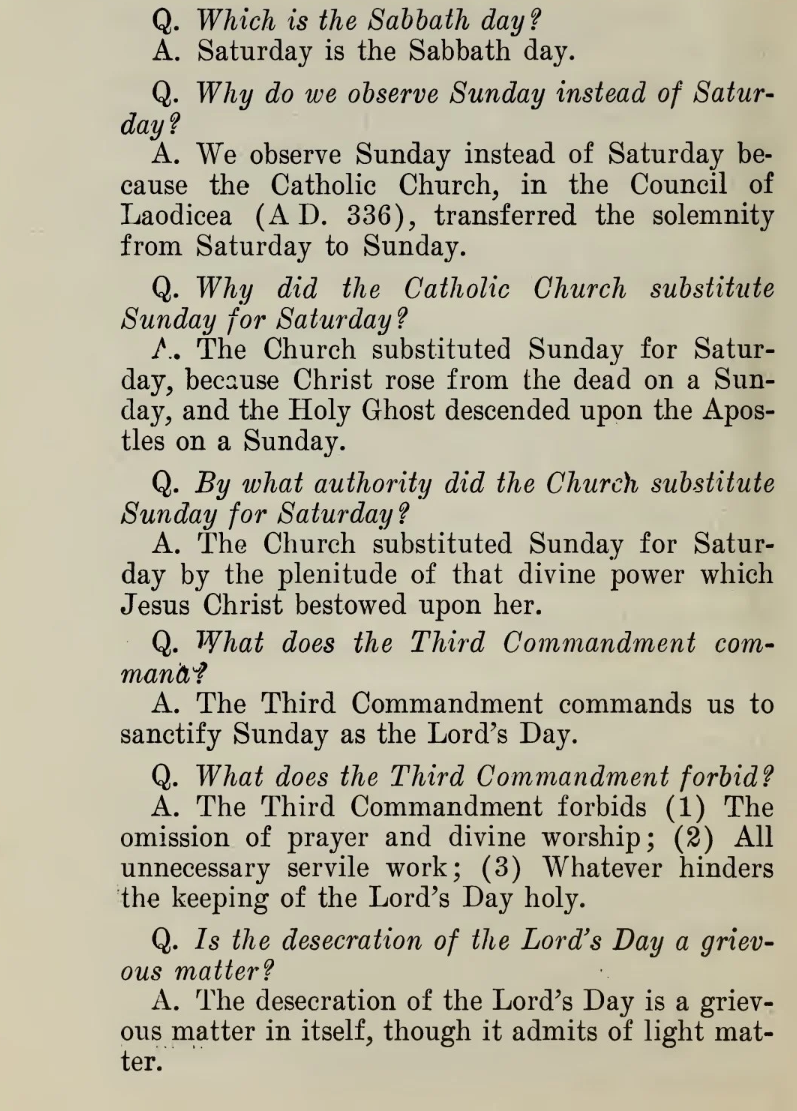
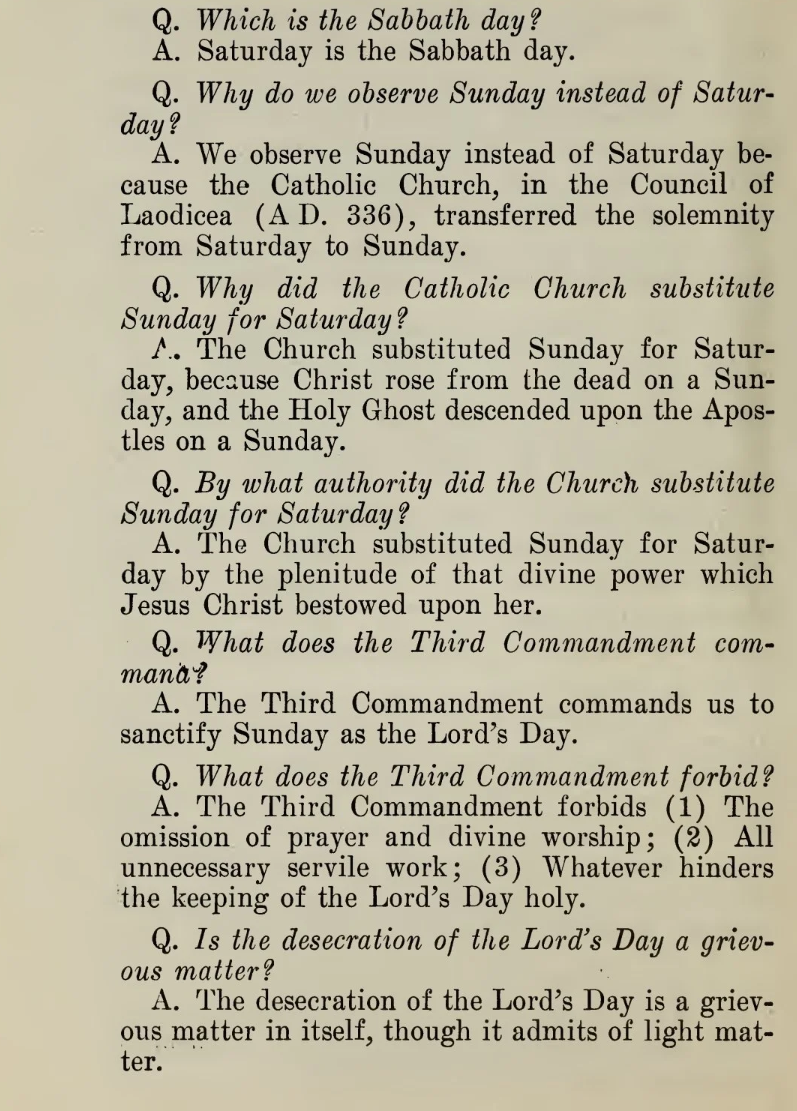
An excerpt from The Convert’s Catechism of Catholic Doctrine explicitly admitting transferring the seventh-day Sabbath to Sunday.
This shift was not a scriptural evolution, but a calculated ecclesiastical change. Even The Convert’s Catechism of Catholic Doctrine explicitly admits this transition, stating that the church exercised its own authority to move the solemnity from the seventh day to the first.
Key Takeaways from the Council of Laodicea (c. A.D. 336)
Canon 29: This specific ruling explicitly forbade Christians from "Judaizing" by resting on the Sabbath (Saturday), commanding them instead to work on that day and honor the Lord’s Day (Sunday) if possible.
The Legacy: Rather than repenting of its lukewarm nature, Laodicea used its influence to codify a departure from the "blueprint" of the early Church.
The Admission: Catholic doctrine openly acknowledges that the change from the seventh-day Sabbath to Sunday was an act of the Church, not a command found in Scripture.
The Catholic Church is transparent about its role in shifting the Sabbath from Saturday to Sunday, asserting that it exercised its own ecclesiastical authority to make the change. This admission underscores a vital historical reality: for centuries after the resurrection, the followers of Jesus Christ continued to honor the seventh-day Sabbath, right up until this institutional shift.
When Protestant churches later branched off during the Reformation, they broke away from many doctrines but chose to retain this specific tradition of "the Lord’s Day" (Sunday) rather than returning to the biblical Sabbath. This creates a significant conflict, as it prioritizes a man-made tradition over a divine decree. Jesus spoke directly to this tendency, reserving some of His harshest warnings for those who elevate human tradition above the commandments of God:
“He answered and said to them,
”Well did Isaiah prophesy of you hypocrites, as it is written: 'This people honors Me with their lips, But their heart is far from Me. And in vain they worship Me, teaching as doctrines the commandments of men.'"For laying aside the commandment of God, you hold the tradition of men making the word of God of no effect through your tradition which you have handed down. And many such things you do." (Mark 7:16 & Mark 7:13)
Jesus was vehemently opposed to changing God's commandments and elevating man's doctrine above God’s word.