


THE MEANING
OF LIFE
THE CONCLUSION – THE HOPE WE HAVE IN WHAT WAS PROMISED TO US
Why is Jesus called the "Living Hope"? Beyond the ritual of the Mikveh lies a promise made before time began. Discover how the "imperfect" waterpots of the Old Covenant were filled by Christ to bring life and immortality to light through the Gospel.
What to Know
What It Is – Mikveh, Baptism, and the Unfolding of God’s Plan - A simple question — why baptism is not defined at the start of the Gospels — leads to a profound discovery: the significance of mikveh in Scripture. The evolving meaning of mikveh, from “a collection of waters” to “hope”, reveals that both mikveh and baptism were designed as foreshadowings of Jesus Christ, pointing directly to the hope found in Him. While modern archaeology is helping us recover details that were once unfamiliar, the people of the New Testament era understood mikveh’s symbolic depth well—its cleansing, its hope, and its prophetic purpose.
Jesus Christ as the Fulfillment of Mikveh — Our True Hope - New Testament writers — especially Paul — saw Jesus Christ as the fulfillment of the Old Testament mikveh imagery. Paul calls God the “God of hope” (Romans 15:13) and reminds believers that “hope does not put us to shame” because it is rooted in Christ Himself (Romans 5:5). This echoes Jeremiah’s declaration that God is the “Mikveh of Israel” — the true Hope of His people (Jeremiah 14:8).
The Six Waterpots — Imperfection Made Complete in Christ - John 2:6 records “six waterpots of stone” used for ritual purification at the wedding in Cana. The number six symbolizes incompleteness in Scripture. These jars represented the incomplete purification of the Old Covenant — ritual washings that pointed to something greater. When Jesus transforms the purification water into wine, He reveals that He completes what the law could only foreshadow. As Paul explains, Christ brought life, immortality, and grace that had been planned “before time began” (2 Timothy 1:9–10). Christ fills what was lacking — He completes the meaning of mikveh and fulfills the law, not by abolishing it, but by giving it its full purpose (Matthew 5:17).
Jesus Christ as Our Living Hope - The New Testament connects hope — not to sentiment, but to the resurrection of Jesus Christ. Peter says believers are “born again to a living hope through the resurrection of Jesus Christ from the dead” (1 Peter 1:3). This living hope is “foreordained from the foundation of the world” (1 Peter 1:20); anchored in Christ’s death and resurrection; proof that God will grant eternal life to those who follow Him. Through Jesus, hope becomes active, assured, and eternal — no longer symbolic, but living.
The Hope of Eternal Life — God’s Promise From the Beginning - The promise of eternal life appears repeatedly in the New Testament and was part of God’s plan from the beginning (Titus 1:2). Peter, Paul, and the other apostles understood that Christ’s sacrifice and resurrection were the means through which humanity could inherit this promise. Because Christ was raised, our hope is secure, and we are assured that God will one day do the same for us. Jesus is not only the fulfillment of mikveh but the pathway to immortality, the One through whom believers receive the eternal inheritance promised before the world began.
Baptism as the Entrance Into This Hope - Baptism is the God-ordained way to enter this living hope and the coming Kingdom of God. It unites believers with Jesus Christ’s death and resurrection and grants access to the eternal life He promised. It is through baptism—and the faith it represents—that we are prepared to hear His words at the end of the age:
“Come, you blessed of My Father, inherit the Kingdom prepared for you from the foundation of the world…”(Matthew 25:34)
What began from the simple question and observation of why the term baptism isn’t defined at the beginning of the Gospels led us to the significance of the word mikveh. Through this word, we have seen how mikveh, and ultimately baptism, was actually a foreshadowing of Jesus Christ, revealing the hope we have in Him and the hope He freely offered to others during His ministry. As we continue to discover new things through archaeology, our understanding of the Bible and the time it was written continues to expand. However, it’s important to remember that although God inspired the New Testament for us to learn from and apply to our lives today, the authors of the New Testament wrote directly to the people and culture of their time. The things we are now discovering that may have been “lost” to us previously were not to the people of the time of the New Testament. These people were familiar with all of the aspects of hope and mikveh that we are only beginning to uncover today.
We can see all these aspects of mikveh and how they relate to Jesus Christ throughout the New Testament. Paul, when writing to the early church in Rome, says such in Romans 15:13,
“May the God of hope fill you with all joy and peace in believing...” In this verse, Paul refers back to Jeremiah 14:8, which declares the hope and mikveh that is Jesus Christ. Later in Romans, Paul also writes,
“…and hope does not put us to shame, because God’s love has been poured into our hearts through the Holy Spirit which has been given to us.” (Romans 5:5)
Paul tells us in the preceding verses that character actually produces hope, and it’s this hope that we should have no shame in.
Why should we have no shame in this hope? Because it’s Jesus Christ.
“For the Scripture says [referring to Isaiah 28:16], ‘Everyone who believes in Him will not be put to shame.’ (Romans 10:11)
New Testament authors understood not only how Jesus Christ was our hope (or Mikveh) but, more importantly, what that hope “foreordained before the foundation of the world” truly meant for them and, thus, humanity. As mentioned earlier, Jesus’ miracle of turning water into wine showed the whole purpose and plan of God. There is one other detail in this account that wasn’t elaborated on but is an important note for this point. John 2:6 records that “six waterpots of stone” were present at that wedding, representing the ritual purification required by the Old Testament. The number six is prominent throughout the Bible. According to online sources including Steppes of Faith, the number six is used primarily to describe imperfection or incompleteness. When addressing the multitudes that came to see Him, Jesus Christ says about the law,
“Do not think I came to destroy the Law or the Prophets. I did not come to destroy but to fulfill.” (Matthew 5:17)
Those six waterpots representing the purification of the Old Testament were incomplete and imperfect because they were missing something essential.
What was needed for these waterpots to be filled up? Paul tells us in 2 Timothy,
“…Who [speaking of Jesus Christ] has saved us and called us with a holy calling, not according to our works, but according to His purpose and grace which was given to us in Christ Jesus before time began, but has now been revealed by the appearing of our Savior Jesus Christ, who has abolished death and brought life and immortality to light through the gospel…” (2 Timothy 1:9-10)
Jesus Christ’s manifestation and sacrifice filled up and gave the true meaning of the law, making those waterpots containing only water complete. Only because of Jesus Christ were the things foreshadowing Him from the Old Testament completed and made perfect, finally bringing forth the hope of healing that God promised us from the beginning.
When looking at the life of Jesus Christ and the example that He set for us, there is one last aspect of hope that is revealed to us, and perhaps the most important. Paul first alludes to this aspect of hope in his epistle to Titus:
… in the hope of eternal life, which God, who never lies, promised before the ages began and at the proper time manifested in His word through the preaching with which I have been entrusted by the command of God our Savior…” (Titus 1:2)
From the very beginning in the Garden of Eden, God had a purpose and promise for humanity, which was the promise of eternal life if we follow His way. The promise of eternal life is a prominent theme in the New Testament, as it is referred to 41 times by name. Peter recognizes the importance of eternal life and how Jesus Christ played a crucial role in this fundamental promise from God to humanity. Notice what Peter says in 1 Peter:
“Blessed be the God and Father of Lord Jesus Christ! According to His great mercy, He has caused us to be born again to a living hope through the resurrection of Jesus Christ from the dead, to an inheritance that is imperishable, undefiled, and unfading…” (1 Peter 1:3-6)
Peter sees Jesus Christ as not only the hope or mikveh from the Old Testament but now in a new light as our living hope. We are not only saved by Jesus Christ’s willful laying down of His life for us, but we are also assured of God’s promise that He will do the same for us through the example we see through Jesus as our living hope. Later in the same chapter, Peter talks about this new hope that we see through Jesus Christ when he says,
“He [Jesus Christ] indeed was foreordained before the foundation of the world, but was manifest in these last times for you who through Him believe in God, who raised Him from the dead and gave Him glory so that your faith and hope are in God.” (1 Peter 1:20-21)
From the very beginning, it was God’s plan for Jesus Christ to come and die for our sins, allowing humanity a pathway to eternal life. Likewise, from the beginning, it was planned that Jesus Christ would have to be raised from the dead, so our faith would become a living hope from the example we see of Jesus Christ. Peter and other New Testament authors understood and showed us they saw all these aspects of Jesus Christ and how He was truly our hope in everything throughout their writing. Only through the hope of Jesus Christ coming and dying for our sins can we have the hope of eternal life that was promised to us. Baptism, and all it represents through Jesus Christ, is the only means of gaining that promise, entering the Kingdom of God, and hearing the words from Jesus on that day, as he says in Matthew 25:34,
“Come, you blessed of My Father, inherit the kingdom prepared for you from the foundation of the world…”
Table of Contents
1. The Beginning: The Origins of Baptism (Part 1)
2. The Washing Away of Sin (Part 2)
3. Mikeveh – A New Meaning (Part 3)
4. The Intertestamental Period: The Silent Years (Part 4)
5. The Hope in Jesus Christ’s Healings (Part 5)
6. Did Jesus Just Turn Water into Wine? (Part 6)
7. The Conclusion: The Hope We Have in What was Promised to Us (Part 7)
DID JESUS JUST TURN WATER INTO WINE?
Was the miracle at Cana more than just a wedding gift? Discover why the "six stone water jars" were actually instruments of ritual purification and how Christ turning water into wine signaled the end of temporary rituals and the birth of an everlasting covenant.
What to Know
What It Is – The First Miracle of Jesus Christ - The account of Jesus turning water into wine in John 2 is the first recorded miracle of Jesus Christ and marks the official beginning of His public ministry (John 2:11). Unique to the Gospel of John — called the “spiritual gospel”— this miracle stands apart from the other gospel accounts and is intentionally placed early to reveal Christ’s divine identity and mission.
A Miracle Rooted in Ritual Purification - John emphasizes that the six stone water jars used in the miracle were mikvoth — large stone vessels used for Jewish rites of purification and, specifically, pre-wedding cleansing. Archaeology confirms that stone jars of this size (20–30 gallons each) match those used for ritual immersion during the Second Temple period. Their presence means this wedding had undergone the traditional mikveh purification performed days prior.
Why the Stone Jars Matter - These stone jars represent the old system of ceremonial cleansing, essential in Jewish life but temporary in effect. When Jesus transforms the water of purification into wine, He symbolically replaces the old covenant — centered on repeated washings and sacrifices — with the new covenant sealed in His blood (Luke 22:20). The act reveals Jesus as the true source of cleansing, hope, and spiritual renewal.
Wine as Covenant Symbolism - Throughout Scripture, wine symbolizes joy, blessing, sacrifice, and covenant. In the Old Testament, wine accompanied offerings and holy days; In the New Testament, Jesus identifies wine as representing His blood poured out for the forgiveness of sins. By turning water used for ritual cleansing into wine, Jesus foreshadows His role as the ultimate purification, accomplishing eternally what water and sacrifices could only temporarily provide (Hebrews 9:14–15; 10:1–4).
The “Third Day” and Prophetic Imagery - John notes that the miracle occurred on the third day (John 2:1), a detail rich with biblical symbolism. The third day often signifies divine presence, preparation, or resurrection—seen in Exodus 19, the sign of Jonah, and Christ’s own resurrection. That Jesus performs His first miracle on the third day at a wedding highlights the prophetic trajectory toward the future marriage of the Lamb (Revelation 19:7).
A Revelation of Jesus’ Purpose - This miracle is far more than a display of supernatural power or compassion for a family. It reveals Jesus’ true character and mission — He is the fulfillment of the mikveh, the Hope of Israel, and the source of cleansing; He transforms the old into the new; He inaugurates His ministry with a symbolic act pointing to His sacrificial blood; He sets the stage for the New Covenant and the future wedding between Christ and His Bride.
Jesus’ first miracle is not merely a moment of provision — it is the unveiling of God’s plan, the transition from ritual purification to eternal redemption, and a preview of the ultimate wedding to come.
The Book of John is written from the perspective of showing Jesus Christ as both the Son of God and a human, someone who, like us, had to resist sin and the same temptations while in a mortal body. The symbolism and themes throughout the Book of John, such as John’s contrast of light and darkness to belief and unbelief are distinct from the other gospels, whose primary focus is on Jesus Christ’s teachings, parables, and life. As a result of these distinct and differing perspectives, the early church referred to the Gospel of John as “the spiritual gospel.” This distinction makes it noteworthy that an account of Jesus Christ is given in John, which is not referenced in other gospels. The account is significant because it happens near the beginning of Jesus Christ’s ministry. According to many scholars and even the Bible, as stated in John 2:11, this event marks the beginning of Jesus Christ’s public ministry. The account is recorded in John 2 when Jesus turns water into wine.
A typical mikveh pool that would be used for the pre-wedding cleansing in the Jewish faith.

A typical mikveh pool that would be used for the pre-wedding cleansing in the Jewish faith.
Many online sources and scholars explain the meaning of this miracle as Jesus Christ showing His power over all things down to the atomic level. Others think this miracle is included to show Jesus Christ’s personal side, where He takes an interest in the honor of the family and acts to prevent any shame from happening to them. While both explanations hold some weight and are true to an extent, the miracle’s actual meaning and distinction of being Jesus Christ’s first publicly may be far more profound. You are now familiar with the importance of mikvoth in ancient Israel, and their widespread use for the ritualistic cleansing of sin and the hope of physical healing. There was another important use for mikvoth, and in fact, it is still used in the Jewish faith today. According to the publication Jewish Rhode Island, mikvoth were and still are used before weddings to symbolize the washing away of the bride or groom’s previous sins so both can enter the marriage cleansed. Like other ritual cleansings that mikvoth were used for during the intertestamental period, this pre-wedding mikvothwashing also dates back to roughly the 2nd century B.C., with its roots going back to the Old Testament, as previously reviewed. With mikvoth being important to even Jewish weddings, it should not be surprising to learn that modern archaeology believes the six waterpots described in John 2:7 were actually mikvoth. This is further demonstrated within Scripture since the preceding verse, John 2:6, records these six stone water jars as being there “for the Jewish rites of purification, each holding twenty or thirty gallons.”
These six water jars, discovered during recent archaeological excavations, provide you with an idea of what the water jars would have looked like. These water jars would be a similar shape and size to the ones described in John 2:6.
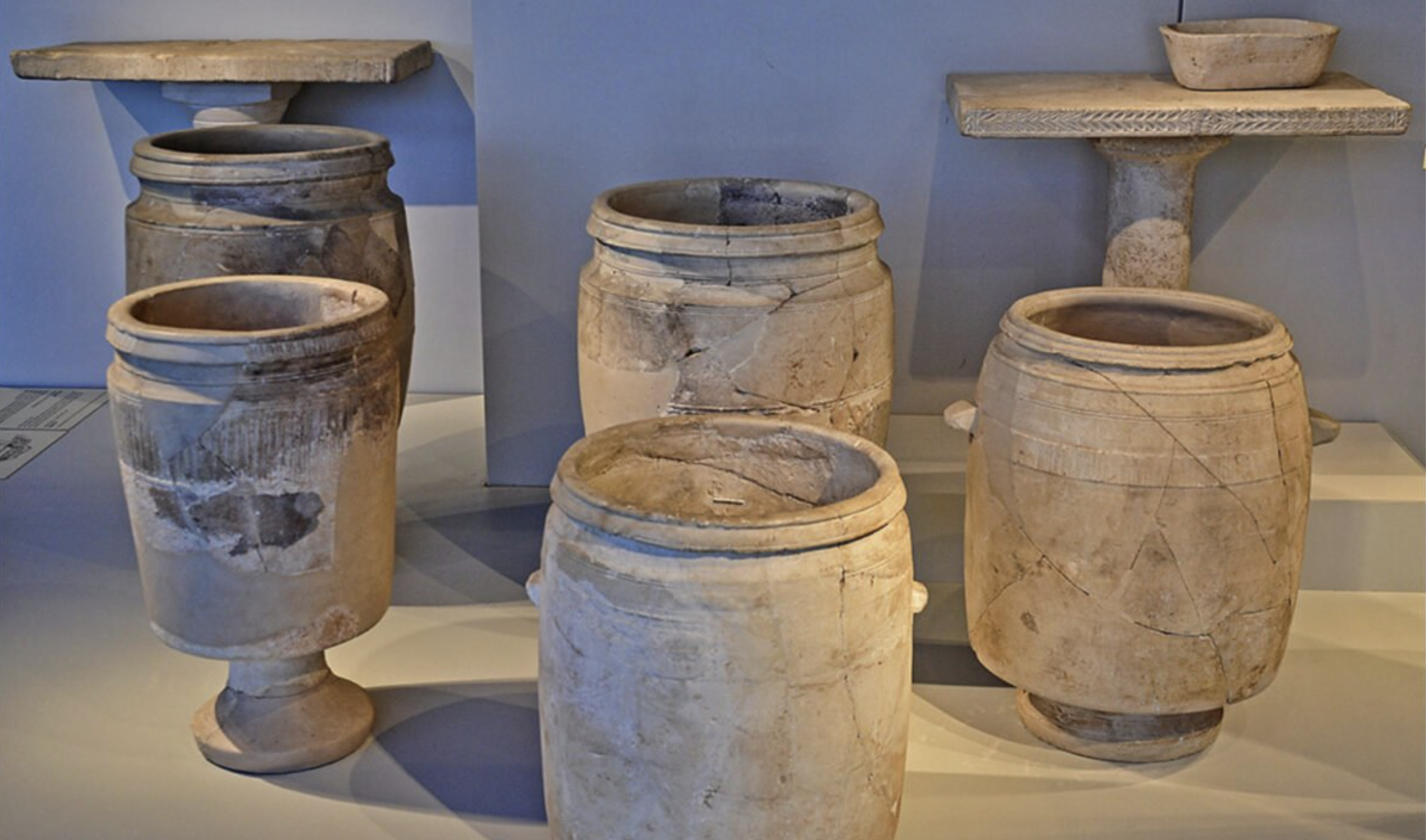
These six water jars, discovered during recent archaeological excavations, provide you with an idea of what the water jars would have looked like. These water jars would be a similar shape and size to the ones described in John 2:6.
The jars would have had to be present for the pre-marital cleansing, which would have occurred within four days prior to the wedding. Interestingly, the amount of water that each jar holds (twenty or thirty gallons) is also recorded in John. This is important because these jars would have had to be large enough for total immersion according to the Jewish ritual practices, but they would also have to hold enough water to satisfy the guests for the remainder of the wedding. Considering that Jewish weddings during Jesus’s time could last up to 7 days, a large amount of water, and thus wine, would be needed.
The implications and symbolism of this miracle are remarkable to our understanding. From what we now know, mikveh was originally associated with water and was later used to mean “hope” and to represent Jesus Christ as our hope, as we have seen recorded in the prophets of the Old Testament. With this understanding, do we see the entirety of God’s plan present in this first miracle, which began Jesus Christ’s public ministry? When Jesus Christ turned the ritually cleansing, purifying water from the stone jars into wine, which would represent His blood?
Throughout the Bible, wine is used to symbolize various things and plays a significant role. In the Old Testament, wine is used in the sacrificial system through drink offerings (where wine was poured out on the altar with the sacrifice) and was required on most annual holy days. In the New Testament, we learn what wine represents and why it is integral to the sacrificial system. Jesus plainly states in Luke 22:20,
“This cup is the new covenant in My blood, which is shed for you.”
No longer is the water of the Old Testament needed, which merely covered sin temporarily. Through Jesus Christ’s blood, we now have access to something far greater as the author of Hebrew states,
“How much more will the blood of Christ, who through the eternal Spirit offered Himself without blemish to God, purify our conscience from dead works to serve the living God. Therefore, He is the Mediator of a new covenant, so that those who are called may receive the promised eternal inheritance, since a death has occurred that redeems them from the transgressions committed under the first covenant.” (Hebrews 9:14-15)
Another noteworthy detail is mentioned within John's account. That is the miracle of turning water into wine happened on the third day (John 2:1). With this miracle happening on the third day and at a wedding, the parallels are once again striking and show us the tremendous symbolism to both Jesus Christ and the Father’s plan. Three days is prominent throughout Jesus's parables and the Old Testament. We reviewed an example of this earlier in Exodus 19:10 when the children of Israel had to wash their clothes and prepare to be in the presence of God for three days. However, the most well-known example of this third day is the sign of Jonah that Jesus gave to the Pharisees as Him being the Messiah (Matthew 12:40).
Through Jesus Christ's first miracle, the plan of God and Jesus's total purpose is revealed to us. Even though the ancient Israelites did not fully understand the mikveh’s (or mikvoth) purpose and usage in their language, they were practicing their hope in God and the One who would come as Jesus Christ. The sacrifices and water purification rituals of the Old Testament could only temporarily cleanse them from their sin, as alluded to in Hebrew 10:14. Jesus Christ's coming, and willful shedding of His blood for us turned the old purification rituals of the Old Testament into an everlasting covenant, symbolized to us through mikveh and thus baptism. We should also remember that all of this happened at a wedding. This miracle symbolizes the whole of God's plan, including its ending, eventually leading to and culminating in the marriage of the Lamb to His Bride as Revelations shows us:
"Let us rejoice and exult and give Him the glory, for the marriage of the Lamb has come, and His Bride has made herself ready…" (Revelation 19:7)
Table of Contents
1. The Beginning: The Origins of Baptism (Part 1)
2. The Washing Away of Sin (Part 2)
3. Mikeveh – A New Meaning (Part 3)
4. The Intertestamental Period: The Silent Years (Part 4)
5. The Hope in Jesus Christ’s Healings (Part 5)
6. Did Jesus Just Turn Water into Wine? (Part 6)
7. The Conclusion: The Hope We Have in What was Promised to Us (Part 7)
THE HOPE IN JESUS CHRIST’s HEALINGS
Were Jesus Christ’s miracles at the Pools of Bethesda and Siloam a coincidence? Archaeology reveals these were actually ancient Mikveh pools. Discover how Jesus used these "collections of water" to prove He was the living fulfillment of Jeremiah’s prophecy: the true Hope of Israel.
What to Know
What It Is – Jesus’ Healings at the Pools - Two of Jesus Christ’s most significant miracles — the healing of the man lame for 38 years (John 5) and the healing of the man blind from birth (John 9) — take place at or involving ancient pools. Recent archaeological discoveries confirm that both Bethesda and Siloam were mikveh pools, ritual baths used for purification and associated with hope and healing in Jewish tradition.
Why These Miracles Are Uniquely Important - John tells us that Jesus performed countless miracles, far more than could be written (John 21:25). Therefore, the ones preserved in Scripture are intentionally chosen. The miracles at Bethesda and Siloam are recorded not only because of the healings themselves but because of the symbolic setting — these were not ordinary pools, but mikvoth deeply tied to Jewish expectations of cleansing, restoration, and spiritual hope.
Pools as Symbols of Hope — and Jesus as the True Source - In John 5, the lame man places his faith in the pool to heal him, waiting decades for the water to be stirred. Jesus corrects this misplaced hope by healing him instantly, showing that no pool— no ritual — holds the power to save. Only Christ does. In John 9, Jesus instructs the blind man to wash in the Pool of Siloam, requiring him to take action. Even then, the pool is only symbolic — the healing still comes from Christ. In both cases, the pools serve as visual lessons: Jesus is the true Mikveh, the true Hope, and the true Healer.
The Archaeological Link to Mikveh Pools - Modern archaeological work — including findings published by the Biblical Archaeology Society — confirms that both pools tied to these miracles were mikvoth. Once seen as places where purity and hope could be found, these ritual baths now become the settings for Christ to reveal that He Himself is the fulfillment of what mikveh represents: cleansing, hope, renewal, and salvation.
From “Waters” to “Hope” — Fulfilled in Christ - In the Old Testament, mikveh originally meant “a collection of waters,” but later prophets — especially Jeremiah — used it to mean “hope” and even applied it directly to God (Jeremiah 14:8; 17:13). Jesus’ miracles at the mikveh pools make this symbolism unmistakable. The pools represented the hope of healing;
Jesus is the true Hope of Israel who actually heals; the physical mikvoth pointed toward cleansing and renewal; Jesus is the One who cleanses spiritually and restores fully.
The True Mikveh of Israel - These miracles reveal that Jesus Christ — “the Lord who heals you” (Exodus 15:26)— is the fulfillment of everything the mikveh symbolized. The lame man and blind man encountered not just water, but the living Mikveh, the Hope of Israel, the Savior who brings complete healing and spiritual renewal.
With this background of mikvoth and their importance to Judaism, some passages in the New Testament begin to take on new meaning and can be seen from a different perspective.
During Jesus Christ’s ministry, He healed many lame, blind, and deaf people. In fact, there are so many of these healings that John tells us:
“Now there are also many other things that Jesus did. Were every one of them to be written, I suppose the world itself could not contain the books that would be written (John 21:25).”
If Jesus Christ performed this many miracles as John wrote, then the ones recorded for us in the New Testament have been included for specific reasons.
Two examples of these healings, and Jesus Christ’s most well-known, are found in the book of John when He heals a man who could not walk for 38 years (John 5:1-8) and a blind man from birth (John 9:7). In reading both of these accounts, notice we are told both of these healings happened at pools, and those pools were directly involved in the healing or mentioned by Jesus. In the first healing, the man who could not walk says to Jesus,
“Sir, I have no one to put me into the pool when the water is stirred up, and while I am going another steps down before me (John 5:6).”
The man is placing his faith in the pool to heal him, but Jesus’ response is direct. The pool will not provide the hope or healing the man seeks, but only the One the man is talking to can do so. Unlike the pool the man is putting his hope into, Jesus Christ only needs to tell the man, “Rise, take up your bed and walk” (John 5:8), and immediately he can. In the second healing, the blind man is not around a pool. Jesus Christ is the one who references the pool in this healing when He tells the blind man, “Go, wash in the pool of Siloam (John 9:7).” Notice in the first healing, Jesus says the pool is not needed for healing and performs the healing Himself; however, in the second healing He asks the blind man to take action by washing and uses the pool in the healing. Even though the pool is directly used in the second healing, the healing the blind man experiences still ultimately comes from Jesus.
Why is it significant that these two healings were performed near pools? Recently, according to Biblical Archaeology Society and other archaeological finds, it has been discovered that both pools mentioned in the healing accounts in John (Bethesda and Siloam) were mikvoth (or mikveh pools). Immediately, the symbolism of what Jesus Christ conveyed in these healings and miracles should become striking. The man who could not walk had been waiting at one of these mikveh most of his life, putting his hope there. Jesus Christ came and became that mikveh for him. The blind man from birth had to take action and use a mikveh to complete his healing in the thing that represented the hope of Jesus Christ. In both of these instances, we begin to see how and why the word initially used as “a collection [of waters]” was inspired by God to be used as “hope” later when the prophets wrote. Eventually these mikvoth would become prevalent around Israel, with their roots based in the hope of physical healing for chronic conditions, representing the future Messiah. Now these mikveh pools had become the places of Jesus Christ’s first public miracles of healing, showing that He was the Mikveh and Savior that Israel had been waiting for as Jeremiah stated,
“O you Hope of Israel, its Savior in time of trouble… (Jeremiah 14:8).”
Jesus Christ, the God of the Old Testament, was Israel’s and is our true “Lord who heals you (Exodus 15:27).”
Table of Contents
1. The Beginning: The Origins of Baptism (Part 1)
2. The Washing Away of Sin (Part 2)
3. Mikeveh – A New Meaning (Part 3)
4. The Intertestamental Period: The Silent Years (Part 4)
5. The Hope in Jesus Christ’s Healings (Part 5)
6. Did Jesus Just Turn Water into Wine? (Part 6)
7. The Conclusion: The Hope We Have in What was Promised to Us (Part 7)
THE INTERTESTAMENTAL PERIOD - THE SILENT YEARS
Between the prophets and the Gospels lie 400 years of silence—but the archaeology speaks volumes. Discover why hundreds of ritual immersion pools began appearing across Israel just before Jesus arrived, and how the "Mikveh" became the physical precursor to Christian baptism.
What to Know
What It Is – Mikveh’s Changing Meaning - The Hebrew word mikveh carries two key meanings in the Old Testament: a “collection of waters” in early writings and “hope” in later prophetic texts. These dual meanings reveal God’s layered use of mikveh to teach both physical purification and spiritual expectation — concepts essential for understanding the origins of baptism.
The Silent Years and the Rise of Ritual Immersion - Between Malachi and the ministry of John the Baptist lies a period of roughly 400 years without prophetic writings. Known as the intertestamental period, this era profoundly shaped Jewish religious life. During this time, the practice of ritual immersion became firmly established through the widespread use of mikveh pools across Israel.
Mikveh Pools in Jewish Life - Beginning in the 2nd century B.C., mikveh pools — stone baths used for ritual purity through immersion — became a defining feature of Jewish communities. Archaeologists have discovered more than 700 mikvoth in Israel alone, with 200 in Jerusalem and 50 near the Temple Mount. Their concentration around the Temple emphasizes their centrality, as countless Jewish pilgrims required ritual cleansing before participating in sacrifices and worship.
Why Mikveh Pools Matter for Understanding Baptism - The strong cultural presence of mikveh pools meant that ritual immersion was already deeply woven into Jewish life by the time Jesus and John the Baptist began their ministries. This explains why the New Testament does not introduce or define baptism at the outset—its foundations were already understood through centuries of ritual immersion tied to purity, repentance, and preparation to approach God.
A Key Connection to Baptism - When the New Testament speaks of baptism, it builds on the established imagery of the mikveh: immersion in water leading to spiritual cleansing and renewed hope. Recognizing mikveh’s development—from “waters,” to “hope,” to ritual immersion—helps reveal the full significance of baptism as both a physical act and a spiritual symbol rooted in ancient Israel.
We have reviewed the term mikveh and see that it has the meaning of “a collection [of waters]” in early Old Testament writings, but “hope” in later Old Testament writings. Both definitions and their usage give us a deeper understanding to what God was conveying when he inspired mikveh to be used in these varying ways. However, although it is not stated in the Old Testament and only came later during the time between the Old and New Testament, another usage of mikveh needs to be understood to recognize its significance and how it relates to baptism entirely. For roughly four hundred years, spanning the ministry of Malachi to John the Baptist, Jewish tradition says no prophet spoke in the land of Israel. Jewish tradition considers this time the silent years from God and scholars refer to this period as the intertestamental period. Even though there were no Biblical writings during this time, many important events happened during this period, which influenced Jewish thinking and prepared the world for Jesus Christ’s arrival and His gospel.
An ancient ritual bath (mikveh pool) outside of Jerusalem.
One such important event from this period was the adoption of the mikveh pool into Jewish life. Only found in Israel, mikveh pools (or mikvoth) began to appear throughout the land of Israel and in historic communities of the Jewish diaspora, starting in the 2nd century B.C. According to the Britannica Encyclopedia, mikvoth are baths used for ritual immersion in Judaism to achieve ritual purity. They can be found in almost any ancient Jewish community due to their strong ties to ritual purity within the Jewish faith. To give you a sense of their importance, according to the publication The Times of Israel, 700 mikvoth have been discovered throughout Israel. Of the 700 mikvoth discovered so far, 200 are found in Jerusalem, and of these, 50 are located near the Temple Mount. The location of these mikvoth, and their strong presence in Jerusalem and near the Temple Mount, clearly show their role and importance. Jerusalem, and especially the Temple Mount, was the center of the sacrificial system during the Old Testament and through the intertestamental period. As a result, there could be thousands of Jewish pilgrims in need of ritual cleansing at any time of the day, with many more thousands above that in need around the holy days.
Interactive Map of Excavated Mikvehs
For those interested in exploring the full distribution of known and excavated mikvehs in West Bank and East Jerusalem, view the interactive map available here.
Table of Contents
1. The Beginning: The Origins of Baptism (Part 1)
2. The Washing Away of Sin (Part 2)
3. Mikeveh – A New Meaning (Part 3)
4. The Intertestamental Period: The Silent Years (Part 4)
5. The Hope in Jesus Christ’s Healings (Part 5)
6. Did Jesus Just Turn Water into Wine? (Part 6)
7. The Conclusion: The Hope We Have in What was Promised to Us (Part 7)
MIKVEH - A NEW MEANING
How can a word for "a collection of water" also mean "hope"? Explore the fascinating Hebrew word mikveh and discover how its transformation from Genesis to Jeremiah reveals the true purpose of baptism and our relationship with the Hope of Israel.
What to Know
What It Is – The Meaning of Mikveh - The Hebrew word mikveh first appears in Genesis 1:10, where God gathers the waters into one place. Traditionally, mikveh means a “collection of waters,” a definition consistently seen throughout the Pentateuch, Chronicles, and Wisdom literature. Verses like Leviticus 11:36 show that a gathered, abundant body of water was considered inherently clean, reinforcing mikveh as a symbol of purity, cleansing, and ritual readiness.
A Term That Evolves Beyond Water - As the Old Testament progresses, mikveh begins to take on a new and surprising meaning. In Ezra 10:2, after Israel’s sin of taking pagan wives, the word appears in a different sense: “now there is hope in Israel.” Here, mikveh shifts from describing waters to expressing the idea of hope — a striking transformation given its long-established connection with cleansing.
Mikveh as “Hope” — A Title of God Himself - Jeremiah expands this meaning even further. Twice he calls God “the Hope (Mikveh) of Israel” (Jeremiah 14:8; 17:13). Instead of using the standard Hebrew word for “hope,” tikveh, Jeremiah assigns the term mikveh to God, revealing a deeper theological truth: God Himself is the source of cleansing, restoration, and true hope.
Why Mikveh Shifts in Meaning - The shift from “collection of waters” to “hope” is deliberate. Throughout Scripture, water symbolizes purification, renewal, and restoration — all qualities that ultimately come from God. As Israel returns from exile and confronts its sin, the use of mikveh highlights that the same God who cleanses is the One who gives hope.
The Connection to Baptism - Understanding mikveh is essential for understanding baptism. The word links cleansing water with spiritual hope, tying the physical symbol to the deeper reality it represents. Baptism unites both meanings: it is immersion in water (a mikveh) and an expression of hope in God’s cleansing, saving work.
The first time that mikveh is used in the Bible is in Genesis 1:10, when “God called the dry land Earth, and the gathering together of the waters He called Seas.” According to many online sources, including Strong’s Concordance, the word “gathering together” used in this verse is mikveh and means “a collection.” Most online sources, such as Blue Letter Bible, and various Hebrew sources like Mikvah.org, define mikveh as “a collection [of waters]” due to the word’s strong and repeated connection with water. Throughout the Pentateuch (the first five books of the Bible), the Chronicles of the Kings, (1st and 2nd Chronicles and Kings), and the Books of Wisdom (Job, Psalms, and Proverbs) we see mikveh used in a similar way to mean “a collection [of water].” We see a noticeable example of the usage of mikveh in Leviticus 11:36:
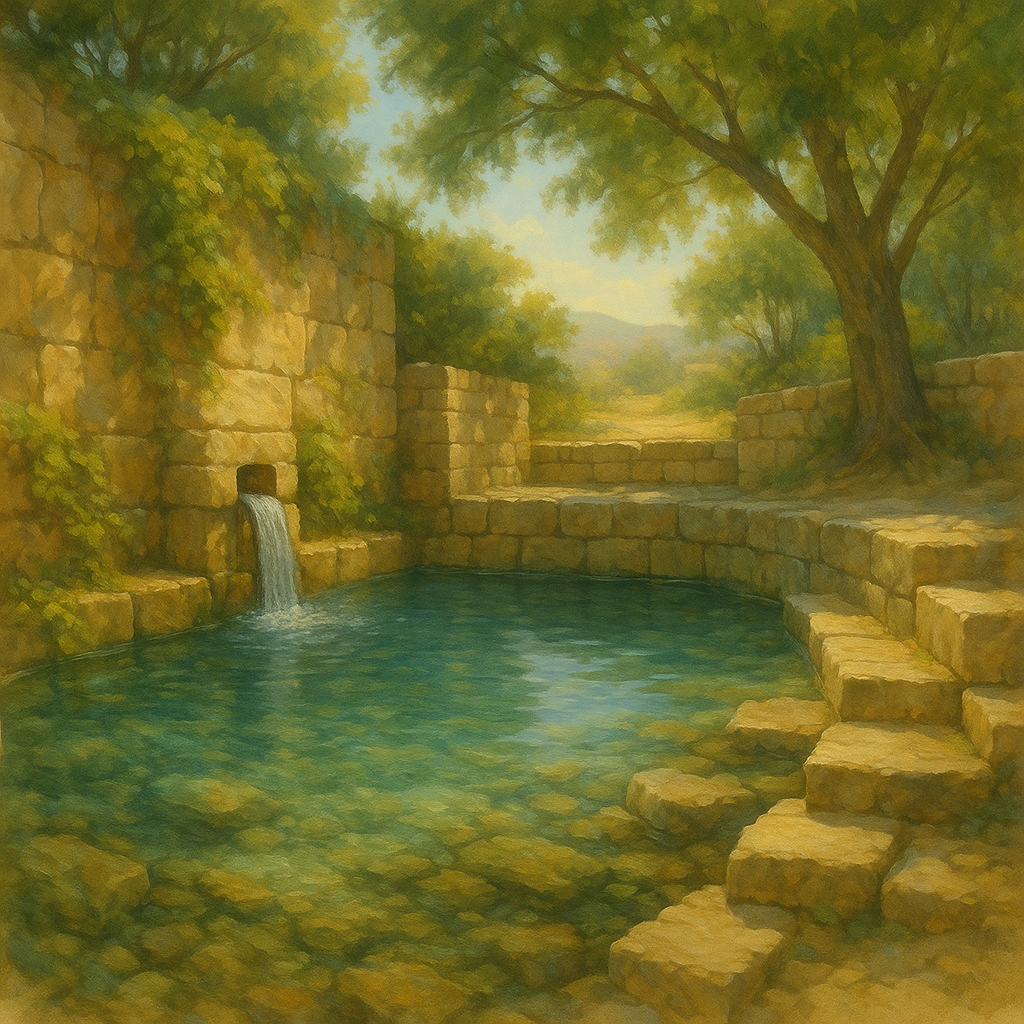
An artistic representation of a cistern filled with clear, “living” water. Surrounded by lush greenery, this scene reflects the biblical setting of ritual cleansing described in Leviticus 11:36, where a natural “collection of waters” is considered clean.
“Nevertheless a spring or a cistern, in which there is plenty of water, shall be clean, but whatever touches any such carcass becomes unclean.” (Leviticus 11:36)
This verse is referring to the cleanliness laws found in the Old Testament and when something should be deemed clean or unclean. Notice that a collection of waters (or, as the verse says, ‘plenty of water’) is always clean. Throughout the early books of the Old Testament, we see the same imagery being conveyed of mikveh as it relates to water. However, as we progress through the Old Testament, we see mikveh used in a different and interesting way. In Ezra, we see a clear example of the different way mikveh begins to be used. At the end of the verse, Shekaniah is recorded as saying,
“…we have trespassed against our God, and have taken pagan wives from the people of the land; yet now there is hope in Israel in spite of this.” (Ezra 10:2)
(Note: although Ezra is near the beginning of the Bible in most versions, Ezra was written after the exile of Israel from the land by the Babylonians, closer to the writings of the major prophets).
At the time this book was written, the people with Ezra clearly understood they did wrong against God with their actions. However, with all their work in restoring the Temple and Jerusalem, the remark of “now there is hope in Israel in spite of this” is a peculiar usage of mikveh in this context. Why is mikveh, previously only used to mean “a collection [of waters],” now being used in a context to mean “hope?” Jeremiah gives us a more striking example of mikveh being used in this new manner and relates this word directly to God. In order to gain the proper context for what Jeremiah is talking about in these verses, we will begin with the preceding verse,
“O LORD, though our iniquities testify against us, do it for Your name’s sake; for our backslidings are many, we have sinned against You. O the Hope of Israel, his Savior in times of trouble…” (Jeremiah 14:7-8)
Similar to the verses we read in Ezra, these verses in Jeremiah talk about the iniquities and sins that the people have committed against God. Moreover, similar to Ezra, Jeremiah also incorporates this new meaning of mikveh by calling God “The Hope (Mikveh) of Israel.” This is not a one-time occurrence either, as Jeremiah also makes use of the different meaning of mikveh again later on,
“LORD, You are the Hope (Mikveh) of Israel; all who forsake You will be put to shame.” (Jeremiah 17:13)
According to the Blue Letter Bible and various online sources, the Old Testament already had a word for “hope” that appears 32 times. This word is tikveh, meaning “an expectation” or “to hope for.” This discovery and the preceding verses related to mikveh prompt several important questions. What does it mean that God is the Mikveh of Israel and, therefore, our Mikveh, as Jeremiah says in Jeremiah 14:8? Why does mikveh change from “a collection [of waters] to “hope” rather than employing “tikveh?” Moreover, what connection does mikveh have to the concept of baptism?
Table of Contents
1. The Beginning: The Origins of Baptism (Part 1)
2. The Washing Away of Sin (Part 2)
3. Mikeveh – A New Meaning (Part 3)
4. The Intertestamental Period: The Silent Years (Part 4)
5. The Hope in Jesus Christ’s Healings (Part 5)
6. Did Jesus Just Turn Water into Wine? (Part 6)
7. The Conclusion: The Hope We Have in What was Promised to Us (Part 7)
THE WASHING AWAY OF SIN
Before there was "Baptism," there was the ritual washing of the Hebrews. Discover why God commanded three-day cleansings at Sinai and how the ancient Israelites understood the link between physical water and spiritual purity long before the New Testament was written.
What to Know
What It Is – Ritual Cleansing in Scripture - The practice of washing with water for ritual purification is woven throughout the Old and New Testaments. From the cleansing of Israel before meeting God at Sinai (Exodus 19:10) to David’s plea for spiritual washing (Psalm 51:7), Scripture consistently presents water as a symbol of consecration, purity, and preparation to meet God.
A Symbol of Readiness to Enter God’s Presence - Ritual cleansing was not superficial — It often required multiple days of washing and preparation. These washings signified that approaching God required purification of both body and heart. Even in Revelation 7:14, those who endure the Great Tribulation are described as having “washed their robes…in the blood of the Lamb,” showing that spiritual cleansing remains central in God’s plan.
A Practice Deeply Rooted in Israel’s Daily Life - Biblical law required washing in numerous situations — after a woman’s monthly cycle (Leviticus 15:21-22); after healing from disease or skin conditions (Leviticus 14:7-9); after contact with a dead body (Numbers 19:11-13); before offering sacrifices (Exodus 29:4). For priests, failure to wash properly—especially on holy days—could even result in death, demonstrating how seriously God regarded this act of purification.
Physical Cleansing Pointing to Spiritual Cleansing - Although ritual washing symbolized purification, God always desired inner cleansing above external ceremony. David recognized this when he connected washing with the removal of sin (Psalm 51). Jesus confronted the Pharisees for appearing outwardly clean but being inwardly corrupt (Matthew 23:27), reinforcing that true cleansing must be spiritual, sincere, and transformative.
Washing as a Foundation for Understanding Baptism - Because ritual washing was central to Israel’s worship and identity, the concept of cleansing through water was already deeply understood long before John the Baptist or Jesus Christ appeared. This explains why baptism is not defined at the start of the New Testament—its symbolism had already been introduced through centuries of ritual purifications in the Old Testament.
The Missing Link – The Meaning Behind Washing - All ritual washing pointed to a greater spiritual reality. To understand baptism’s full symbolism, we must examine a single key Hebrew word: mikveh—a term that reveals the deeper meaning behind washing, purity, hope, and God’s plan for spiritual renewal.
The use of water for ritual cleansing was important to the Hebrews. In fact, the practice can be seen throughout Scripture in both the Old and New Testaments. God commanded Moses in Exodus 19:10:
“Go to the people and consecrate them today and tomorrow; and let them wash their clothes. And let them be ready for the third day. For on the third day the LORD will come down upon Mount Sinai in the sight of all the people.”
This wasn’t a simple process either, but a thorough cleansing as the process would last three days. David alluded to a cleansing like this in Psalms 51:7 when he says,
“Purge me with hyssop, and I shall be clean: wash me, and I shall be whiter than snow.”
Jesus Christ also references the cleansing that is required for His followers through The Great Tribulation when He says,
“These are the ones who come out of the Great Tribulation and washed their robes and made them white in the blood of the Lamb.” (Revelation 7:14)
The practice of ritual cleansing through water to come into God’s presence was not only applied to the washing of clothes. The practice was similarly applied to the washing of oneself to become ritually cleansed as well. In Leviticus 15:21-22, we see that women were commanded to wash themselves after their monthly cycle. Leviticus 14:7-9 shows us that the act of washing was also required after recovering from a skin disease, like leprosy, or when coming into contact with a corpse, as mentioned in Numbers 19:11-13. The act of washing oneself in water was so significant and important to God, that it was even commanded of Aaron and of his sons. In Exodus we read,
“And Aaron and his sons you shall bring to the door of the tabernacle of meeting, and you shall wash them with water.” (Exodus 29:4)
Aaron and his sons were required to wash themselves before offering any sacrifices to God, especially on the High Day of Atonement. This washing was so important that failure to not wash properly would result in death.
The symbolism of immersing oneself in water to become ritually, and thus, spiritually cleansed was well understood to the ancient Israelites as this concept is pervasive throughout the Old Testament. However, even though God wanted the Israelites to practice this ritual cleansing for what it symbolized (just like how God commanded the Israelites to keep the Passover even though the full meaning wouldn’t be revealed to them until nearly 1,200 years later), He was more interested in their spiritual cleansing. Although Psalm 51:7 was mentioned earlier, washing oneself from sin was on David’s mind throughout Psalm 51 as he correlates this washing to burnt sacrifices and the removal of sin. Jesus Christ also elaborates on the spiritual cleansing He desires from His followers, when He tells the Pharisees,
“Woe to you, scribes and Pharisees, hypocrites! For you are like whitewashed tombs which indeed appear beautiful outwardly, but inside are full of dead men’s bones and all uncleanness.” (Matthew 23:27)
Even though on the outside the Pharisees appeared righteous and interested in following God’s law, on the inside they were actually ‘whitewashed.’ Their true interest in following God’s law was primarily for their own personal gain. Likewise, major prophets such as Jeremiah, Ezra, and Zechariah also allude to this symbolism throughout their writings.
So, with this background and seeing the pervasiveness of washing throughout the Old Testament, are we now able to begin to see why the concept of baptism, and what it symbolized, was not defined at the beginning of the New Testament? Perhaps, but there is still a missing, and very important piece, related to washing and its link to baptism. After all, we know that the act of washing was only symbolic of the type of spiritual cleansing that Jesus Christ desires of His Followers.
So, what does it symbolize?
We can begin to understand the symbolism more fully through a single Hebrew word – mikveh.
Table of Contents
1. The Beginning: The Origins of Baptism (Part 1)
2. The Washing Away of Sin (Part 2)
3. Mikeveh – A New Meaning (Part 3)
4. The Intertestamental Period: The Silent Years (Part 4)
5. The Hope in Jesus Christ’s Healings (Part 5)
6. Did Jesus Just Turn Water into Wine? (Part 6)
7. The Conclusion: The Hope We Have in What was Promised to Us (Part 7)
THE BEGINNING: THE ORIGINS OF BAPTISM
Why did the Pharisees recognize baptism before it was ever explained in the New Testament? Discover the "missing" history of this sacred rite and why Jesus Christ’s immersion was a monumental turning point in God’s plan for humanity.
What to Know
What It Is – The Baptism of Jesus Christ is a defining moment recorded in three gospels (Matthew, Mark, Luke) and referenced in John — a rare fourfold witness emphasizing its central role in the New Testament and the plan of God. At Christ’s baptism, the Holy Spirit descended upon Him, confirming Jesus as the Son of God and the One who would baptize with the Holy Spirit (John 1:33–35).
A Pivotal Event in God’s Plan - Scripture shows that Jesus’ baptism was foreordained before the foundation of the world (1 Peter 1:20). God highlights this event multiple times because it marks the beginning of Christ’s public ministry and reveals His divine identity and purpose.
The First Introduction to Baptism in the Bible - When reading the Bible from beginning to end, Jesus’ baptism is the first major appearance of baptism — before its meaning is ever explained. The gospel writers present it as inherently significant, assuming readers recognize its importance, even though its spiritual meaning is clarified later.
Baptism’s Meaning Explained Later in Scripture - The purpose of baptism is first hinted at in John 3, where Jesus describes its connection to being “born again.” The full explanation comes after Christ’s resurrection in Acts 2:38 and Acts 22:16, identifying baptism as the moment of repentance, forgiveness, and the washing away of sins. Paul later summarizes baptism’s meaning: it symbolizes being buried with Christ and rising to walk in newness of life (Romans 6:3–4).
Why the Pharisees Already Understood Baptism - In John 1:25–26, the Pharisees never ask what baptism is. Instead, they ask John why he is baptizing — showing that ritual washing and purification were already well understood in Jewish culture. Only someone with prophetic authority was expected to baptize, which is why John’s actions demanded explanation.
Old Testament Roots and Cultural Background - While the practice of baptism doesn’t formally appear in the Old Testament, its conceptual foundation — cleansing, repentance, purification, and renewal — runs throughout Scripture. The Hebrew language itself reflects a culture centered on God’s law, containing multiple nuanced terms for sin, purification, and love. These linguistic roots help illuminate the deeper meaning of baptism as it unfolds in the New Testament.
In the first book of the New Testament, an important event takes place – Jesus Christ’s baptism. This event is so significant that not only is it recorded in the first book of the New Testament (Matthew), but directly in three of the four gospels (Matthew, Mark, and Luke). Further, reference to Jesus’s baptism is also made in the fourth gospel, John, where he says,
“I did not know Him, but He who sent me to baptize with water said to me, ‘Upon whom you see the Sprit descending, and remaining on Him, this is He, who baptizes with the Holy Spirit.’ And I have seen and testified that this is the Son of God.” (John 1:33-35)
When God states something in the Bible twice, we know it’s important for us to take notice and action, if applicable. When God inspires something to be repeated four times to give abundant witness, we know it is something truly significant, and in this case, a monumental moment in the plan of God. Peter alludes to why this event was so significant in his first epistle,
“He [Jesus Christ] indeed was foreordained before the foundation of the world, but was manifest in these last times for you…”
(1 Peter 1:20)
Part of God’s plan is being shown to us through Jesus Christ’s baptism.
Reading through the various accounts of Jesus Christ’s baptism in the gospels, you may notice something perplexing, but noteworthy which occurs with baptism in general. If you had no prior knowledge of the Bible and read through it for the first time from beginning to end, Jesus’s baptism would be the first time you would be formally introduced to the concept and practice. The definition of baptism, what it means, and its representation within the plan of God isn’t explained beforehand, but only after.
The first such instance in the Bible where the purpose of baptism is alluded to is in John 3. Jesus, while talking to Nicodemus, expounds on baptism’s role as being vital for the new spiritual birth that must take place for believers to enter the Kingdom of God. However, the role of baptism isn’t specifically defined until after Jesus’s crucifixion in Acts where we are told that baptism represents “the remission of sins” (Acts 2:38; 22:16).
These verses illustrating the role of baptism were not inspired and written until some 20-30 years after Jesus’s crucifixion. In spite of this, at the time we read about Jesus Christ’s baptism in the gospels, the authors intend for us to immediately understand its significance, importance, and meaning. This is illustrated to us in John, where it says,
“They [the Pharisees] asked him [John the Baptist], ‘Then why are you baptizing, if you are neither the Christ, nor Elijah, nor the Prophet?’ John answered them, ‘I baptize with water, but among you stands one you do not know, even He who comes after me, the strap of whose sandal I am not worthy to untie.” (John 1:25-26)
The Pharisees don’t ask John what baptizing is or its significance. They grasp the importance since to them only someone of prominence like a prophet or the Messiah has the authority to baptize. They instead ask him why he is baptizing.
This is puzzling because although baptism’s origins can begin to be traced back to the Old Testament, the full concept of burying your old self and becoming a new person through baptism is first recorded by Paul, some 20-30 years after Jesus’ crucifixion. Paul explains baptism’s role to the believers in Rome in his epistle to them,
“Or do you not know that as many of us as were baptized into Christ Jesus were baptized into His death? Therefore, we were buried with Him through baptism into death, that just as Christ was raised from the dead by the glory of the Father, even so we also should walk in newness of life.” (Romans 6:3-4)
These examples force us to ask ourselves, why did this occur this way in the Biblical narrative? Is it simply because the authors of the New Testament forgot to explain baptism’s importance? Or perhaps it was because the practice was only adopted right before Jesus Christ, so as a result didn’t appear in the Old Testament? Regardless, we will look at these questions and others. While looking, we will discover that there is so much more to baptism, and its true meaning, then what we may have originally thought.
To fully understand the importance of baptism and its origins, we need to go back to the Old Testament. The practice of baptism doesn’t show up in the Old Testament, but the concept and roots go all the way back to Genesis. However, before preceding it’s important to point out something necessary to our understanding of this topic. Through language, we are able to see what topics are important to different cultures. For example, if you look at present-day English you can see topics that we hold important in our society with the recent creation of more words and phrases revolving around technology. The same concept can be applied to any society or language, and this is especially true of ancient Hebrew. The Hebrew language revolves around God and His law. Such things were an important aspect of their life, so their language was developed and evolved to represent that. Similar to our earlier example regarding present-day English, if we do the same with Hebrew, we see there are three different Hebrew words for describing both sin and love. Both of these words are important to construct a proper relationship with God (contrast this to English where there is only one word for “love”, and ancient Greek where there are four different words for “love” - showing us the priority of these cultures). Knowing what beliefs are important to different cultures at different times will be especially important, as we will see with this concept throughout the Old Testament. The meaning of certain words changes, which gives us a clearer understanding to their original intent, and eventually to their complete meaning.
Table of Contents
1. The Beginning: The Origins of Baptism (Part 1)
2. The Washing Away of Sin (Part 2)
3. Mikeveh – A New Meaning (Part 3)
4. The Intertestamental Period: The Silent Years (Part 4)
5. The Hope in Jesus Christ’s Healings (Part 5)
6. Did Jesus Just Turn Water into Wine? (Part 6)
7. The Conclusion: The Hope We Have in What was Promised to Us (Part 7)