

WHEN WAS THE FIRST NEW TESTAMENT WRITTEN? AND BY WHOM? (PART 4)
What to Know
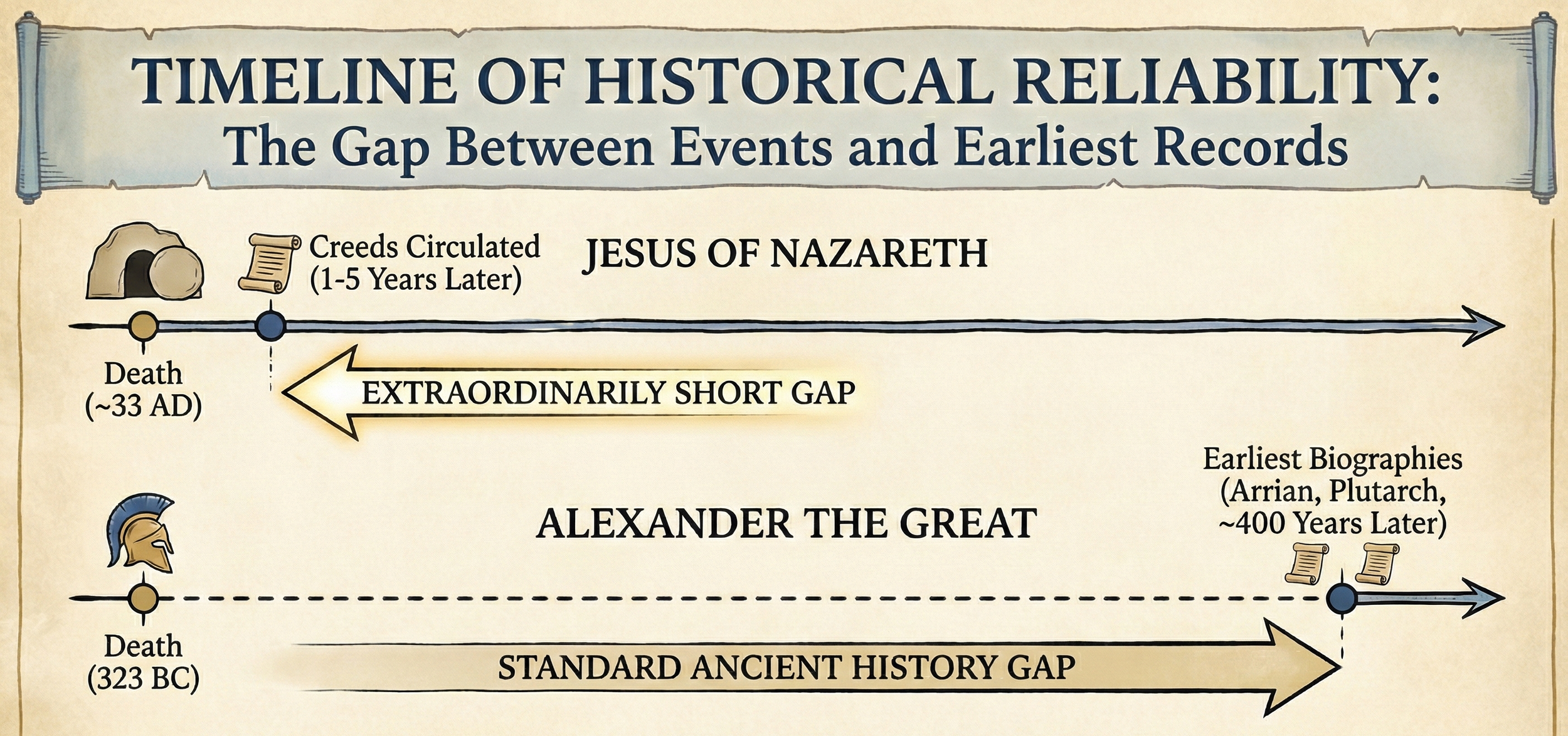
Extraordinary Proximity: Unlike most ancient figures, the records for Jesus Christ’s life began circulating within 1–5 years of the events. In historical scholarship, this is an extraordinarily short gap that makes the New Testament more reliable than the biographies of Alexander the Great or Socrates.
The Power of Early Creeds: Scholars have identified "creeds"—succinct statements of faith—in the New Testament (like 1 Corinthians 15) that were formulated within months of the crucifixion. These early records were shared while eyewitnesses were still alive to either verify or disprove the claims.
A Shield Against Legend: Historians note that it typically takes two generations for legends to replace historical facts. Because the claims of Jesus’s death and resurrection circulated immediately, there was no time for "legendary embellishments" to wipe out the hard core of truth.
The Criterion of Embarrassment: Secular scholars use the "criterion of embarrassment" to verify authenticity. The fact that the New Testament includes details that would have been socially or politically embarrassing to the early Church suggests the authors were committed to recording actual events rather than inventing a myth.
Historical records and non-Biblical sources affirm that Jesus Christ lived, had a ministry, was crucified, and was believed to have been resurrected. These essential points, central to the New Testament, are also documented in historical records outside the Bible. Remarkably, even supernatural events such as the darkening of the sun after Jesus's crucifixion (as explained in the previous post), are extensively recorded.
We've previously discussed the widespread circulation of New Testament copies throughout the Roman Empire and their proximity to the events they describe. Some fragments date back to as early as 50–60 A.D., a period when eyewitnesses would have still been alive. However, even earlier evidence exists beyond the New Testament. Critical scholars have identified sermon summaries in Acts (2:22-36, 3:13-16; 4:8-10; 5:29-32; 10:39-43; 13:28-31) and creeds—succinct statements of faith—found in Romans 4:25; Philippians 2:8; 1 Peter 3:18; Galatians 3:13; and 1 Corinthians 15:3, which all mention Jesus's death. The most famous is the creed in 1 Corinthians 15:3-8, which scholars believe circulated within 1-5 years of Jesus's death.
The German atheist and critic Gerd Lüdemann asserts that "the elements in the tradition are to be dated to the first two years after the crucifixion of Jesus…not later than three years." Respected scholar James D.G. Dunn similarly states, "This tradition, we can be entirely confident, was formulated as tradition within months of Jesus's death."
To grasp the significance of how early these creeds circulated, consider the example of Alexander the Great. Historians generally agree on the major events of Alexander's life, yet the earliest reports come from Arrian and Plutarch, nearly 400 years after Alexander died in 323 B.C. In historical scholarship, a 400-year gap is considered quite close to the actual events, which is why scholars are confident about Alexander's life. In contrast, the documentation of Jesus's life and death, within just a few years or months of the events, is extraordinary in the context of ancient history. This comparison highlights the strong evidence for the accuracy and reliability of the New Testament. To reject the Bible's accuracy would imply questioning the existence of other historical figures like Alexander the Great, Aristotle, or Socrates.
The early circulation of these creeds is significant for two key reasons. First, the claims about Jesus's death by crucifixion and other events were made at the same time and place they occurred. If these claims were false, eyewitnesses could have easily disproven them. Furthermore, crucifixions were public events intended to serve as a deterrent, and Jesus's crucifixion was witnessed by a large assembly of Jewish leaders and a crowd, as described in Luke 23:1-4. This event is later referenced in Acts 2:36, a sermon that critical scholars believe began circulating within months of Jesus's crucifixion. Yet, there is no record of anyone denying Jesus's death at that time.
Second, the short timeframe between the events and the circulation of these creeds prevents the possibility of legendary embellishments replacing the actual events, as some critics claim. A.N. Sherwin-White, a classical historian from Oxford University, states that "the span of two generations [or less] is too short to allow legendary tendencies to wipe out the hard core of historical fact."
Additionally, the criterion of embarrassment further supports the authenticity of the accounts of Jesus's crucifixion. This criterion suggests that authors are unlikely to invent details that would embarrass their message unless those details were accurate. Although primarily applied to the Bible, this criterion is also used by scholars to analyze other historical documents. For example, Jan Nattier employs this method in her analysis of Buddhist texts in her work "A Few Good Men: The Bodhisattva Path according to The Inquiry of Ugra (Ugraparipṛcchā)" (University of Hawaii Press, 2005).
Table of Contents
Textual Criticism of the Bible (Part 1)
The Evidence of Jesus Christ Outside the Bible (Part 2)
The Evidence of Jesus Christ Through the Darkening of the Sun (Part 3)
When was the First New Testament Book Written and by whom? (Part 4)
The Historical Reliability of the New Testament and Gospels (Part 5)
Proving the Accuracy of the Bible Through Prophecy (Part 6)
Proof of the Bible Through the Crucifixtion and Ressurection (Part 7)
A New Beginning - What does this Mean for Us? (Part 8)
Sources
Josephus, Flavius - Antiquities of the Jews (Book 18, Chapter 3) - Provides a non-Christian reference to Jesus, mentioning his crucifixion under Pontius Pilate.
Tacitus, Cornelius - Annals (Book 15, Chapter 44) - Refers to Jesus's execution during the reign of Tiberius by the procurator Pontius Pilate.
Lüdemann, Gerd - The Resurrection of Christ: A Historical Inquiry (2004) - Discusses the early dating of Christian creeds and Lüdemann's views as a critical scholar.
Dunn, James D.G. - Jesus Remembered (2003) - Provides evidence and analysis on the early tradition of Jesus’s resurrection and the formation of creeds.
Sherwin-White, A.N. - Roman Society and Roman Law in the New Testament (1963) - Analyzes the historical reliability of the New Testament using comparisons with other historical figures.
Nattier, Jan - A Few Good Men: The Bodhisattva Path according to The Inquiry of Ugra (Ugraparipṛcchā)(University of Hawaii Press, 2005) - Uses the "principle of embarrassment" to analyze Buddhist texts.