


THE MEANING
OF LIFE
WHEN WAS THE FIRST NEW TESTAMENT WRITTEN? AND BY WHOM? (PART 4)
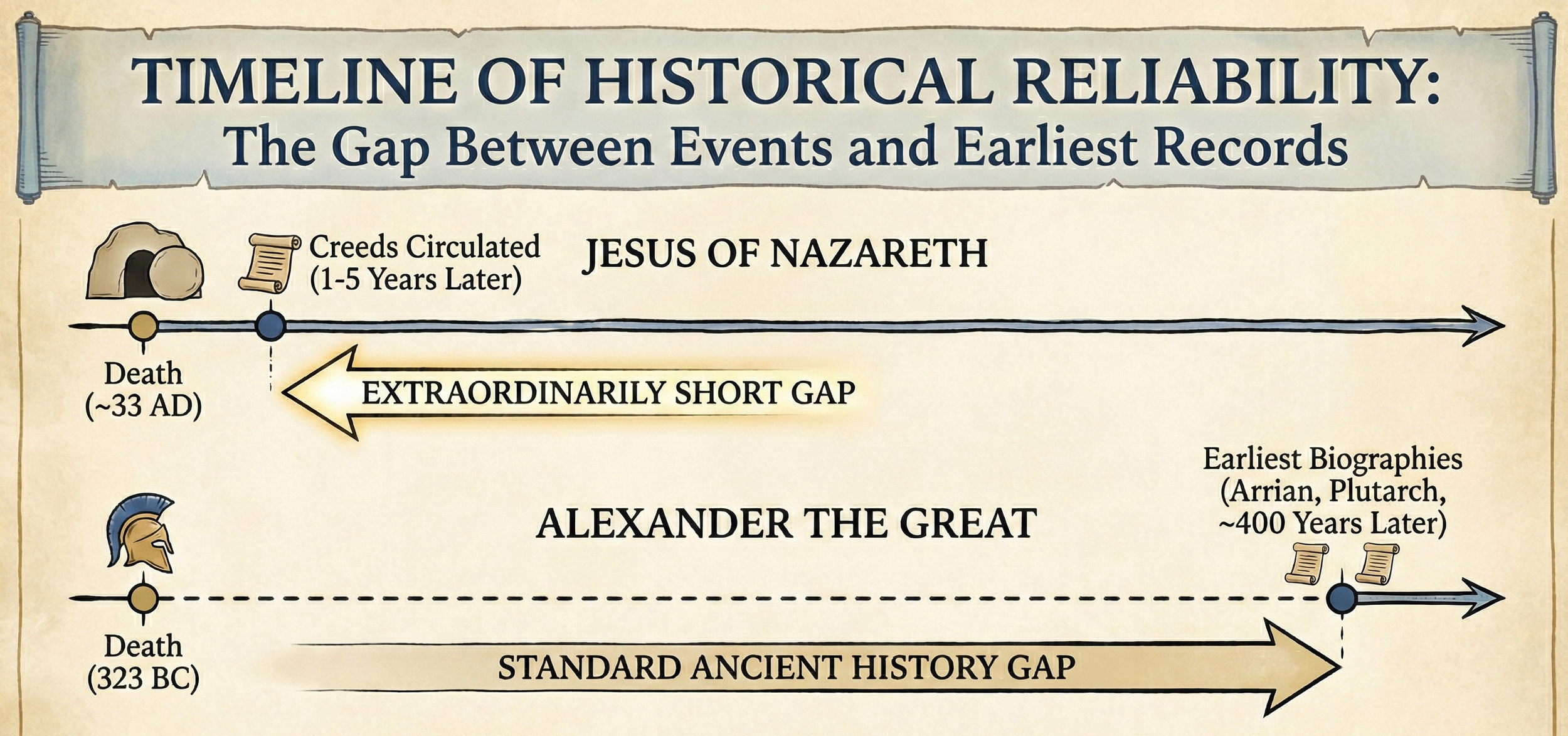
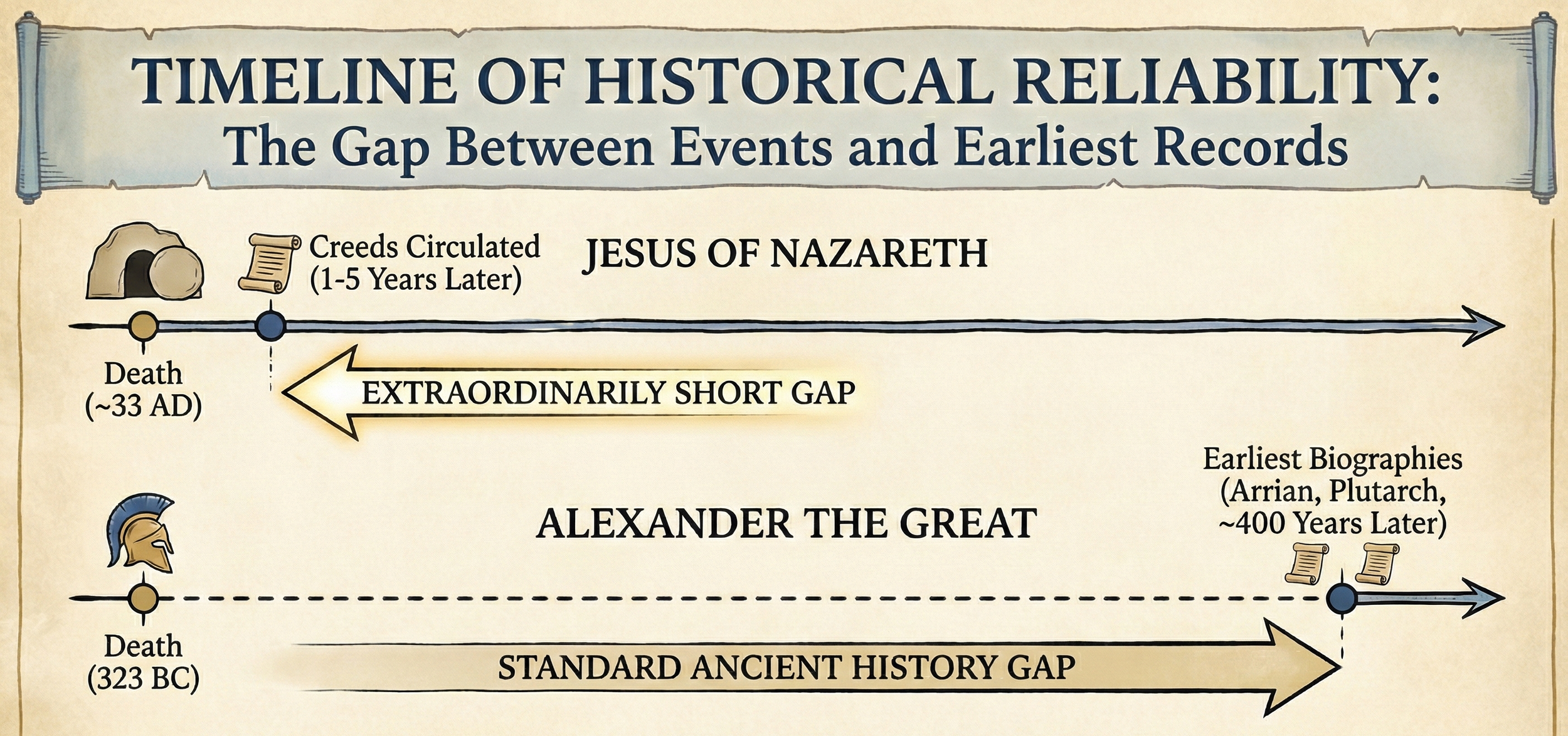
How soon after the crucifixion did the first reports of the Resurrection appear? While most ancient biographies were written centuries after their subjects died, the "creeds" of the New Testament circulated within months.
What to Know
Extraordinary Proximity: Unlike most ancient figures, the records for Jesus Christ’s life began circulating within 1–5 years of the events. In historical scholarship, this is an extraordinarily short gap that makes the New Testament more reliable than the biographies of Alexander the Great or Socrates.
The Power of Early Creeds: Scholars have identified "creeds"—succinct statements of faith—in the New Testament (like 1 Corinthians 15) that were formulated within months of the crucifixion. These early records were shared while eyewitnesses were still alive to either verify or disprove the claims.
A Shield Against Legend: Historians note that it typically takes two generations for legends to replace historical facts. Because the claims of Jesus’s death and resurrection circulated immediately, there was no time for "legendary embellishments" to wipe out the hard core of truth.
The Criterion of Embarrassment: Secular scholars use the "criterion of embarrassment" to verify authenticity. The fact that the New Testament includes details that would have been socially or politically embarrassing to the early Church suggests the authors were committed to recording actual events rather than inventing a myth.
Historical records and non-Biblical sources affirm that Jesus Christ lived, had a ministry, was crucified, and was believed to have been resurrected. These essential points, central to the New Testament, are also documented in historical records outside the Bible. Remarkably, even supernatural events such as the darkening of the sun after Jesus's crucifixion (as explained in the previous post), are extensively recorded.
We've previously discussed the widespread circulation of New Testament copies throughout the Roman Empire and their proximity to the events they describe. Some fragments date back to as early as 50–60 A.D., a period when eyewitnesses would have still been alive. However, even earlier evidence exists beyond the New Testament. Critical scholars have identified sermon summaries in Acts (2:22-36, 3:13-16; 4:8-10; 5:29-32; 10:39-43; 13:28-31) and creeds—succinct statements of faith—found in Romans 4:25; Philippians 2:8; 1 Peter 3:18; Galatians 3:13; and 1 Corinthians 15:3, which all mention Jesus's death. The most famous is the creed in 1 Corinthians 15:3-8, which scholars believe circulated within 1-5 years of Jesus's death.
The German atheist and critic Gerd Lüdemann asserts that "the elements in the tradition are to be dated to the first two years after the crucifixion of Jesus…not later than three years." Respected scholar James D.G. Dunn similarly states, "This tradition, we can be entirely confident, was formulated as tradition within months of Jesus's death."
To grasp the significance of how early these creeds circulated, consider the example of Alexander the Great. Historians generally agree on the major events of Alexander's life, yet the earliest reports come from Arrian and Plutarch, nearly 400 years after Alexander died in 323 B.C. In historical scholarship, a 400-year gap is considered quite close to the actual events, which is why scholars are confident about Alexander's life. In contrast, the documentation of Jesus's life and death, within just a few years or months of the events, is extraordinary in the context of ancient history. This comparison highlights the strong evidence for the accuracy and reliability of the New Testament. To reject the Bible's accuracy would imply questioning the existence of other historical figures like Alexander the Great, Aristotle, or Socrates.
The early circulation of these creeds is significant for two key reasons. First, the claims about Jesus's death by crucifixion and other events were made at the same time and place they occurred. If these claims were false, eyewitnesses could have easily disproven them. Furthermore, crucifixions were public events intended to serve as a deterrent, and Jesus's crucifixion was witnessed by a large assembly of Jewish leaders and a crowd, as described in Luke 23:1-4. This event is later referenced in Acts 2:36, a sermon that critical scholars believe began circulating within months of Jesus's crucifixion. Yet, there is no record of anyone denying Jesus's death at that time.
Second, the short timeframe between the events and the circulation of these creeds prevents the possibility of legendary embellishments replacing the actual events, as some critics claim. A.N. Sherwin-White, a classical historian from Oxford University, states that "the span of two generations [or less] is too short to allow legendary tendencies to wipe out the hard core of historical fact."
Additionally, the criterion of embarrassment further supports the authenticity of the accounts of Jesus's crucifixion. This criterion suggests that authors are unlikely to invent details that would embarrass their message unless those details were accurate. Although primarily applied to the Bible, this criterion is also used by scholars to analyze other historical documents. For example, Jan Nattier employs this method in her analysis of Buddhist texts in her work "A Few Good Men: The Bodhisattva Path according to The Inquiry of Ugra (Ugraparipṛcchā)" (University of Hawaii Press, 2005).
Table of Contents
Textual Criticism of the Bible (Part 1)
The Evidence of Jesus Christ Outside the Bible (Part 2)
The Evidence of Jesus Christ Through the Darkening of the Sun (Part 3)
When was the First New Testament Book Written and by whom? (Part 4)
The Historical Reliability of the New Testament and Gospels (Part 5)
Proving the Accuracy of the Bible Through Prophecy (Part 6)
Proof of the Bible Through the Crucifixtion and Ressurection (Part 7)
A New Beginning - What does this Mean for Us? (Part 8)
Sources
Josephus, Flavius - Antiquities of the Jews (Book 18, Chapter 3) - Provides a non-Christian reference to Jesus, mentioning his crucifixion under Pontius Pilate.
Tacitus, Cornelius - Annals (Book 15, Chapter 44) - Refers to Jesus's execution during the reign of Tiberius by the procurator Pontius Pilate.
Lüdemann, Gerd - The Resurrection of Christ: A Historical Inquiry (2004) - Discusses the early dating of Christian creeds and Lüdemann's views as a critical scholar.
Dunn, James D.G. - Jesus Remembered (2003) - Provides evidence and analysis on the early tradition of Jesus’s resurrection and the formation of creeds.
Sherwin-White, A.N. - Roman Society and Roman Law in the New Testament (1963) - Analyzes the historical reliability of the New Testament using comparisons with other historical figures.
Nattier, Jan - A Few Good Men: The Bodhisattva Path according to The Inquiry of Ugra (Ugraparipṛcchā)(University of Hawaii Press, 2005) - Uses the "principle of embarrassment" to analyze Buddhist texts.

THE ANISOTROPIC GEMSTONES OF REVELATION 21
Why are diamonds—the world's most famous "precious" stone—missing from the New Jerusalem? Discover the startling optical physics hidden in Revelation 21 and why every single gemstone in the city's foundation shares a rare property that creates a "rainbow" of light.

“The foundation of the wall of the city [New Jerusalem] were adorned with all kinds of precious stones: the first foundation was jasper, the second sapphire, the third chalcedony, the fourth emerald, the fifth sardonyx, the sixth sardius, the seventh chrysolite, the eighth beryl, the ninth topaz, the tenth chrysoprase, the eleventh jacinth, and the twelfth amethyst.” (Revelation 21:19-20)

Pictured above is the Nicol prism, invented by William Nicol in 1828, which consists of two specially cut calcite prisms bonded together with an adhesive. This prism transmits waves vibrating in one direction only and thus produces a plane-polarized beam from ordinary light.
The study of light polarization gained significant momentum in the early 19th century, mainly due to the groundbreaking work of French engineer and physicist Étienne-Louis Malus. In 1808, Malus made the pivotal discovery that light could be polarized through reflection, meaning that it would bounce off when it hit a surface, causing the light waves to align in a specific orientation. Typically, light waves vibrate in multiple directions as they travel. However, when reflected off certain surfaces, the vibrations become restricted to a particular plane, producing polarized light. This insight paved the way for developing instruments to observe polarized light better. Building on this foundation, Scottish physicist William Nicol invented the Nicol prism. This device, composed of two pieces of calcite glued together, allowed only light traveling in a single direction to pass through. By 1828, Nicol had applied this invention to create the polarizing light microscope. This tool became fundamental in the study of gemstones' optical properties.

Sir David Brewster, Scottish physicist, who discovered the concept of double refraction, which paved the way for the discovery of anisotropic stones.
Sir David Brewster, another Scottish physicist, expanded on Nicol's work through a series of experiments from 1815 to 1830, delving deeper into the behavior of light as it passed through various crystals. His investigations explored critical areas of optical science, such as birefringence, chromatic polarization, and the refractive index of polarized light. During this period, Brewster made a crucial discovery: specific stones could split a single light ray into two distinct rays, a phenomenon known as double refraction. This property became the defining feature of what we now call anisotropic stones, including many gemstones used throughout history.
But what does this history of gemstones and polarized light have to do with the Bible and science?
These discoveries laid the groundwork for modern gemology. Today, gemologists use polarized light microscopes to examine the anisotropic properties of stones. This practice continues to benefit from the pioneering work of Brewster and Nicol. Their contributions transformed the understanding of gemstones, revealing optical properties that were previously inaccessible. Remarkably, these characteristics were not known until the 19th century, adding a layer of awe to the detailed description in Revelation 21. In this passage, John lists twelve gemstones as the foundations of New Jerusalem. This vision now resonates with this new and expanded scientific understanding:
“The foundation of the wall of the city [New Jerusalem] were adorned with all kinds of precious stones: the first foundation was jasper, the second sapphire, the third chalcedony, the fourth emerald, the fifth sardonyx, the sixth sardius, the seventh chrysolite, the eighth beryl, the ninth topaz, the tenth chrysoprase, the eleventh jacinth, and the twelfth amethyst.” (Revelation 21:19-20)
All the gemstones listed by John in Revelation are anisotropic! Furthermore, John mentions only 12 gemstones in his account. While hundreds of gemstones have been discovered today, historically (and at the time when John wrote Revelation), there were 28 primary gemstones referred to as "precious" and "semi-precious." This number is often referenced in historical records or for simplified contexts, typically including the most well-known and commonly recognized gemstones since many of the newly discovered gemstones are varieties or subsets of these original 28.
The odds of John randomly selecting 12 gemstones from this group and having all of them be anisotropic would be an astonishing 1 in 16,715! This calculation assumes that all gemstones were equally likely to be included, which wasn't the case since some were considered more valuable than others. Even when narrowing it down through the Bible, you can see that certain gems and stones were esteemed more highly than others. For instance, in the Old Testament God commands the ancient Israelites to make for Aaron a breastplate of precious gemstones as described in Exodus 28:17-20. That chapter tells us specifically what gemstones were to be used in that breastplate:
“The first row shall be a sardius, a topaz, and an emerald; this shall be the first row; the second row shall be a turquoise, a sapphire, and a diamond; the third row, a jacinth, an agate, and an amethyst; and the fourth row, a beryl, an onyx, and a jasper.”
Interestingly, when looking at the breastplate that the ancient Israelites were commanded to make for Aaron and his sons, an exciting distinction emerges: while diamonds are included among the stones listed for Aaron’s breastplate, they are notably absent from the list that John provided in Revelation when describing the New Jerusalem.
Despite their brilliance, diamonds are isotropic, meaning they do not interact with light in the same dynamic way as anisotropic gems. Curiously, John replaces some stones from the Exodus breastplate in Revelation, such as agate with chalcedony (a variety of agate) and onyx with another gem. Only turquoise is anisotropic of the four stones replaced between the two lists. John substitutes it with yet another anisotropic stone. He could have easily chosen other significant biblical gems like garnets or diamonds, or other precious gemstones such as spinel, amber, glass, or opal. Still, he opted for a different set of symbolic stones all of which are anisotropic.
Below are the gemstones which are included in the list of those to be in the New Jerusalem, but do not show up in the account in Exodus of those that were in Aaron’s breastplate. Notice some of the gemstones added to this list, especially chrysoprase, looks to be almost opaque. It would have been very difficult for John to know at the time of writing that this gemstone could not only allow light through, but that the light passing through would result in color.


Below are gemstones mentioned in both accounts of the New Jerusalem and Aaron’s breastplate. Once again, notice how some of the gemstones appear opaque (such as jasper) and others appear transparent (such as topaz and beryl). For some of these gemstones it would be hard to imagine light could pass through. For others, that could easily be seen, but for these gemstones the fact that color results (and not just plain light shining through) would have been much harder for John to know without divine knowledge.


Finally, the gemstones below are the ones that were included on Aaron’s breastplate, but are not in the New Jerusalem. Of the gemstones below, most look to be opaque and were actually anisotropic. The only one that wasn’t is diamond, which is isotropic in nature. These gemstones were replaced with all anisotropic gemstones as listed above.


God selected the stones and gemstones for the new temple's foundation, deliberately avoiding those that would fade in color or lose their brilliance in light. Instead, He chose gemstones that disperse light to create stunning rainbow effects—well before we even understood this unique characteristic of these gems.
“And He who sat there was like a jasper and a sardius stone in appearance; and there was a rainbow around the throne, in appearance like an emerald.” (Revelation 4:3)
Why would He want this?
Although the gemstones listed in Revelations have spiritual significance, Revelation describes New Jerusalem in physical terms. Its application in the universe will most likely be both spiritual and physical. The Bible tells us there will no longer be any light in that city, but the light we know of now will be replaced with a pure and perfect light – from God the Father and Jesus Christ. Imagine the effects and beauty these gemstones will give off when their light source is totally pure.
“And the city had no need of the sun, neither of the moon to shine in it; for the glory of God gave it light, and the Lamb is the light thereof.” (Revelation 21:3)
The gemstones listed in Revelation 21 provide more than just a glimpse of the beauty of God's coming Kingdom and the New Jerusalem; they reveal divine knowledge far beyond what John or anyone in the first century could have understood. The precise mention of these anisotropic gems—nearly 1,800 years before their unique optical properties were discovered—points to the Bible's divine inspiration and prophetic insight. This alignment with modern scientific discoveries further proves that the Bible is not merely a product of its time but a timeless revelation from God. Whether through the precious stones of the New Jerusalem or the symbolic gems of the priesthood, the Bible continues to unveil truths that only an omniscient Creator could have known.
Table of Contents
Science and Scientists
All Things Were Created
Hanging in the Void
The Creator’s Vantage Point
Noah’s Ark: The Engineering Marvel that Survived the Flood
The Fragile Earth: Soil Erosion
The Polar Ice Caps and Frozen Realm
The Heavens Stretched Above the Earth
The Anisotropic Gemstones of Revelation 21
The Solar Eclipse

THE HEAVENS STRETCHED ABOVE THE EARTH
Did the Bible predict the expanding universe? While the Big Bang theory faces new challenges from the James Webb Telescope, the ancient Hebrew word "natah" reveals a universe that is both "stretched out" and continuously sustained. Explore the startling connection between cosmic dust and the "canopy" of Isaiah.

“This is what God the LORD says— the Creator of the heavens, who stretches them out, who spreads out the earth with all that springs from it, who gives breath to its people, and life to those who walk on it…” (Isaiah 42:5)
To properly grasp how our current view and understanding of the universe came about (the Big Bang Theory), we must first briefly visit a debate that has been happening since the time of the ancient Greeks – whether the universe is infinite or finite. This debate spanned across many ancient cultures, but the ancient Greeks began and influenced this debate greatly due to their mastery and excellence in so many different scientific and philosophical fields. There were differing views among the ancient Greeks with some arguing, such as Anaximander and Democritus, the universe was infinite, boundless, and had no size or shape. Others, such as Pythagoras and Aristotle, believed the opposite to be true. That is that the universe was bounded, limited (finite), and essentially spherical in shape.
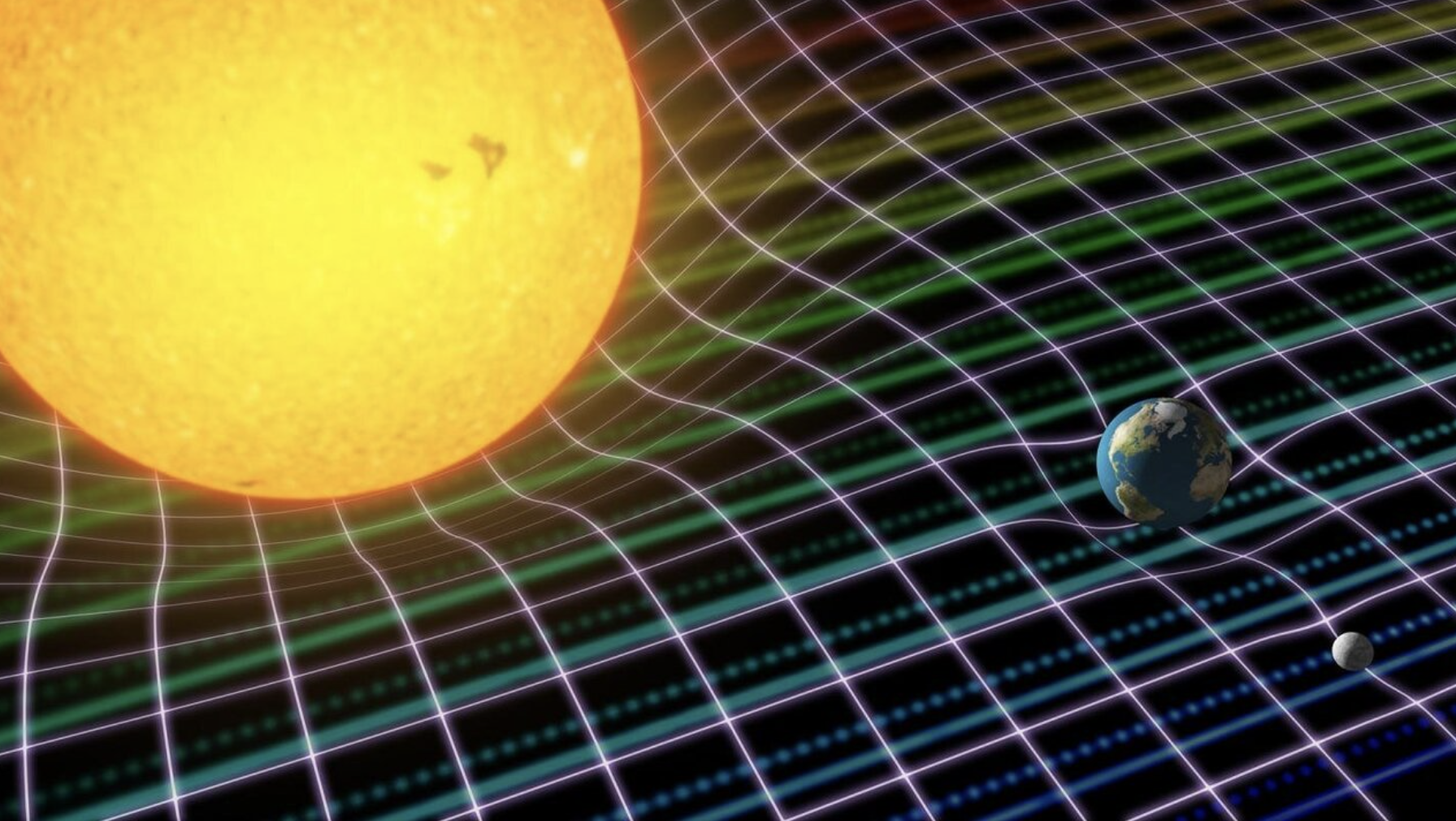
Massive objects like planets and stars curve the fabric of space and time. This curvature tells objects how to move. Instead of considering gravity a force, this theory shows that objects follow the curves in space created by these masses.
By the 20th century, considerable technological and scientific advancements had been made, allowing humanity to peer into the heavens for the first time, and approach this ongoing debate from a new perspective. In 1915, the prevailing consensus of the scientific community was that the universe was static (unchanging), ageless, and infinite. This was before Albert Einstein introduced his theory of general relativity, which provided a new framework for understanding the nature of space, time, gravity, and ultimately the universe. His theory argued the opposite of the prevailing consensus, that the universe was finite, had a beginning, and was ever-expanding. Einstein’s theory was the groundwork which allowed Edwin Hubble and other astronomers to make groundbreaking observations during the 1920s, demonstrating that the galaxies were moving away from each other, suggesting that the universe was expanding. These observations are what ultimately led to the Big Bang theory being solidified as the predominant view in the scientific community.
The Big Bang theory continues to be dominant view in the scientific community today, however, recently cracks have begun to appear due to the recent launch of the James Webb telescope in December 2021. Some of the early images released from the James Webb telescope show six large galaxies (each consisting of millions of stars) being presumed to have been formed just 500-600 millions years after the Big Bang.

The image from the James Webb telescope, taken in December 2021, which shows the six large galaxies presumed to have been formed just 500 - 600 million years after the Big Bang.
Why is this such a problem and contradicts, or at the very least, calls into question the established model of the Big Bang?
Nancy Levenson, the Director of the Space Telescope Science Institute, which operates the James Webb telescope for NASA, says this of the unexpected find: “The reason why it [the released images] flies in the face of our current understanding of cosmology is because our cosmological theory predicts that it should take much longer for galaxies of this mass to form. We think that it should take about 2 billion years, at least, to form these large galaxies with so many stars.” These findings are still being reviewed and further research into this matter is needed. However, based on the initial findings and statements made, it seems like there will certainly be some new understandings that come from this discovery.
We shouldn’t be surprised that the Big Bang model is beginning to be challenged. Although it is true that the universe had a beginning (Genesis 1:1), the actual workings of the universe are far more complicated, which we are beginning to see revealed to us through the findings of the James Webb telescope. Even though these things are coming to light now in the scientific community, the Bible already has some of these things recorded, and helps us to understand some of these complexities with a term that’s used throughout. This term appears in Isaiah:
“Thus says the LORD God, He created the heavens above, and stretched them out…” (Isaiah 42:5)
The word “stretch” is derived from the Hebrew word natah which is used approximately 215 times throughout the Bible with over 25 different meanings. Through this word natah we begin to see some of the complexity that God built into the universe.
Before we continue, it should be noted that many writers, and even some scholars, have attempted to correlate this Hebrew word natah to the concept of an ever-expanding universe, in order to align it to contemporary scientific theories, such as the Big Bang. A primary example that many of these writers use to make this point is given to us in Isaiah and is located near the end of the verse in question,
“…And spreads them out like a tent to dwell in.” (Isaiah 40:22)
Instead of natah being translated as “stretched”, in this instance it is translated as “spreads” which some online writers and scholars interpret as a constant and expanding universe. However, in order to see what this word, and thus the verse, actually means we need carefully analyze this Hebrew word. The first time natah is used in the Bible is found in Genesis 12:8, where it is states that Abram pitched (natah) his tent. Pitching a tent would have caused fabric to stretch out over the poles, but this fabric wouldn’t keep expanding or even be stretchy. Once the fabric was fully stretched out, it stopped. When the Bible describes God as "stretching the heavens," it refers to an initial action of arranging the stars and their positions, similar to stretching fabric over tent poles. This action was completed, but God’s ongoing maintenance of the universe continues, as suggested in Hebrews, where the author says,
“The Son is the radiance of God’s glory and the exact representation of His being, sustaining all things by His powerful word.” (Hebrews 1:3)
This dual aspect of the universe—its initial creation and its ongoing maintenance—parallels the Big Bang Theory and modern cosmology, which hold that the universe expanded rapidly at its creation but continues to expand at just the right rate to sustain life. The Bible’s description of cosmic stretching aligns closely with these concepts. In fact, the Bible goes beyond the initial creation event, suggesting that the universe's expansion is both completed and ongoing. Isaiah 40:22 employs two distinct Hebrew verb forms: one to describe the ongoing stretching of the heavens and another to indicate that this stretching has already been accomplished.
Moreover, this biblical claim of simultaneous completion and ongoing maintenance is not limited to the universe’s expansion. For example, the same principle is applied to God’s laying of Earth’s foundations. Isaiah 51:13 and Zechariah 12:1 refer to this process, which aligns with the geophysical discovery that long-lived radiometric elements were placed into the Earth’s crust more than four billion years ago. These elements were positioned in just the right quantities to ensure the continual building and sustaining of continents. This concept of completed yet ongoing creation echoes the scientific understanding of the universe's precise, finely tuned nature.
Through the preceding verses that we covered we looked at the word natah and the true meaning to this Hebrew word as “stretch” or “spread out.” However, we are introduced to another concept which is connected to this word in Isaiah 40:22, which may surprise you.
“It is He that sits upon the circle of the Earth, and the inhabitants thereof are as grasshoppers; Who stretches out the heavens like a curtain and spreads them out like a tent to dwell in.” (Isaiah 40:22)
We previously looked at the first part of this verse and its implications to a spherical Earth, but the ending is just as important and has implications to the universe. The word translated as “curtain” in the last part of this verse is more closely translated as “canopy.” This verse is the only time that this Hebrew word “dōq” is used in the Bible. This Hebrew word dōq is strongly correlated to the Hebrew word “dāqaq”, which you can see in many online Biblical concordances, and means “to crush, pulverize, thresh; to crush or to be fine; to pulverize and make dust of.” Essentially, Isaiah 40:22 says this “canopy” that God spread or stretched out above the Earth was finely beaten, pulverized, and small powder or dust. Take a moment to consider and fully grasp what’s being said in this verse, since a full understanding wasn’t available to humanity until 1970, when Don Brownlee at the University of Washington in Seattle first reliably identified the extraterrestrial nature of collected dust particles. His discovery resulted in other scientists looking into cosmic dust and the role it plays in the universe, and its importance. The information they discovered was actually contained and given to humanity some 2,700 years prior in the Bible.

An image taken by the James Webb telescope of cosmic dust. Through pictures like these showing the expansiveness and vastness of cosmic dust throughout the universe, we are beginning to understand just how important cosmic dust is to the origin and makings of universe.
As we continue to deepen our understanding of the universe, we are reminded of the ongoing dialogue between science and the Bible, particularly as it relates to the origins and nature of the universe. From the debates of the ancient Greeks to the groundbreaking theories of the 20th century, humanity's quest to comprehend the universe has evolved dramatically. The proposed discovery of cosmic expansion reshaped our perception of space, time, and the universe and led us to accept the Big Bang Theory as the predominant view held in the scientific community. Yet, the recent findings from the James Webb telescope hint at complexities in the universe that challenge these most established scientific models and concepts.
The Bible has long contained references that align with some of these cosmic truths, offering insights that science is only beginning to uncover. The Hebrew word natah — meaning "stretch" or "spread out" — in Isaiah provides a glimpse into how the Bible has described the structure and maintenance by God of the heavens for thousands of years. These ancient scriptures speak of God stretching out the heavens like a canopy. Now, with modern discoveries about cosmic dust and the expanding universe, we can appreciate the depth of these descriptions in a new light. As scientific inquiry and biblical wisdom intersect, we gain a fuller picture and understanding of the universe's grandeur and the Creator's sustaining power.
Table of Contents
Science and Scientists
All Things Were Created
Hanging in the Void
The Creator’s Vantage Point
Noah’s Ark: The Engineering Marvel that Survived the Flood
The Fragile Earth: Soil Erosion
The Polar Ice Caps and Frozen Realm
The Heavens Stretched Above the Earth
The Anisotropic Gemstones of Revelation 21
The Solar Eclipse

THE POLAR ICE CAPS AND THE FROZEN REALM
How did an ancient writer in the Middle East describe miles-deep ice and frozen oceans? While the North Pole wasn't "discovered" until the 1900s, the Book of Job accurately detailed the "frozen deep" millennia ago. Discover the polar evidence hidden in the Bible's oldest book.

“From the chamber of the south comes the whirlwind, and cold from the scattering winds of the north. By the breath of God ice is given, and the broad waters are frozen.” (Job 37:9)
In the late 19th century, the era of exploration and the allure of discovering new lands began to diminish as the world became “smaller.” By this time, most of the Earth had been explored due to prioritization based on resources and perceived competitive advantage that a place could give. The only places that remained unexplored were extreme frontiers, such as the North or South Pole. Like with so many things, scientific progression prevented humanity from exploring these unknown areas. As time progressed into the 20th century, technological advancements began to allow humans to explore these new frontiers by creating vehicles that could withstand the harsh and hazardous environment, and gear that would allow us to survive in these extreme conditions.

A portrait of Robert Peary (1856-1920) taken in Cape Sheridan, Canada in 1909.
Today, a debate has emerged regarding this new age of exploration into these more hostile environments: who was the first person to reach the North Pole? Unlike Antarctica, a landmass capable of preserving human relics and exploration, the North Pole and its surrounding regions are a vast expanse of ice with extreme conditions, rarely making it to freezing (32 degrees Fahrenheit), even in the summer months. These extreme conditions make travel to the North Pole by ocean difficult, since oftentimes extreme and rapidly changing conditions would get vessels stuck in ice, causing the men on board to die of exposure (freezing to death) or starvation. As a result, travel to the North Pole by land, via Greenland, became the preferred method. Many historians believe Robert Peary was the first person to make it to the North Pole, with his explorations beginning in 1886. Through a series of eight expeditions, he is recorded as finally reaching the North Pole on his last expedition in 1909.
There are also historical records of other people who may have seen the polar ice caps before Robert Peary in 1909. However, none of those people reached the North Pole as Robert Peary did. Further, we can see from the historical record that all of this exploration took place in the 1800s. There is no record that anyone saw the polar ice caps before this date due to the challenges of travel and surviving there, as discussed earlier.
How then does the Bible make mention of the polar ice caps millennia before the first recorded siting?
Although there’s much debate on the subject, many sources consider the book of Job as the oldest book in the Bible, with most sources dating this book to before the 6th century B.C. The author of Job 37 writes, “From the chamber of the south comes the whirlwind, and cold from the scattering winds of the north. By the breath of God ice is given, and the broad waters are frozen (Job 37:9-10).” Later in Job 38, God is recorded answering Job by saying, “From whose womb comes the ice? And the frost of heaven, who gives it birth? The waters harden lie stone, and the surface of the deep is frozen (Job 38:29-30).”

Picture of the polar ice caps in its natural landscape. Taken in 2018.
According to Dr. Henry Morris (founder of ICR), the book of Job interestingly “refers to cold, snow, ice, and frost more than in any other book of the Bible” despite Job living in the land of Uz, located in modern-day Syria (although the climate was different in Syria at the time of Job, Syria is still nowhere close to the polar ice caps). We should take note of the words used in this passage, such as in Job 37:10. The words for “broad waters” clearly describes massive bodies of ice when looking at its context and the meaning of the original Hebrew words. Then in Job 38:30, God’s response to Job is recorded and He states the surface of the deep as being frozen. The word “deep” in this verse comes from the Hebrew word “tehom”, which refers to not only the deeps, but also to an abyss, and great quantities of water. These passages together clearly show us that it isn’t surface water being described in these passages (as some scholars try to argue due to the implications of the alternative). In actuality, thick quantities of ice, miles deep, are being described in these passages, just like the polar ice caps - the only places on Earth that match this description.
As we’ve seen with so many other discoveries, Robert Peary (or whoever else may have been the first to discovered or make it to the North Pole) only “re-discovered” the polar ice caps. The knowledge of the polar ice caps, and what lies at the poles, was actually inspired by God to be put into the Bible over 1,500 years before they were re-discovered in modern times.
Table of Contents
Science and Scientists
All Things Were Created
Hanging in the Void
The Creator’s Vantage Point
Noah’s Ark: The Engineering Marvel that Survived the Flood
The Fragile Earth: Soil Erosion
The Polar Ice Caps and Frozen Realm
The Heavens Stretched Above the Earth
The Anisotropic Gemstones of Revelation 21
The Solar Eclipse

THE FRAGILE EARTH (SOIL EROSION)
Who "discovered" soil erosion? While modern geology credits 18th-century thinkers, the Book of Job described the "wearing away of stones" millennia ago.

“But as a mountain erodes and crumbles and as a rock is moved from its place, as water wears away stones and torrents wash away the soil, so you destroy a person’s hope.” (Job 14:18-19)

A portrait of James Hutton (1726–1797) by Sir Henry Raeborn.
Portrait by Sir Henry Raeburn, courtesy of the Scottish National Portrait Gallery.
James Hutton was a Scottish farmer and naturalist who lived in the 18th century. He was an acute observer of the world around him, and was known for making sound and reasoned arguments about geology by his peers. In the end, it was primarily Hutton’s background in farming which drove him to try to understand how the land he worked with every day was able to withstand the destructive forces of wind and weather. To better understand why, Hutton devoted the majority of his life, scientific knowledge, and his keen sense of observation to better understand the processes taking place. Through time and his continued dedication, Hutton came to believe the Earth was constantly being formed over and over through processes such as erosion and sedimentation, which challenged the prevailing belief at the time. Hutton’s groundbreaking views and discoveries led him to being known as the founder of modern geology.
Hutton’s work was only the beginning with his work sparking renewed interest in geology, especially in erosion’s effect on soil. This renewed interest lasted through the rest of the 18th century, and eventually resulted in the first published essay on the subject by William Morris Davis in 1899. Interestingly, Thomas Jefferson also demonstrated awareness of soil erosion and its effects, making mention of these phenomena in a letter dated 1813. However, Davis was given primary credit due to his extensive knowledge on these subjects and since his essay was in a published format. Davis’ erosion theory dominated for nearly 50 years until it was challenged by others in 1950.
Due to his extensive work in observing erosion and its effects, Hutton is considered the founder of geology, and even Davis is given credit to discovering erosion due to his expertise in the matter and publishing the first essay on the matter. In fact, the ideas of Hutton and Davis were so revolutionary and made such an impact on the thinkers of the time, that their work is credited as inspiring Charles Darwin and Sir Charles Lyell with their contributions to the field later. However, like so many other discoveries made in modern times, we see that God originally revealed this knowledge to humanity and humanity is only now “re-discovering” this information thousands of years later. The Bible records Job speaking these words regarding erosion in plain language:
“But as a mountain erodes and crumbles and as a rock is moved from its place, as water wears away stones and torrents wash away the soil, so you destroy a person’s hope.” (Job 14:18-19)
Modern scholars date the book of Job to at least the 5th century B.C. with Jewish views holding that the book of Job was written by Moses along with the Pentateuch (in the 13th century B.C). Even if the conservative view of scholars is taken and we consider Job was written in the 5th century B.C., this still means that God revealed this knowledge of erosion to Job, and inspired him to write these words about 2,300 years before the modern “discovery” by Hutton. Hutton’s observations eventually led him to believe that the Earth was older than 6,000 years old, in opposition to the view at the time that the Earth was only 6,000 years old (presumably due to the commonly held Biblical belief). However, this belief is a misunderstanding of Scripture as the Bible doesn’t state the Earth as only being 6,000 years old. The original Hebrew in the Genesis account actually indicates the Earth as being much older. There are other articles and information going into this subject more in-depth, nevertheless, this further shows that even though Hutton’s original idea was counter to the “Biblical” narrative of the time, his work in reality provided further reliability to God’s inspiration of the Bible.
Table of Contents
Science and Scientists
All Things Were Created
Hanging in the Void
The Creator’s Vantage Point
Noah’s Ark: The Engineering Marvel that Survived the Flood
The Fragile Earth: Soil Erosion
The Polar Ice Caps and Frozen Realm
The Heavens Stretched Above the Earth
The Anisotropic Gemstones of Revelation 21
The Solar Eclipse

NOAH’S ARK: THE ENGINEERING MARVEL THAT SURVIVED THE FLOOD
How did an ancient man with no shipbuilding experience design a vessel that outperforms modern cargo ships? Discover the "perfect proportions" of Noah’s Ark and why the dimensions given in Genesis 6 perfectly align with the physics of buoyancy discovered centuries later.

“Make yourself an ark of gopherwood; make rooms in the ark, and cover it inside and outside with pitch. And this is how you shall make it: the length of the ark shall be three hundred cubits, its width fifty cubits, and its height thirty cubits.
(Genesis 6:14-15)

Faithful photographic reproduction of a two-dimensional painting of Archimedes.
Commonly regarded by many historians as one of the world’s greatest scientists, Archimedes gave us many principles and equations, which are still used in mathematics today. One of Archimedes most well-known discoveries is the Archimedes principle, which he discovered in 256 B.C. The principle states, “a result stating that a body totally or partially immersed in a fluid is subject to an upward force equal in magnitude to the weight of fluid it displaces.” This principle is more commonly referred to as buoyancy. When we think of buoyancy, we most likely think of boats and what allows objects to float on water. However, the historical record tells us that the discovery of Archimedes’ principle wasn’t to help with a problem he had with boats. The discovery was actually to help to determine if a crown made for the king, Hieron of Syracuse, was made of pure gold as the goldsmith had claimed (this story was first recorded in the 1st century B.C. by Roman architect Vitruvius). Regardless of the intended application for this discovery at the time, to us this principle has become synonymous with ships as it is this understanding which allows the modern world to create the massive cruise and cargo ships we see today.
If Archimedes had read the Bible, he probably would have had an easier time devising this principle. One of the oldest books in the Bible, Genesis, was written by Moses and dates back to the 13th century B.C. The information in this book is even older, dating back to the creation and dawn of human civilization. Although this discovery was revolutionary for the Greeks, the Bible shows us this fundamental principle within its first six chapters. In Genesis 6 of Genesis, we read about Noah’s ark and the impending flood that will eventually come onto the Earth.
The beginning of Genesis 6 tells us why this flood is occurring as well as the instructions to Noah regarding the ark, but in the middle of Genesis we find the exact dimensions that the ark should be made to:
“This is how you are to build it: The ark is to be three hundred cubits long, fifty cubits wide, and thirty cubits high.” (Genesis 6:15)
Why is this such as important detail?
Analysis of these dimensions show that the dimensions recorded in Genesis 6:15 are the exact proportions needed according to buoyancy (Archimedes’ principle), which would have allowed the ark to float. Ask yourself, how was Noah, a man with no prior knowledge in ship-building and not living near a large body of water, able to know the steps required to build the ark and the exact dimensions required for it to float, only recently confirmed by modern science?
In 1993 a scientific study was headed by Dr. Seon Hong at the world-class ship research center KRISO, based in Dajeon, South Korea (Dr. Seon Hong was later appointed general director of KRISO). This study was to compare the hull dimensions and design of the ark to modern cargo ships to determine which design was the most practical. Out of the twelve hulls tested, it was concluded that no hull design of a modern cargo ship outperformed Noah’s Ark. Furthermore, it was determined that the dimensions and instructions outlined to Noah in Genesis 6 would have made a perfectly balanced ship, with the balance easily lost if the proportions were modified even slightly.
More recently, student research from the University of Leicester conducted in 2014, shows the dimensions described in the Genesis account were more than adequate to accommodate the weight of the ark and for holding up to 70,000 animals without sinking (other research shows the number of species alive at the time would have only been 35,000; however, that number is just an estimate and up to interpretation). Student Benjamin Jordan working on the project concluded: “Using the dimensions of the Ark and the density of the water, we were able to calculate its buoyancy force, which, according to Archimedes’ principle, is equal to the weight of the volume of fluid the object displaces.”


The discovery of Archimedes’ principle was a remarkable achievement that revolutionized our understanding of buoyancy and continues to shape modern engineering. However, long before Archimedes, the Bible presented the same principles within the story of Noah’s Ark in Genesis. The precise dimensions of the Ark, as described in Genesis 6, align perfectly with what we now know about buoyancy and ship design.
If you have ever been on a cruise ship or seen a cargo ship floating on the water, you can appreciate the science and exactness that must have gone into perfecting these ships’ design. Beginning in the late 18th century, the design of modern cargo ships, as we see them today, began to be slowly perfected over the course of centuries. However, with all the time, money, resources, and lost lives spent perfecting this design and pushing the boundaries on the size of these ships, the answer to their questions was already given to them, inspired by God, millennia before.
Table of Contents
Science and Scientists
All Things Were Created
Hanging in the Void
The Creator’s Vantage Point
Noah’s Ark: The Engineering Marvel that Survived the Flood
The Fragile Earth: Soil Erosion
The Polar Ice Caps and Frozen Realm
The Heavens Stretched Above the Earth
The Anisotropic Gemstones of Revelation 21
The Solar Eclipse

THE CREATOR’S VANTAGE POINT
Who "discovered" that the Earth was round? While history books credit Pythagoras, the Bible recorded the "circle of the Earth" centuries earlier.

“It is He who sits above the circle of the earth, And its inhabitants are like grasshoppers,
Who stretches out the heavens like a curtain, And spreads them out like a tent to dwell in.” (Isaiah 40:22)
Around 500 B.C. Greek thought began to shift with more philosophers accepting the notion that the Earth and its existence could be explained by natural processes rather than Greek mythology. This revolutionary shift led to many of the scientific principles we still use and are taught today in the fields of physics, astronomy, ethics, and of course mathematics (such as the famous Pythagorean theorem). One of the major scientific discoveries made around this time is the first recorded observation that the earth was round (and not flat like widely believed in other ancient civilizations) by Pythagoras. Roughly 250 years later after Pythagoras’ discover, Eratosthenes was able to devise a precise theory to measure the circumference of the Earth at between 24,000 and 29,000 miles (variations exist because the exact unit of measure is unknown and the figure is derived from other historical documents of the time). The earth is now known to measure 24,901 miles around the equator.

2015: Earthrise 2.0 (Lunar Reconnaissance Orbiter)
“The image is simply stunning,” said Noah Petro, who was Deputy Project Scientist for the Lunar Reconnaissance Orbiter (LRO) at NASA’s Goddard Space Flight Center when this unique view of Earth was taken by the LRO. Launched in 2009, LRO captures some 12 Earthrises daily, but is generally busy look at the Moon’s surface. On occassion, such as this, planets sometimes come into view as LRO points its instruments into space for atmospheric observations and calibration. This image is a composite of high-resolution black-and-white Narrow Angle Camera (NAC) and lower-resolution color Wide Angle Camera (WAC) images.
Image credit and text: NASA/Goddard/Arizona State University
History scholars credit Pythagoras as the first person to record the Earth is round, but in actuality he is the second. The book of Isaiah recorded this fact roughly 200 years earlier (around 740 B.C):
“It is He who sits above the circle of the Earth, and its inhabitants are like grasshoppers, Who stretches out the heavens like a curtain, and spreads them out like a tent to dwell in.” (Isiah 40:22)
The book of Proverbs also uses the same Hebrew word “ḥûg” (meaning "circle") as found in Isaiah. Like Isaiah, Proverbs was written long before the time of Pythagoras. King Solomon authored Proverbs during his reign over Israel, between 970 and 931 B.C., which is more than 400 years before Pythagoras made his discovery.
"When He prepared the heavens, I was there, when He drew a circle on the face of the deep.” (Proverbs 8:27)
In Job, which dates back to around the patriarchal age, we see the concept of a round Earth also recorded. A more literal translation of this verse in Job states:
“He described a circle upon the face of the waters, until the day and night come to an end.” (Job 26:10)
Upon reading these verses, you might be thinking the words mentioned in both of these verses are “circle” so the writers are describing something different. Consider that there was no word for “sphere” in the ancient Hebrew language. Most Hebrew scholars agree on this that “sphere” and “circle” are the same words in Hebrew. Also, consider, when you’re high above a sphere looking down on it, how does it appear to you? From a high vantage point, does it appear as a circle or a sphere?
The ancient Greeks philosophers are the most well-known in history and are credited for laying the foundations of western thought, including advancing our understanding of the Earth and science. They are revered in history for their advancements, achievements, and discoveries in so many different fields of study, which are still used and taught today. However, long before Greek philosophers like Pythagoras and Eratosthenes theorized the Earth’s roundness, the Bible had already alluded to this truth in Isaiah 40:22: It is He who sits above the circle of the Earth.” While ancient civilizations held varying beliefs about the Earth’s shape, the Bible presented a clear depiction that aligns with what we now know scientifically. This verse and others found in the Bible, written centuries before these groundbreaking discoveries, highlights the Bible’s remarkable insight into the natural world, providing evidence that its teaching were not bound by the limitations of human understanding at the time.
“He [God] reveals deep and secret things, He knows what is in the darkness, and light dwells in Him.” (Daniel 2:22)
Table of Contents
Science and Scientists
All Things Were Created
Hanging in the Void
The Creator’s Vantage Point
Noah’s Ark: The Engineering Marvel that Survived the Flood
The Fragile Earth: Soil Erosion
The Polar Ice Caps and Frozen Realm
The Heavens Stretched Above the Earth
The Anisotropic Gemstones of Revelation 21
The Solar Eclipse

HANGING IN THE VOID
Elephants, turtles, or empty space? While ancient mythologies claimed the Earth was held up by physical giants or beasts, the Book of Job declared it "hangs on nothing" millennia before modern science.

“He stretches out the north over empty space; He hangs the earth on nothing.”
(Job 26:7)
Throughout humanity’s existence, people have always struggled to explain the Earth and to make sense of how it and the things around it operated. Hindu mythology stated the world was on the back of eight elephants, which then lie on the back of a giant turtle. In Greek mythology, it was Atlas, the son of Titan Iapetus and the Oceanid Clymene, who was known as “the Titan who held the world [or sky] upon his shoulders.” Even in ancient Norse mythology (dating back to 790-1100 B.C) we see a similar concept where four dwarves (Austri, Vestri, Sudri, and Nordr) supported the four corners of the Earth. This was the prevailing thoughts of the people during this time, and continued for thousands of years. It wasn’t until 1543 that Nicolas Copernicus wrote about his radical theory in heliocentric hypothesis (The Copernican Planetary Model) that the Earth, along with the other planets in the solar system, rotated around the sun.
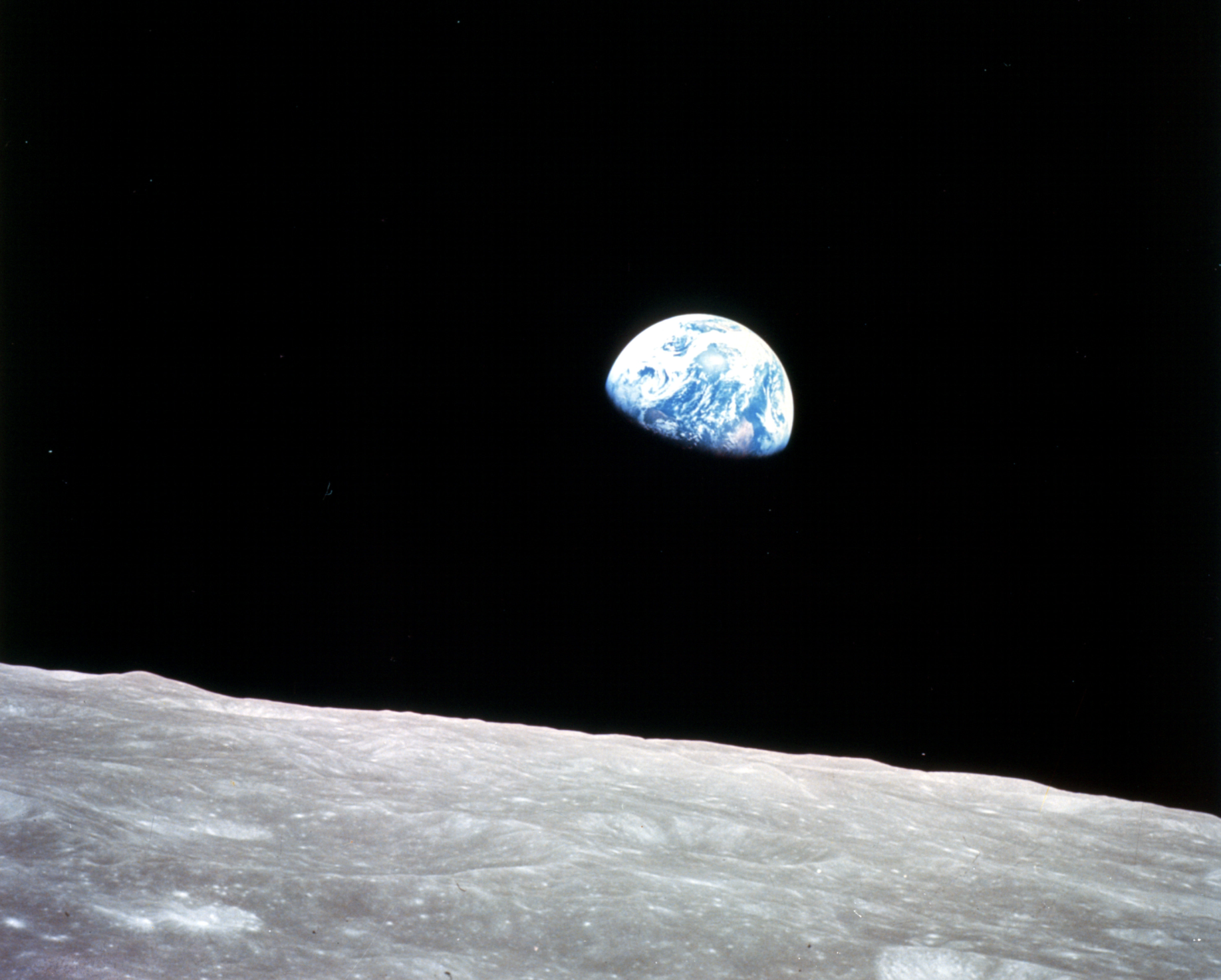
It is important to note that all the myths about gods supporting the Earth in various cultures were created before or during the time the Bible was written. One might expect the Bible to contain a similar idea, suggesting that God physically holds up the Earth. This would seem logical, especially since, unlike other religions, the Bible says there is only one God who created the Earth and sustains everything. However, the Bible takes a completely different stance, one that aligns with modern science—a perspective that wasn't "discovered" until the time of Nicolas Copernicus.
“He stretches out the north over empty (nothing) space; He hangs the earth on nothing.” (Job 26:7)
Job was given this knowledge by God, and he wrote about this remarkable scientific concept more than 2,000 years before it was understood by others. Contrary to the beliefs of his time, Job's description accurately portrays the Earth's situation and how it is held in place, showcasing God's divine power with scientific precision. Throughout the Bible, both in the Old and New Testaments, we find passages that emphasize it is God, our Creator, who grants stability to the Earth through His power, and not through physical forces. Additionally, the phrase “stretching out the heavens” (mentioned in several Bible verses and discussed further later) suggests a vast, unsupported expanse over which God rules. Here are just a few Bible verses that illustrate this knowledge, often through poetic language and imagery.
"He is the radiance of the glory of God and the exact imprint of his nature, and he upholds the universe by the word of his power.” (Colossians 1:17)
"It is He who sits above the circle of the earth, and its inhabitants are like grasshoppers, who stretches out the heavens like a curtain, and spreads them out like a tent to dwell in.” (Isaiah 40:22)
"Covering Yourself with light as with a garment, stretching out the heavens like a tent curtain. He lays the beams of His upper chambers in the waters; He makes the clouds His chariot; He walks upon the wings of the wind.” (Psalms 104:2-3)
"It is He who made the earth by His power, who established the world by His wisdom, and by His understanding stretched out the heavens.” (Jeremiah 10:12)
The ancient world was filled with imaginative explanations for the nature of the Earth, ranging from elephants and turtles to titans and dwarves. Yet, long before Copernicus' groundbreaking heliocentric theory or modern scientific understanding, the Bible provided a profound and accurate description: "He hangs the earth on nothing" (Job 26:7). This statement, written millennia ago, aligns with our current understanding of a planet suspended in space, without the need for mythological supports or fanciful explanations. The verse from Job stands as an example of the Bible’s unique insight, offering truths that predate human discovery and continue to affirm the harmony between faith and science.
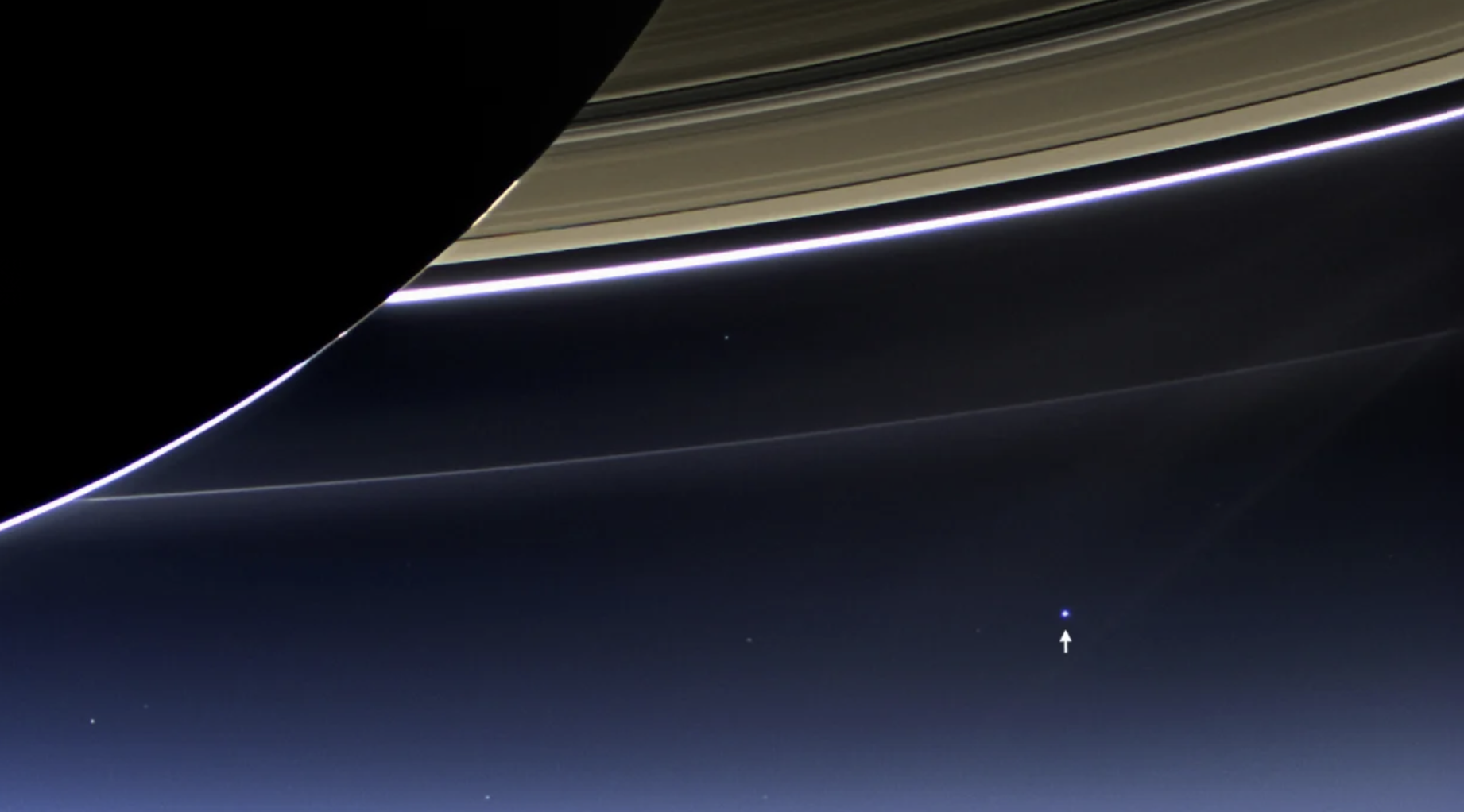
Earth as viewed from NASA's Cassini spacecraft from 900 million miles away (Credit: NASA)
One of the farthest-away pictures of Earth ever taken.
Table of Contents
Science and Scientists
All Things Were Created
Hanging in the Void
The Creator’s Vantage Point
Noah’s Ark: The Engineering Marvel that Survived the Flood
The Fragile Earth: Soil Erosion
The Polar Ice Caps and Frozen Realm
The Heavens Stretched Above the Earth
The Anisotropic Gemstones of Revelation 21
The Solar Eclipse

THE SOLAR ECLIPSE
Is the solar eclipse a "cosmic coincidence" or a divine signal? Explore the "perfect ratio" that makes Earth the only known planet to witness a total eclipse and why ancient civilizations—and the Bible—viewed the darkening sun as a sobering warning.

On April 8, 2024, something occurred that is truly rare and significant within our universe – a solar eclipse.
Depending on where you live you may experienced a total solar eclipse, a partial eclipse, or nothing at all. If you were fortunate to find yourself in the path of totality (where a total solar eclipse can be seen) then you would have witnessed something many people say is an inspiring and life-changing experience. Science says what you saw is totally unique within the known universe. Today, we are able to calculate precisely where a solar eclipse will occur, for how long, and when it will happen far in advance of its occurrence. This allowed an estimated 7 million people to travel to the path of totality to view it, if they chose. Due to the predictability of the Earth, Moon, and Sun’s orbit ancient civilizations such as the Greeks, Aztecs, and Mesopotamians understood this, too. They were able to calculate when a solar eclipse would occur and for how long, but not exactly where it could be seen. Even if they could calculate where a solar eclipse could be seen it’s doubtful that they would travel there.
We may think of solar eclipses as a cool, natural phenomenon to watch, but practically every ancient civilization saw solar eclipses as a negative and ominous sign by their gods. History indicates that the Mayan and Aztec civilizations feared solar eclipses the most. They saw this event as a battle between light and darkness, where demons were attempting to cast out the light and plunge the Earth into darkness. The Greeks viewed solar eclipses as unhappiness by their gods and an impending punishment or doom. Even one of the most ancient civilizations we have record of, the Mesopotamians, viewed solar eclipses as an omen or a sign of negative things to come. For the majority of civilizations throughout human history, solar eclipses carried with them a warning. The solar eclipse that occurred on April 8, 2024 should be viewed no different, especially with the current state of affairs of the world. There is a lot of information available on why the April 8 solar eclipse was unique in this aspect, but that is not the scope of this article.
I would like to look at the solar eclipse from a different perspective – the uniqueness of it to our planet and it as a sign by God to humanity. Solar eclipses are seen on Earth due to the ratio of size and distance between the Earth, Moon, and Sun. The Sun is 400 times larger than the Moon, but the Moon is 400 times closer to the Earth than to the Sun on average. This ratio is referred to as “the perfect ratio” since it allows the Sun and Moon to appear about the same size in the sky.


This “perfect ratio” is what actually allows the Moon to ‘cover’ the Sun, giving us on Earth the opportunity to witness a solar eclipse. In addition to the size and distance ratios, the Earth and Moon orbit the Sun in elliptical paths. This comic dance between the three celestial bodies complicates things further since the irregular paths of all three objects must perfectly align, along with the tilt of the Earth and Moon, to give us a solar eclipse. In a perfect situation where all three bodies had the same perfectly circular path, we would see a solar eclipse each month. However, due to the irregular paths present solar eclipses occur only twice every three years, and any location on Earth’s surface gets darkened by the Moon only once roughly every 400 years. All of these things working together make a solar eclipse a truly rare and unique cosmic event within the universe. That cosmic event of a solar eclipse also happens to occur on the only known planet with intelligent beings.
Ask yourself, what are the chances of that occurring?
Of all of the planets in our solar system, Earth is the only planet that has all of the required conditions. No other planet comes even close. In other solar systems where we see Earth like planets, most of those planets have multiple moons or they are located in a solar system with two or more stars making a solar eclipse impossible. Yet all of the characteristics needed to witness a solar eclipse are present in our solar system and planet. Even the American Astronomical Society acknowledges how bizarre this is and refers to a solar eclipse as the “cosmic coincidence.” They further state on their website, “Given all the variables, it’s almost surprising that we see eclipses at all.”
The chances of any planet experiencing a solar eclipse are exceedingly rare and the probability being incalculable. Include that this event happens on a planet where humanity is present and we are looking at a truly incomprehensible number. Is this truly just a “cosmic coincidence” as the American Astronomical Society says?
Or perhaps there’s something more to the solar eclipse as all ancient civilizations recognized?
The Bible expounds on this and gives us the answer in Genesis,
“And God said, ‘Let there be lights in the expanse of the heavens to separate the day from the night. And let them be for signs and for seasons, and for days and years (Genesis 1:14).”
God tells us in the first book of the Bible that the lights we see in the expanse of the heavens (the Sun and Moon) were not only created for light and to separate the night from the day. They were also created for humanity as signs. In other verses this Hebrew word “oth”, translated as signs, is translated as “token”, “mark”, or even as God’s “miracles” (We should take note of this last translation of “miracle” since that is exactly what an eclipse is). Just like how God created the moon to go through its many phases to mark the seasons for His appointed Feast times, God also created signs in the heaven like the solar eclipse. The Bible doesn’t mention a solar eclipse by name, but does describe certain events with the description “the sun darkening.” There are many references throughout the Bible of the sun darkening, but these are all prophetic warnings of God’s judgement. In the Old Testament, Joel refers to a solar eclipse,
“The sun shall be turned to darkness, and the moon to blood, before the great and awesome day of the LORD comes (Joel 2:31).”
In the New Testament, Jesus Christ Himself refers to this sign as the impending judgement on humanity when He says,
“Immediately after the tribulation of those days the sun will be darkened, and the moon will not give its light, and the stars will fall from heaven, and the powers of the heavens will be shaken (Matthew 24:29).”
This imagery of a solar eclipse or “the sun darkening” preceding God’s judgement on humanity is repeated throughout the Old and New Testament. The events depicted by Jesus Christ and Revelation indicate something beyond a typical solar eclipse. However, it’s not a coincidence that God created the Earth, Sun, and Moon to experience this phenomenon to remind of His eventual judgement on humanity just as He created the rainbow to remind us of the covenant He made with us as stated in Genesis 9:12.
Today, many people view the solar eclipse as a cosmic event. The millions that witnessed the April 8 solar eclipse were mesmerized and fascinated by it, as they should have been. Within the entire universe, this is truly a rare cosmic event that has been given to us by the Creator of the Universe. Hopefully, everyone enjoyed the April 8 solar eclipse and was inspired by this event. However, we should keep in mind what’s been understood throughout human history and what all ancient civilizations recognized. We should enjoy the spectacle of these events as it’s something totally unique and special that God has given to us, but keep in mind the warning God is telling us with the solar eclipse as well.
Table of Contents
Science and Scientists
All Things Were Created
Hanging in the Void
The Creator’s Vantage Point
Noah’s Ark: The Engineering Marvel that Survived the Flood
The Fragile Earth: Soil Erosion
The Polar Ice Caps and Frozen Realm
The Heavens Stretched Above the Earth
The Anisotropic Gemstones of Revelation 21
The Solar Eclipse

ALL THINGS CREATED
Is the universe a cosmic accident or a masterpiece of engineering? Explore the "fine-tuning" of the four fundamental forces—from gravity to nuclear strength—and discover why the mathematical precision of our world points directly to a Divine Architect.
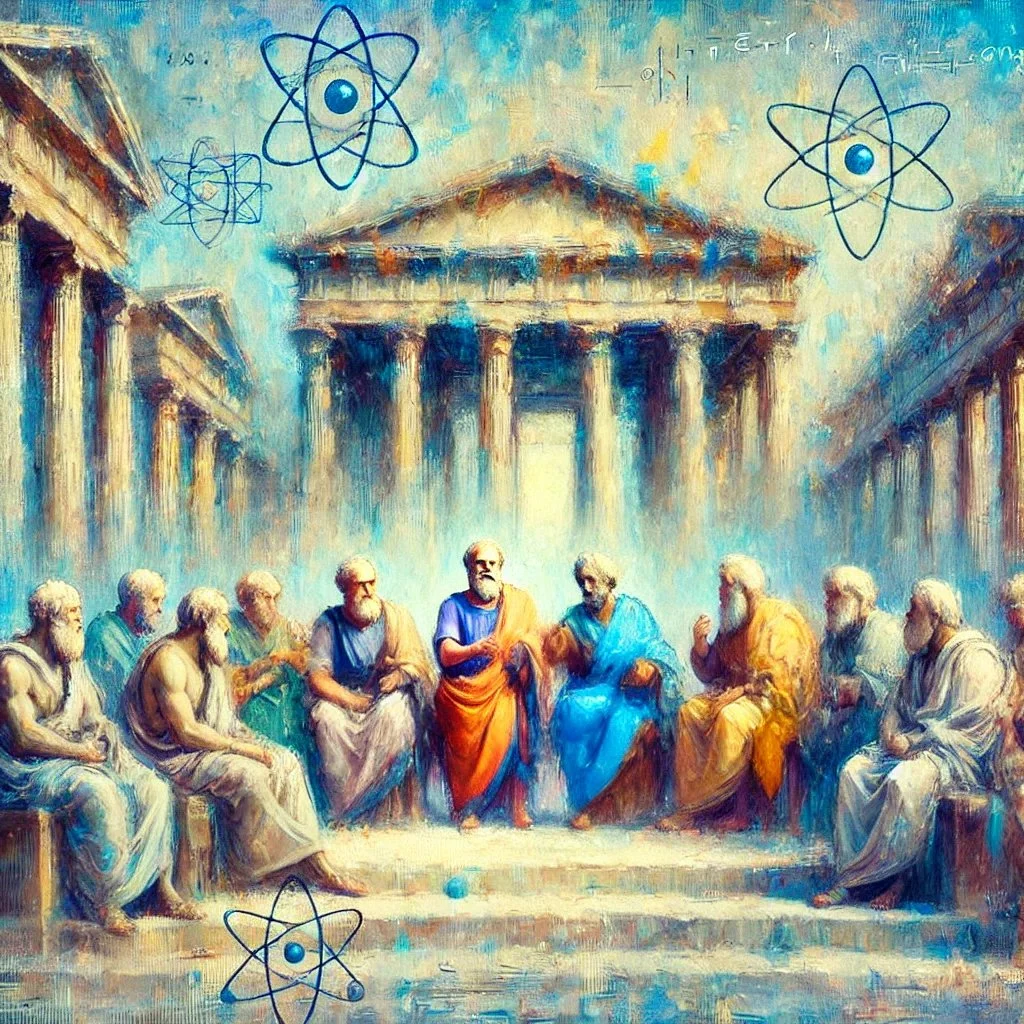
“By faith we understand that time was created by the word of God, so that what is seen was made from things that are invisible.” (Hebrews 11:3)
This verse aligns closely with what we hear from science today; the things created and that exist in our world came not from things seen by us, but from invisible things.
What we discussed in our previous article, Science and Scientists, regarding natural laws and the forces that govern our world is a good example of this. Progressing from philosophical arguments that were briefly discussed, we should also be able to see scientific proof of how these laws came into nature. We are beginning to see just that occur within science through a term called “fine-tuning.” Simply put, fine-tuning is the process of making small adjustments to something, which eventually leads to the best or desired performance, or desired outcome. The concept of fine-tuning was discovered in 1961 by Robert H. Dicke. Due to its profound implications, it has already been implemented in a variety of fields such as physics, engineering, and computer science.

SpaceX rocket boosters successfully landing on LZ1 and LZ2 landing pads after launch.
This picture was donated to the public domain by SpaceX.
In 2017, SpaceX used the fine-tuning concept to achieve what so many thought was impossible: successfully launching and landing re-used rocket boosters for space exploration. Recently in 2023, we’ve seen AI (artificial intelligence) dominate headlines with the introduction of new AI platforms, which many experts claim will fundamentally change society and how we interact with computers. Both these inventions are impressive and will change our lives; however, let’s consider for a moment both of these examples from another perspective. No one would argue that either of these breakthroughs just occurred. On the contrary, these breakthroughs only occurred as the result of meticulous planning, design, and construction by someone (or in this case, a group of people) with the same objective. This fact should be absolutely clear and indisputable. So, if these facts are indisputable, how much more indisputable should the fine-tuning of our universe, and the exponentially more complex processes which took place, be to us?
To properly understand the complexity of the fine-tuning that was required when it comes to the creation of the universe, it is important to be acquainted with the four fundamental forces which govern the universe. All four of these forces interact with each other, so all had to come into existence within hundredths of milliseconds of one another. In addition, all of these forces had to come into existence in the perfect ratio for the universe to not only be created, but to sustain life and continue to exist. These four fundamental forces are widely accepted throughout the scientific community as the governing forces of the universe.
To illustrate this point, I will be using information from IntelligentDesign.org.
These four fundamental forces, and a brief explanation of each, are as follows:
The gravitation force constant (large scale attractive force, holds people on planets, and holds planets, stars, and galaxies together) – too weak and planets and stars cannot form; too strong and stars burn up too quickly.
Electromagnetic force constant (small scale attractive and repulsive force, holds atoms’ electrons and nuclei together) - if it were slightly weaker or stronger, we wouldn’t have stable chemical bonds.
Strong nuclei force constant (small-scale attractive force, holds nuclei of atoms together, which otherwise repulse each other because of the electromagnetic force) – if it were weaker, the universe would have far fewer stable chemical elements, eliminating several that are essential for life.
Weak nuclear force constant (governs radioactive decay) – if it were much stronger or weaker, life-essential stars could not form.
Although these forces are very technical and complex, it’s important to understand the scale that is being dealt with to properly comprehend the intricate design required for all this to occur at the perfect time and in the perfect ratio. So, to give you an example, when theorists are dealing with the fundamental forces they consider in terms of their range, which is theoretically infinite. To get around this, theorists compare each of these constants against the gravitation force constant to get a more exact awareness on the precision of fine-tuning required for each individual constant (the range would be when the force is at its weakest and strongest). So, using this technique, theorists have observed that the strong nuclear force compared to the gravitational force is 1,040 times stronger, or put another way, is ten thousand, billion, billion, billion, billion times the strength of gravity.
If we take this range and represent it by a ruler stretching across the observable universe, this would be the equivalent to 15 billion light years. Now, you would probably think because of the strength of the gravitation force, there would be considerable leeway for this force to fluctuate, but that is actually the opposite of what we see. If the gravitation force constant was increased by just 1 part in 1,034 of the range of force strengths, the universe couldn’t have life sustaining planets, like the Earth. Measuring this in the example of the ruler, this would be the equivalent of moving less than one inch on that universe-long ruler! If you just contemplate the precision of this force for a few seconds, you quickly begin to realize how everything fits together too perfectly for it to all have happened by accident.
The example of the gravitation force constant was just one of how these four fundamental forces are fine-tuned. This same precision is seen in all four of them, but for the sake of this article I’ve only tried to help you understand the precision required for one. It should also be noted that not only are these four fundamental forces fine-tuned, but scientists have discovered another 22 lesser forces that were not mentioned. The fine-tuning for these 22 lesser forces is the same seen in the four fundamental forces. If any of these forces were off by the smallest fraction (to the extreme that was illustrated with the gravitation constant example), and didn’t happen with hundredths of milliseconds of the others (all of these forces interact with each other), then the universe would not be here, and life on Earth would not exist.
The amazing knowledge that has been discovered regarding natural laws, and more recently, the fine-tuning of the universe, shows us the full power and majesty of God as its Creator. While Genesis is the most well-known account of creation in the Bible, there are actually many other places throughout the Old and New Testaments which speaks to God’s role in the creation of the universe and its laws, as well as sustaining them. In a book that actually pre-dates Genesis (in regards to the events described), the book of Job gives us some fascinating insights into this. Job 38 includes a discourse between Job and God, and contrasts what God can do with what humans are able to do.
“Where were you when I laid the foundations of the earth? Tell me, if you have understanding. Who determines its measurements – surely you know! Or who stretched the line upon it? (Job 38:4)
We read in both Psalms and Isaiah that the world was created and is sustained by God:
“O Lord, how manifold are your works! In wisdom you have them all; the earth is full of your possessions [or creation].” (Psalms 104:24)
“Thus says God, the Lord, Who created the heavens and stretched them out, Who spreads out the earth and what comes from it, Who gives breath to the people on it and spirit to those who walk in it.” (Isaiah 42:5)
The New Testament also speaks similarly when Paul speaks to the Colossians:
“He is before all things, and in Him all things hold together.” (Colossians 1:17)
The Bible is filled with verses like these that not only speak to God’s majestic power, but also to His sustaining attributes as the Creator of the Universe. Through these verses, and the many more available, we see a clear picture of the God that was intimately involved in every aspect of creation, and His power to continue to sustain.
So, ask yourself again, where did the natural laws come from, and why do we see such order and consistency in the universe? The answer should be clear.
The theologian Thomas Aquinas thought about this question, and puts it succinctly in his book Summa Theologica,
“Therefore it is necessary to arrive at a first mover, put in motion by no other; and this everyone understands to be God.”
Table of Contents
Science and Scientists
All Things Were Created
Hanging in the Void
The Creator’s Vantage Point
Noah’s Ark: The Engineering Marvel that Survived the Flood
The Fragile Earth: Soil Erosion
The Polar Ice Caps and Frozen Realm
The Heavens Stretched Above the Earth
The Anisotropic Gemstones of Revelation 21
The Solar Eclipse

SCIENCE AND SCIENTISTS
Does the Bible contradict science, or does it actually provide the foundation for it? Explore the history of scientific thought—from Aristotle to Einstein—and discover why the consistent laws of physics point toward a Creator who established them "by Him and for Him."

“For by Him were all things created, that are in heaven, and that are in Earth, visible and invisible, whether by thrones, or dominions, or principalities, or powers: all things were created by Him and for Him.” (Colossians 1:16)
Before diving into specific scientific proofs in the Bible, it’s important to first look at “science” and what it means. This is especially important since we’re living in a time when many people believe the Bible and science contradict one another, which I hope these articles and other material on this website will show is actually the opposite of the truth. The Bible and science both complement one another, as we’ll see, and this should be expected since God, the Creator of all things, also created science.
Let’s first briefly look at the term “scientist.” The term actually only dates back to 1833 and was coined by British polymath William Whewell. Whewell was just the first person to coin the term, but history shows scientists have been with us for far longer. Modern scholars consider the well-known ancient Greek Aristotle to be the first recorded “scientist” in history, largely due to his extensive knowledge of natural phenomenon, and his curiosity in trying to understand why things happen as they do. Others may argue the astronomer Galileo Galilei is the first true “scientist” due to his use of experimentation, observation, and math to understand nature (instead of common sense and logical deductions used by Aristotle). Regardless of who the first scientist was, we can see that science dates back thousands of years, and even before these men, perhaps to the beginning of humanity.
These scientists made science what it is today, that is observing and then using those observations to establish rules and laws to explain how the world operates. In the realm of physics, this process is done largely through mathematical equations. Understanding this brings us to an important question to consider:
If these great scientists from the past only discovered these laws, then where did they come from?
For science to exist and to be trusted, the observations seen must be consistent and repeatable. For the observations we see to be consistent and repeatable, there must be specific laws that are being followed, otherwise everything would be in constant change and science would be impossible. This is an important point to consider since life itself and our interactions with the world would be impossible unless we had established, predictable, and constant laws. At some point, these laws of the universe had to be established. Not surprisingly, this observation was made in the beginning of science by the ancient Greeks and they debated this topic extensively. In school we learned about famous Greek scientists such as Socrates, Plato, and the previously mentioned Aristotle. These men were not only considered great scientists of their age, but also great philosophers. The Greeks realized that oftentimes science and philosophy needed to be included together to form a wholistic and complete picture of the reasoning and laws which govern the universe. This correlation between philosophy and science exists even today. Some of the great scientists of the 20th century, such as Albert Einstein and Nikola Tesla, considered themselves to be “philosophical scientists.”


Both ancient Greeks and modern scientists understand that science and philosophy are needed together to begin to understand and answer some of these big questions, but the question still remains. Where did the laws come from that allow science to exist?
The Natural Laws argument comes from the philosophical field and dates back to Aristotle. According to the Massachusetts Institute of Technology (MIT), the argument states, “the observation of governing laws and existing order in the universe indicates the existence of a superior being who enacted these laws.” Due to the age of this argument, there is obviously much debate, specifically on what should be considered a natural law versus a man-made law or observance.
Regardless, through basic observation and common sense we can see there are obviously core laws built into the universe which humanity can merely just discover such as mathematics, engineering, and physics. Without these laws present and consistent, our interaction with the universe would be impossible. Considering this, ask yourself:
If these laws are present, orderly, and consistent then what would that imply?
The Bible tells us plainly what this implies and precisely where these laws came from.
“For the LORD is our Judge, the LORD is our Lawgiver, the LORD is our King, He will save us.” (Isaiah 33:22)
In the New Testament of the Bible, we see the apostle James state something similar:
“There is only one Lawgiver and Judge, the One who is able to save and destroy…” (James 4:12)
You might think these verses refer to the LORD as the giver of the law, particularly in the Old Testament, and that’s partially correct. However, consider the Hebrew word translated as “Lawgiver” here: ḥāqaq. This word is also used in Proverbs, but not in reference to God’s law. Instead it is used to describe the creation of the Earth and the establishment of the laws of the universe.
“When He gave the sea its boundary so the waters would not overstep His commands, and when He appointed [ḥāqaq] the foundations of the earth…” (Proverbs 8:29)
Whether it was Aristotle or Galileo, whoever was the first person to observe or discover these natural laws did only that - discover. As the Bible states and we are able to see all around us, it was God Who created not only the universe, but also the laws that govern it and provide stability. When we ask where did the natural laws come from, we should consider Paul’s word in Colossians who succinctly summarizes this point,
“He is before all things, and in Him all things hold together.” (Colossians 1:17)
Paul, and other Biblical authors before him, are given no consideration by scholars as being great scientists or philosophers from their times. However, we see the Biblical authors, who were inspired to write these words by God, come to the same conclusion regarding natural laws and a Lawgiver well before the great minds of the ancient Greeks, like Aristotle, began to grasp with these questions. The intricate relationship between science and the Bible is not one of opposition but of complementarity. As we’ve explored, the Bible anticipated many of the questions that would later be formalized by great minds like Aristotle, Socrates, and Plato. The natural laws they discussed and we’ve “discovered” are not inventions of humanity, but rather, reflections of the divine order established by God from the very beginning. These laws provide the consistent, predictable foundation upon which science stands, and their existence points to the necessity of a Lawgiver. As we look at the universe and the governing principles within it, it becomes clear that science, rather than contradicting the Bible, affirms the existence of a Creator. The Bible not only explains where these laws originated, but offers a broader understanding of their purpose, as seen in scriptures in both the Old and New Testaments. Just as science relies on consistent laws, our lives depend on a God who created them and continues to hold sustains and all holds all these things together. Through this, we see that both the Bible and science ultimately lead us back to the same truth: that God is the author of all creation, including the laws that govern it.
Table of Contents
Science and Scientists
All Things Were Created
Hanging in the Void
The Creator’s Vantage Point
Noah’s Ark: The Engineering Marvel that Survived the Flood
The Fragile Earth: Soil Erosion
The Polar Ice Caps and Frozen Realm
The Heavens Stretched Above the Earth
The Anisotropic Gemstones of Revelation 21
The Solar Eclipse

THE EVIDENCE OF JESUS OUTSIDE THROUGH THE DARKENING OF THE SUN (PART 3)
History and science agree: the darkness at the crucifixion was no ordinary eclipse. Discover the ancient Roman archives and non-Biblical historians that corroborate the supernatural "portent" recorded in the Gospels.
What to Know
Multiple Outside Accounts: Rufinus, Phlegon of Tralles, and Tertullian—all non-biblical writers—corroborate the biblical narrative of a sudden darkness immediately following Jesus’ crucifixion, underscoring its historicity.
Significance of Darkness: For the ancient Jewish audience, darkness often symbolized God’s judgment (e.g., Genesis 1:2, Exodus 10:22). This alignment with Jewish tradition amplifies the event’s importance, especially surrounding Jesus’ controversial death.
Roman Archive References: Tertullian mentions that Roman records documented this phenomenon. Although those archives were likely destroyed in the Roman sacking of Jerusalem (70 A.D.), his testimony shows the official recognition of the crucifixion’s extraordinary circumstances.
Not a Natural Eclipse: Phlegon describes an eclipse during a full moon—impossible for a standard solar eclipse—while Tertullian highlights the same timing, reaffirming the supernatural nature of the darkness and cementing its consistency with the biblical accounts.

Let's now look at a particularly remarkable and supernatural event recorded in the Gospels immediately after Jesus' death. While we'll reference the Bible to highlight this event, our primary aim is to examine it from a historical perspective through non-Biblical sources and accounts. We'll compare the biblical account to other non-biblical sources to demonstrate that this event wasn't only recorded in the Scriptures — others witnessed and documented it as well making it indisputable, historical fact.
We'll examine the darkness that covered the land right after Jesus Christ died. This event, occurring immediately after the death of someone as controversial as Jesus, is highly significant. For ancient peoples, notably the Jews, darkness often symbolized divine judgment on the Earth. This is seen in biblical examples such as Genesis 1:2, where the Earth was formless and dark, and Exodus 10:22, where darkness served as a judgment against the Egyptians. These examples underscore that the concept of darkness as a sign of judgment was well-established and would have been especially meaningful to the people of that time, especially the Jews. Historical records show that this event did not go unnoticed; it was recorded exactly as it happened.
The Greek historian Rufinus notes:
"Search your writings, and you shall find that in Pilate's time, when Christ suffered, the sun was suddenly withdrawn and darkness followed."
This account corresponds precisely with what is written in Matthew 27:45-46:
"Now from the sixth hour (Noon) until the ninth hour (3 p.m.), there was darkness over all the land. And about the ninth hour, Jesus cried out with a loud voice, saying, 'Eli, Eli, lama sabachthani?' that is, 'My God, My God, why have You forsaken Me?'"
Phlegon of Tralles, a historian from the reign of Tiberius Caesar, provides a second-century record describing a solar eclipse during the time of the full moon, "from the sixth to the ninth hour," just as the Gospels record. He states:
"This eclipse was visible from Jerusalem at moonrise… first visible from Jerusalem at about 6:20 p.m. (the start of the Jewish Sabbath and also the start of Passover day in 33 AD) with about 20% of its disc in the umbra of the earth's shadow… the eclipse finished thirty minutes later, at 6:50 p.m."
Quintus Septimius Florens Tertullian, in his work Apologeticus, comments that many witnesses of Jesus's crucifixion were unaware of the prophecies in Amos and Isaiah predicting darkness and thus believed the darkness was an eclipse. Tertullian wrote that evidence of this event was still available in the Roman archives. This claim is particularly significant, suggesting that records of Jesus's life, death, and resurrection were documented in Rome as early as the first century. These documents would have most likely been destroyed when Rome burned Jerusalem to the ground during the Jewish revolt in 70 A.D. However, before that occurred we have historical proof from Tertullian that such documents existed and were being stored there.
In another writing, Tertullian describes the darkness surrounding the crucifixion as occurring precisely when Jesus was on the cross. He writes:
"In the same hour (as the crucifixion), too, the light of day was withdrawn, when the sun at that very time was in his meridian blaze. Those unaware that this had been prophesied about Christ no doubt thought it an eclipse. You yourselves have an account of the world portent still in your archives."
Tertullian's acknowledgment that this event could not have been an eclipse is crucial, especially in light of the record from Julius Africanus, who stated that a solar eclipse could not have caused the darkness. The Passover Feast is always observed on the 14th day of Nisan, during a full moon. An eclipse can only occur when the moon is new and under the sun, making it scientifically impossible for a total solar eclipse to coincide with a full moon. This crucial detail as acknowledged by Tertullian and Julius Africanus through the historical record, shows that this darkness following Jesus Christ’s crucifixion was truly remarkable and miraculous. Despite the widespread persecution and hostility toward Christianity during this time period, the accounts of these non-biblical sources align perfectly with that of the Bible and synoptic Gospels.
Table of Contents
Textual Criticism of the Bible (Part 1)
The Evidence of Jesus Christ Outside the Bible (Part 2)
The Evidence of Jesus Christ Through the Darkening of the Sun (Part 3)
When was the First New Testament Book Written and by whom? (Part 4)
The Historical Reliability of the New Testament and Gospels (Part 5)
Proving the Accuracy of the Bible Through Prophecy (Part 6)
Proof of the Bible Through the Crucifixtion and Ressurection (Part 7)
A New Beginning - What does this Mean for Us? (Part 8)
Sources
Rufinus of Aquileia: Rufinus's Ecclesiastical History contains references to events surrounding early Christian history, including the supernatural events reported at the time of Jesus’s crucifixion. His work is particularly noted for continuing Eusebius's Historia Ecclesiastica, and it's a valuable source for understanding how early Christians perceived these events(Tertullian) (Wikipedia).
Phlegon of Tralles: Phlegon, a historian during the reign of Tiberius Caesar, is known for his Chronicles, where he mentions unusual astronomical phenomena, including the darkness during the crucifixion. This account is often cited in discussions about non-Christian references to events described in the Gospels (Princeton University Library Catalog).
Tertullian: Tertullian, in his Apologeticus and other writings, discusses the darkness at the crucifixion and asserts that records of this event were kept in Roman archives. His works are among the earliest to argue for the historicity of Jesus's life and the supernatural events surrounding His death from a non-biblical perspective (academic.oup).
Julius Africanus: Julius Africanus, in his Chronographiae, critiques the idea that the darkness was caused by a solar eclipse, noting the impossibility of such an event during a full moon, which is when Passover is observed. This argument is crucial for establishing the event's supernatural nature rather than a natural phenomenon (Princeton University Library Catalog).