


THE MEANING
OF LIFE
WHEN WAS THE FIRST NEW TESTAMENT WRITTEN? AND BY WHOM? (PART 4)
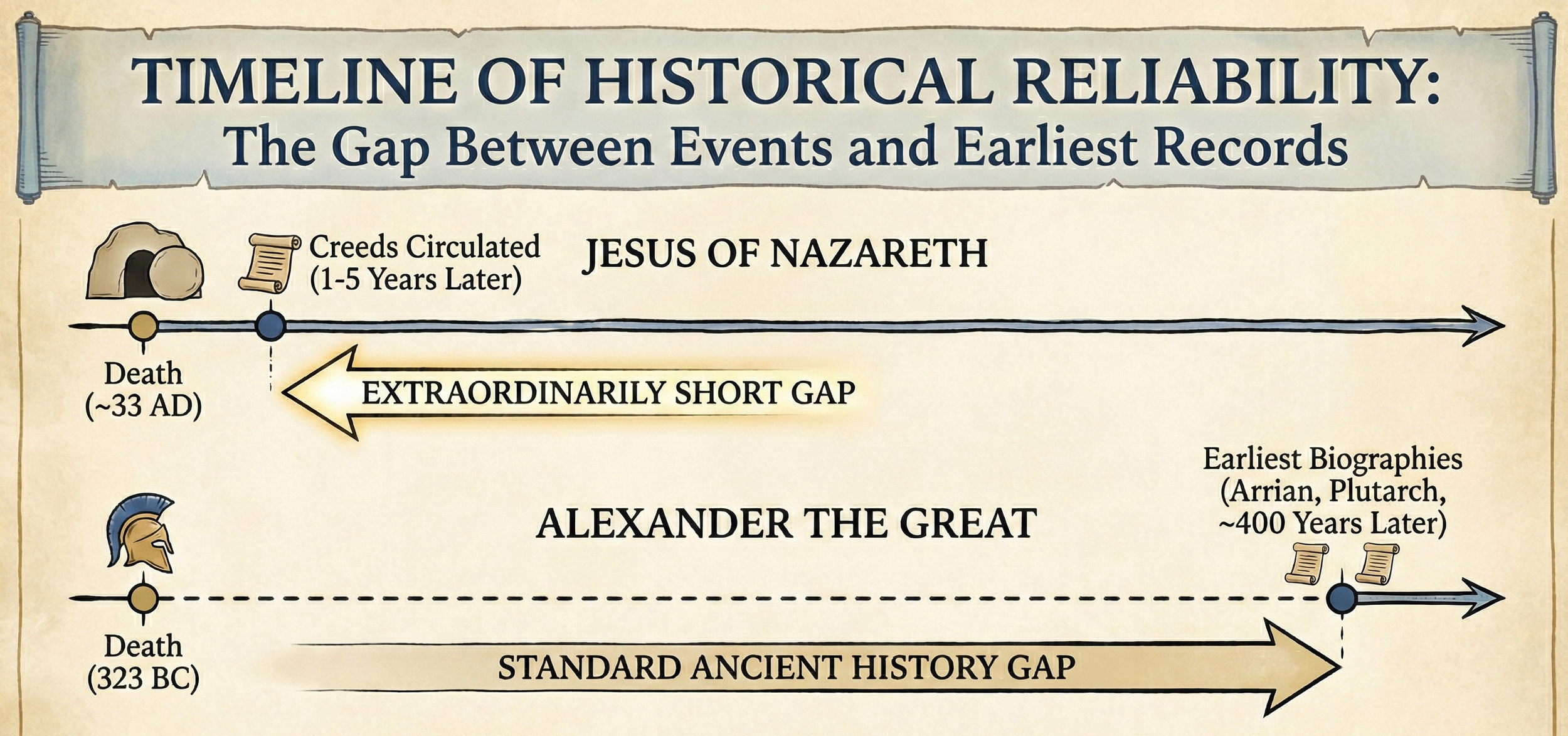
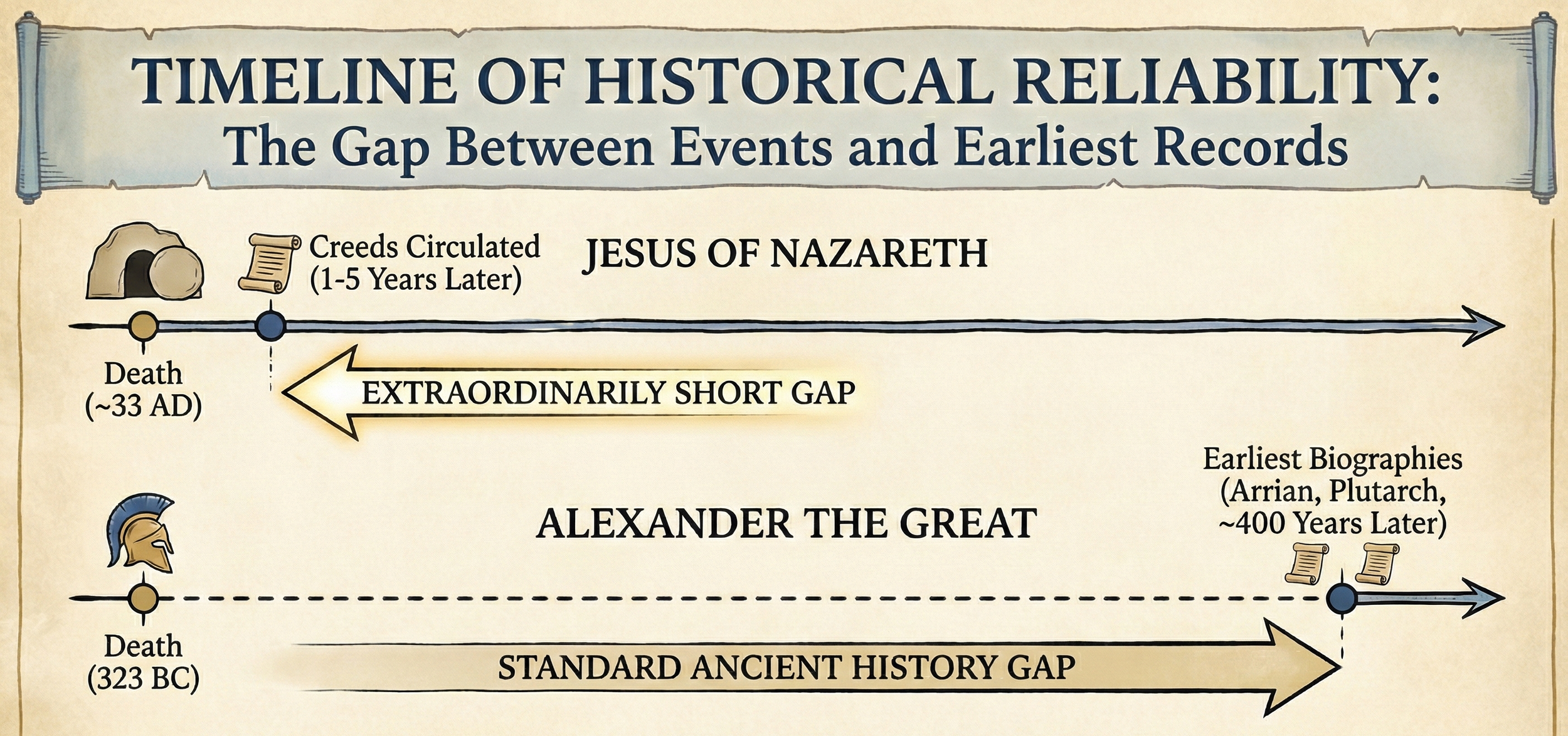
How soon after the crucifixion did the first reports of the Resurrection appear? While most ancient biographies were written centuries after their subjects died, the "creeds" of the New Testament circulated within months.
What to Know
Extraordinary Proximity: Unlike most ancient figures, the records for Jesus Christ’s life began circulating within 1–5 years of the events. In historical scholarship, this is an extraordinarily short gap that makes the New Testament more reliable than the biographies of Alexander the Great or Socrates.
The Power of Early Creeds: Scholars have identified "creeds"—succinct statements of faith—in the New Testament (like 1 Corinthians 15) that were formulated within months of the crucifixion. These early records were shared while eyewitnesses were still alive to either verify or disprove the claims.
A Shield Against Legend: Historians note that it typically takes two generations for legends to replace historical facts. Because the claims of Jesus’s death and resurrection circulated immediately, there was no time for "legendary embellishments" to wipe out the hard core of truth.
The Criterion of Embarrassment: Secular scholars use the "criterion of embarrassment" to verify authenticity. The fact that the New Testament includes details that would have been socially or politically embarrassing to the early Church suggests the authors were committed to recording actual events rather than inventing a myth.
Historical records and non-Biblical sources affirm that Jesus Christ lived, had a ministry, was crucified, and was believed to have been resurrected. These essential points, central to the New Testament, are also documented in historical records outside the Bible. Remarkably, even supernatural events such as the darkening of the sun after Jesus's crucifixion (as explained in the previous post), are extensively recorded.
We've previously discussed the widespread circulation of New Testament copies throughout the Roman Empire and their proximity to the events they describe. Some fragments date back to as early as 50–60 A.D., a period when eyewitnesses would have still been alive. However, even earlier evidence exists beyond the New Testament. Critical scholars have identified sermon summaries in Acts (2:22-36, 3:13-16; 4:8-10; 5:29-32; 10:39-43; 13:28-31) and creeds—succinct statements of faith—found in Romans 4:25; Philippians 2:8; 1 Peter 3:18; Galatians 3:13; and 1 Corinthians 15:3, which all mention Jesus's death. The most famous is the creed in 1 Corinthians 15:3-8, which scholars believe circulated within 1-5 years of Jesus's death.
The German atheist and critic Gerd Lüdemann asserts that "the elements in the tradition are to be dated to the first two years after the crucifixion of Jesus…not later than three years." Respected scholar James D.G. Dunn similarly states, "This tradition, we can be entirely confident, was formulated as tradition within months of Jesus's death."
To grasp the significance of how early these creeds circulated, consider the example of Alexander the Great. Historians generally agree on the major events of Alexander's life, yet the earliest reports come from Arrian and Plutarch, nearly 400 years after Alexander died in 323 B.C. In historical scholarship, a 400-year gap is considered quite close to the actual events, which is why scholars are confident about Alexander's life. In contrast, the documentation of Jesus's life and death, within just a few years or months of the events, is extraordinary in the context of ancient history. This comparison highlights the strong evidence for the accuracy and reliability of the New Testament. To reject the Bible's accuracy would imply questioning the existence of other historical figures like Alexander the Great, Aristotle, or Socrates.
The early circulation of these creeds is significant for two key reasons. First, the claims about Jesus's death by crucifixion and other events were made at the same time and place they occurred. If these claims were false, eyewitnesses could have easily disproven them. Furthermore, crucifixions were public events intended to serve as a deterrent, and Jesus's crucifixion was witnessed by a large assembly of Jewish leaders and a crowd, as described in Luke 23:1-4. This event is later referenced in Acts 2:36, a sermon that critical scholars believe began circulating within months of Jesus's crucifixion. Yet, there is no record of anyone denying Jesus's death at that time.
Second, the short timeframe between the events and the circulation of these creeds prevents the possibility of legendary embellishments replacing the actual events, as some critics claim. A.N. Sherwin-White, a classical historian from Oxford University, states that "the span of two generations [or less] is too short to allow legendary tendencies to wipe out the hard core of historical fact."
Additionally, the criterion of embarrassment further supports the authenticity of the accounts of Jesus's crucifixion. This criterion suggests that authors are unlikely to invent details that would embarrass their message unless those details were accurate. Although primarily applied to the Bible, this criterion is also used by scholars to analyze other historical documents. For example, Jan Nattier employs this method in her analysis of Buddhist texts in her work "A Few Good Men: The Bodhisattva Path according to The Inquiry of Ugra (Ugraparipṛcchā)" (University of Hawaii Press, 2005).
Table of Contents
Textual Criticism of the Bible (Part 1)
The Evidence of Jesus Christ Outside the Bible (Part 2)
The Evidence of Jesus Christ Through the Darkening of the Sun (Part 3)
When was the First New Testament Book Written and by whom? (Part 4)
The Historical Reliability of the New Testament and Gospels (Part 5)
Proving the Accuracy of the Bible Through Prophecy (Part 6)
Proof of the Bible Through the Crucifixtion and Ressurection (Part 7)
A New Beginning - What does this Mean for Us? (Part 8)
Sources
Josephus, Flavius - Antiquities of the Jews (Book 18, Chapter 3) - Provides a non-Christian reference to Jesus, mentioning his crucifixion under Pontius Pilate.
Tacitus, Cornelius - Annals (Book 15, Chapter 44) - Refers to Jesus's execution during the reign of Tiberius by the procurator Pontius Pilate.
Lüdemann, Gerd - The Resurrection of Christ: A Historical Inquiry (2004) - Discusses the early dating of Christian creeds and Lüdemann's views as a critical scholar.
Dunn, James D.G. - Jesus Remembered (2003) - Provides evidence and analysis on the early tradition of Jesus’s resurrection and the formation of creeds.
Sherwin-White, A.N. - Roman Society and Roman Law in the New Testament (1963) - Analyzes the historical reliability of the New Testament using comparisons with other historical figures.
Nattier, Jan - A Few Good Men: The Bodhisattva Path according to The Inquiry of Ugra (Ugraparipṛcchā)(University of Hawaii Press, 2005) - Uses the "principle of embarrassment" to analyze Buddhist texts.
Saturday Sabbath vs. Sunday Sacredness
Why did the Sabbath move from Saturday to Sunday? Discover the "bad seed" of Laodicea and the 4th-century council that officially outlawed the biblical Sabbath. Learn why the Catholic Church admits this was an act of human authority—and why the Reformation never changed it back.
“And to the angel of the church of the Laodiceans write, “These things says the Amen, the Faithful and True Witness, the Beginning of the creation of God:
I know your works, that you are neither cold nor hot. I could wish you were cold or hot.
So then, because you are lukewarm, and neither cold nor hot, I will vomit you out of My mouth.” (Revelation 3:14-16)
The warning to the church in Laodicea was a stark indictment of "lukewarm" faith, a call for urgent repentance. While we often wonder if these biblical churches heeded such warnings, history suggests that Laodicea did not change. Instead, its influence evolved, sowing a "bad seed" that has taken root in much of modern Christianity.
Historically, the church in Laodicea outlasted most of its neighbors in Asia Minor. In approximately A.D. 336, it became the site of a pivotal governing body: The Council of Laodicea. Among its 60 rulings, or "canons," was a decision that would fundamentally alter the course and rhythm of Christian worship: the official mandate to shift the Sabbath from Saturday to Sunday.
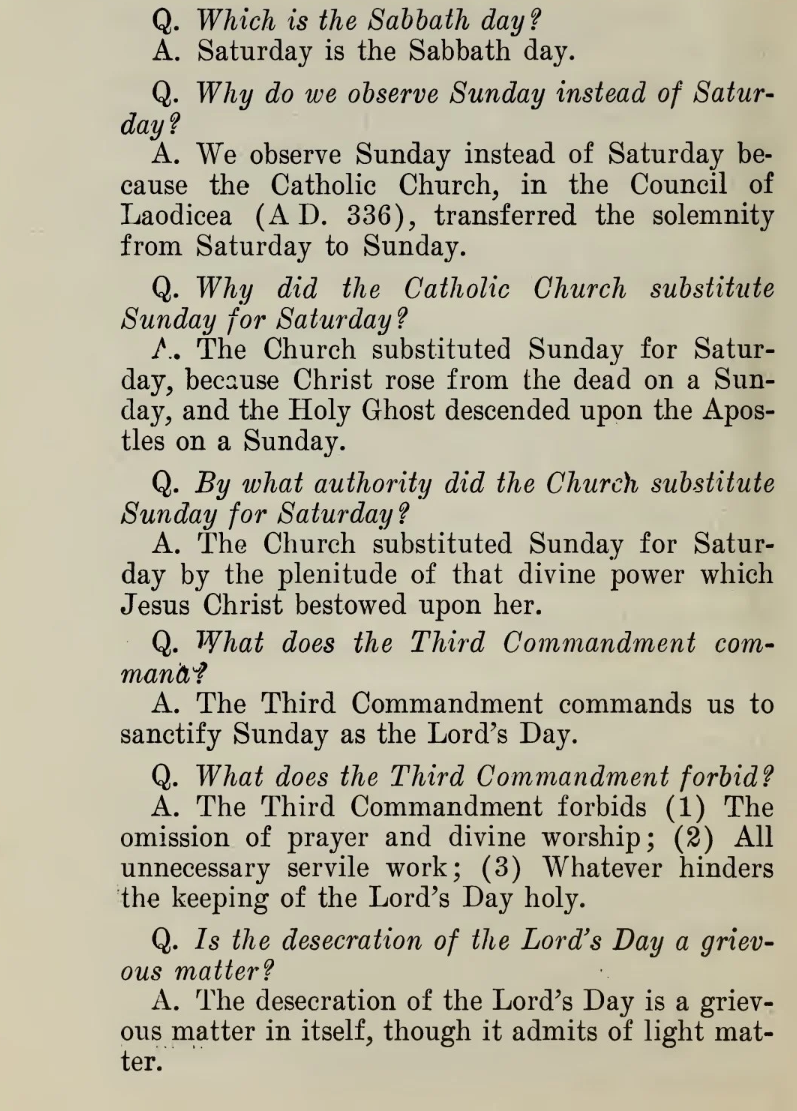
An excerpt from The Convert’s Catechism of Catholic Doctrine explicitly admitting transferring the seventh-day Sabbath to Sunday.
This shift was not a scriptural evolution, but a calculated ecclesiastical change. Even The Convert’s Catechism of Catholic Doctrine explicitly admits this transition, stating that the church exercised its own authority to move the solemnity from the seventh day to the first.
Key Takeaways from the Council of Laodicea
(c. A.D. 336)
Canon 29: This specific ruling explicitly forbade Christians from "Judaizing" by resting on the Sabbath (Saturday), commanding them instead to work on that day and honor the Lord’s Day (Sunday) if possible.
The Legacy: Rather than repenting of its lukewarm nature, Laodicea used its influence to codify a departure from the "blueprint" of the early Church.
The Admission: Catholic doctrine openly acknowledges that the change from the seventh-day Sabbath to Sunday was an act of the Church, not a command found in Scripture.
The Catholic Church is transparent about its role in shifting the Sabbath from Saturday to Sunday, asserting that it exercised its own ecclesiastical authority to make the change. This admission underscores a vital historical reality: for centuries after the resurrection, the followers of Jesus Christ continued to honor the seventh-day Sabbath, right up until this institutional shift.
When Protestant churches later branched off during the Reformation, they broke away from many doctrines but chose to retain this specific tradition of "the Lord’s Day" (Sunday) rather than returning to the biblical Sabbath. This creates a significant conflict, as it prioritizes a man-made tradition over a divine decree. Jesus spoke directly to this tendency, reserving some of His harshest warnings for those who elevate human tradition above the commandments of God:
“He answered and said to them,
”Well did Isaiah prophesy of you hypocrites, as it is written: 'This people honors Me with their lips, But their heart is far from Me. And in vain they worship Me, teaching as doctrines the commandments of men.'"For laying aside the commandment of God, you hold the tradition of men making the word of God of no effect through your tradition which you have handed down. And many such things you do." (Mark 7:16 & Mark 7:13)
Jesus was vehemently opposed to changing God's commandments and elevating man's doctrine above God’s word.

A NEW BEGINNING - WHAT DOES JESUS’ CRUCIFIXION AND RESURRECTION MEAN FOR US? (PART 8)
Does the meaning of life come down to a single historical question? Discover the six factual pillars of the life of Jesus, from the empty tomb to the martyrdom of the Apostles. Explore why world-class scholars and Oxford philosophers calculate a 97% probability of the resurrection—and what that truth means for your purpose today.
What to Know
The crucifixion and resurrection of Jesus Christ are historically reliable: Supported by biblical, historical, archaeological, and extra-biblical evidence, these events stand among the best-documented in ancient history.
Scholarly consensus affirms Jesus’ historicity: The overwhelming majority of historians and scholars agree that Jesus existed, was crucified, and that His followers genuinely believed He rose from the dead.
Evidence supports the resurrection: The crucifixion, burial, empty tomb, post-resurrection appearances, and the disciples’ transformation are well attested. Early Christian creeds and extra-biblical accounts corroborate the New Testament narrative.
Alternative explanations fail: Theories like the Stolen Body, Swoon, Hallucination, Legend, Wrong Tomb, and Conspiracy theories cannot adequately account for the evidence and are critically flawed.
The resurrection validates Jesus’ identity: It confirms His claim to be the Messiah and Son of God, offering profound implications for the meaning of life and the human search for purpose.
The resurrection offers hope and purpose: In a world marked by despair and disconnection, the resurrection of Jesus is a beacon of hope and calls humanity to follow His teachings—love, service, forgiveness, and a transformative relationship with God.
The ultimate meaning of life is found in Jesus Christ: Through His resurrection, He offers eternal life and a clear purpose—living in alignment with God’s plan and reflecting His light in a dark world.

To conclude, the following points about Jesus’ life, death, and resurrection have been established as factual based on the biblical account, supported by historical evidence, archaeological discoveries, and secular (non-biblical) accounts:
Crucifixion: The crucifixion of Jesus is a historically reliable event.
Burial: The burial account fits with all available historical evidence.
Empty Tomb: The empty tomb is attested by multiple sources, with no contradictory accounts.
Post-Resurrection Appearances: The apostles claimed to have personally encountered the resurrected Jesus.
Martyrdom of Apostles: The apostles were willing to suffer and die for their belief in the resurrection.
Conversion of Skeptics: Even those unlikely to believe were converted through personal experiences with the resurrected Christ.
While absolute certainty is difficult to accomplish, the overwhelming evidence supports the historical existence of Jesus Christ. The crucifixion and resurrection of Jesus Christ stand as some of the most well-documented events in ancient history. The convergence of biblical narratives, extra-biblical accounts, archaeological discoveries, and historical scholarship provides a compelling case for these cornerstone events of Christianity. Lee Strobel captures the weight of these findings and their significance: “It didn't take long for me to conclude that the truth or falsity of all world religions — and the ultimate meaning of life itself — comes down to just one key question: did Jesus, or did He not, return from the dead?" The resurrection is pivotal because it validates Jesus’ claims of being the Messiah and carries profound implications for the meaning of life.
Can we confidently assert that Jesus Christ existed approximately 2,000 years ago, was crucified, and was resurrected from the dead? These are bold claims and while absolute certainty may be elusive, the overwhelming consensus among scholars affirms these key points. Philosopher Richard Swinburne of Oxford University, after analyzing the evidence using a strictly factual approach, argued that there is a 97% probability that Jesus rose from the dead. This conclusion underscores the strength of the historical and archaeological evidence. Eric Meyers, emeritus professor of Judaic studies at Duke University, states, "I don't know many mainstream scholars who doubt the historicity of Jesus. The details have been debated for centuries, but no serious scholar doubts that he was a historical figure." The extensive evidence from the Bible and numerous extra-biblical sources affirms not only that Jesus was a real historical figure, but also that He was crucified, and rose from the dead.
If Jesus truly rose from the dead, His claims about Himself demand serious consideration. Jesus foretold His death and resurrection (Matthew 16:21; Mark 8:31) — a feat impossible without divine authority. The resurrection confirms Jesus’ identity as the Son of God and His message of salvation for humanity. N.T. Wright offers a profound reflection: “Why didn't the early Church follow the patterns of other messianic movements after their leaders were executed? Why did it consider Jesus its leader and the fulfillment of Israel's destiny? The unique organization and missionary zeal of the early Church, despite the public humiliation and execution of its leader, points to the profound impact of the post-resurrection appearances of Jesus and the work of the Holy Spirit.”
So, what is the meaning of life? This question, which has echoed through centuries of human thought, finds its ultimate answer in the life, death, and resurrection of Jesus Christ. As we have seen, the resurrection is not merely a religious claim, but a historical event, supported by robust evidence from biblical accounts, historical records, and archaeological findings. The empty tomb, the post-resurrection appearances, and the transformation of the disciples all point to one inescapable conclusion: Jesus Christ rose from the dead, validating His identity as the Messiah and Son of God.
This truth has profound implications for humanity’s enduring search for purpose. In a world marked by existential despair, rising mental health crises, and a growing sense of spiritual disconnection, the resurrection offers a beacon of hope. Jesus declared, "I am the way, the truth, and the life" (John 14:6), revealing that life's ultimate purpose is found in Him. His teachings call us not to superficial religiosity, but to a transformative way of living that aligns with God’s greater plan for humanity.
Now that we have established the reliability of the Bible and the truth of Jesus Christ through the historical record, the question shifts from "What is the meaning of life?" to "What will we do with the meaning that Jesus offers?" Humanity's greatest calling is to live as Christ taught — to love, serve, forgive, and reflect God’s light in a world often overshadowed by darkness. Through His resurrection, Jesus not only conquered death, but opened the door for all to share in eternal life and to have a profound relationship with God, if they choose to follow.
The meaning of life is clear: it is found in Jesus Christ. As Paul writes in Colossians 1:27, “Christ in you, the hope of glory.” Embracing Him means embracing purpose, hope, and the true meaning of life.
But how do we connect with Jesus Christ and His teachings? To find the answers, we must turn to the Bible and uncover what Jesus and Scripture truly teach about the “narrow path” God asks of us which leads to eternal life. We can begin to see that path through God’s established Feast and Holy Days.
Table of Contents
Textual Criticism of the Bible (Part 1)
The Evidence of Jesus Christ Outside the Bible (Part 2)
The Evidence of Jesus Christ Through the Darkening of the Sun (Part 3)
When was the First New Testament Book Written and by whom? (Part 4)
The Historical Reliability of the New Testament and Gospels (Part 5)
Proving the Accuracy of the Bible Through Prophecy (Part 6)
Proof of the Bible Through the Crucifixtion and Ressurection (Part 7)
A New Beginning - What does this Mean for Us? (Part 8)
Sources
Dr. Simon Gathercole on Pauline Epistles: Simon Gathercole, "The Gospel of Paul: What’s the Good News?" The Good Book Company, 2021.
Archaeological Evidence on Judean Life: Byron McCane, "Death in Roman Palestine: Archaeology and the Historical Jesus," Bible Review, 1998.
Byron McCane on Jesus in Historical Context: National Geographic Interview, The Real Jesus, March 2017.
Crucifixion as Historical Fact: John Dominic Crossan, "Jesus: A Revolutionary Biography," HarperOne, 1994.
Women as Witnesses: Josephus, "Antiquities of the Jews," Book IV.
Chuck Colson on the Resurrection: Chuck Colson, "Born Again," Chosen Books, 1976.
N.T. Wright on the Early Church: N.T. Wright, "The Resurrection of the Son of God," Fortress Press, 2003.
Richard Swinburne on the Probability of the Resurrection: Richard Swinburne, "The Resurrection of God Incarnate," Clarendon Press, 2003.
Eric Meyers on the Historicity of Jesus: Eric Meyers, Interview, CNN, "Archaeologists Unearth New Clues About Jesus," 2014.

PROOF OF THE BIBLE THROUGH THE CRUCIFIXION AND RESURRECTION OF JESUS CHRIST (PART 7)
Is the Resurrection a matter of blind faith or historical fact? Explore the overwhelming evidence for the death and rising of Jesus Christ. From the admission of skeptical scholars to the forensic failure of "stolen body" theories, discover why the empty tomb remains the most secure fact of ancient history.
What to Know
The crucifixion and resurrection of Jesus Christ are historically reliable events: Supported by extensive archaeological, historical, and textual evidence, even skeptical scholars like John Dominic Crossan and Bart Ehrman affirm the certainty of Jesus’ crucifixion.
The earliest Christian writings affirm the resurrection: Paul’s epistles (A.D. 50–60) and the Gospels (A.D. 70–100) are based on eyewitness accounts and consistently emphasize the resurrection as central to the Christian faith.
Archaeological evidence supports the Gospels: Excavations in first-century Judea validate the presence of large crowds and widespread diseases, consistent with Jesus’ ministry to the sick and marginalized.
Extra-biblical sources confirm the crucifixion: Roman historian Tacitus, Jewish historian Josephus, and Pliny the Younger independently affirm Jesus’ execution and early Christian worship of Him as God.
Alternative theories fail to explain the resurrection: Theories like the Stolen Body, Swoon, Hallucination, Legend, Wrong Tomb, and Conspiracy theories all face critical flaws and cannot account for the empty tomb and post-resurrection appearances.
The empty tomb and resurrection appearances are credible: Women discovered the empty tomb, an unlikely fabrication in first-century Judea, and the disciples’ transformation from fear to bold proclamation confirms their genuine belief.
The resurrection fueled Christianity’s rapid expansion: The disciples’ unwavering testimony and willingness to endure persecution demonstrate their firm conviction that Jesus truly rose from the dead.
Let’s take a deeper look at the crucifixion and resurrection of Jesus Christ, supported by extensive archaeological, historical, and textual evidence from first-century Judea. Dr. Simon Gathercole, a leading biblical scholar, emphasizes that the earliest Christian writings about Jesus are found in Paul’s epistles, written approximately 25 years after Jesus’ death (A.D. 50–60). These letters provide a window into the beliefs of the early Christian church and underscore the fundamental nature of Jesus’ death and resurrection in the Christian faith. Additionally, the biographical accounts in the New Testament — composed about 40 years after Jesus’ death — are widely believed by scholars to have been written by individuals who either personally knew Jesus or had direct access to eyewitness testimony.
The New Testament narrative aligns closely with archaeological and historical evidence from first-century Judea, providing a well-grounded context for the events they describe. For example, archaeological findings validate the presence of large crowds, as depicted in the Gospels. The widespread prevalence of diseases such as leprosy and tuberculosis in the region would have drawn many to Jesus, who was revered as a healer. These details, corroborated by historical and archaeological data, lend credibility to the Gospel portrayal of Jesus as someone who ministered to the sick and marginalized.
Further insights into the harsh realities of life in Roman Palestine come from archaeologist Byron McCane’s studies of burial practices, which reveal that two-thirds to three-quarters of graves from this period contained the remains of children and adolescents. This grim statistic underscores the challenges of survival in first-century Judea and deepens the understanding of Jesus’ ministry, which was marked by compassion for the afflicted and vulnerable. Together, these layers of evidence reinforce the authenticity of the biblical account, providing a solid foundation for examining the life, crucifixion, and resurrection of Jesus Christ.
The crucifixion itself is among the best-attested events in ancient history. Even skeptical scholars, such as John Dominic Crossan, affirm that "Jesus' crucifixion is as sure as anything historical can ever be." Similarly, Bart Ehrman, critical scholar of the New Testament and agnostic, concedes similarly by stating, “The crucifixion of Jesus by the Romans is one of the most secure facts we have about His life.”
Supporting these statements by modern critical scholars is an abundance of extra-biblical sources that reference Jesus’ crucifixion. Roman historian Tacitus, for example, confirms that “Christus, from whom the name [Christian] had its origin, suffered the extreme penalty during the reign of Tiberius at the hands of Pontius Pilate.” Pliny the Younger, a Roman governor, offers additional insights into the early Christian church. In a letter to Emperor Trajan, dated around A.D. 112, he describes Christians meeting regularly to worship Christ “as to a god,” emphasizing their unwavering devotion to Jesus’ divinity and His status as the Son of God. This worship of Jesus as God is striking, given the cultural context of strict monotheism in Judaism and the Roman Empire's general suspicion of new religions. Lucian, a second-century Greek satirist, also mentions the Christians’ devotion to their “crucified sage,” further corroborating their early belief in Jesus’ resurrection and divine nature. Even Jewish historian Josephus writes of Jesus as a wise man who performed extraordinary deeds and was crucified under Pilate. These accounts provide independent corroborations of the New Testament narrative.
This primary historical evidence, among other support, has led the majority scholar consensus to regard the crucifixion and resurrection of Jesus Christ as historically reliable. In fact, most scholars agree that:
Jesus was crucified and buried in a tomb.
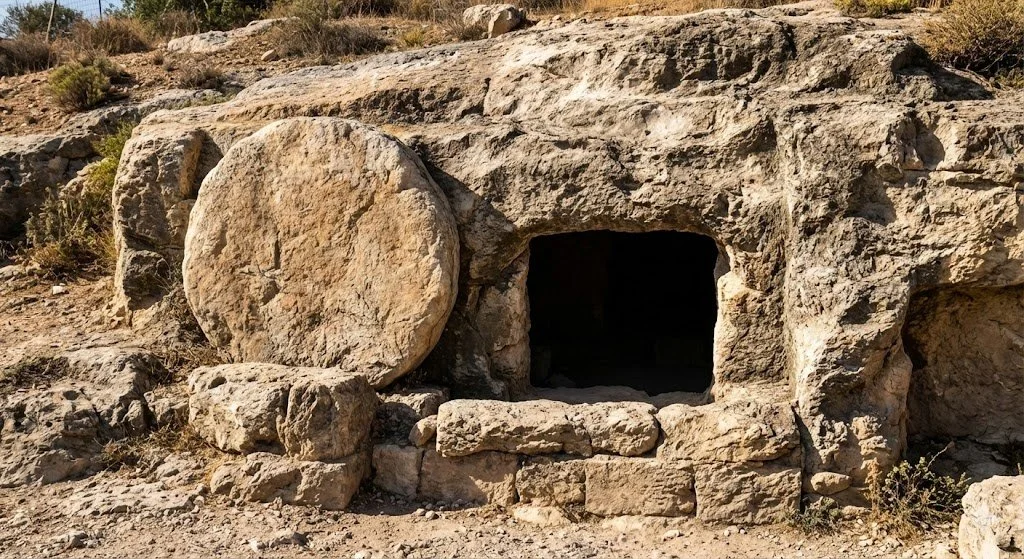
The tomb was found empty.
The disciples had experiences they believed were encounters with the risen Jesus.
The disciples’ belief in the resurrection transformed them and spread rapidly, even amid intense persecution.
We have already established the first point regarding Jesus’ crucifixion and will now examine the remaining elements to demonstrate their credibility as historical facts. Fundamental to the New Testament’s account of Jesus’ resurrection is the discovery of the empty tomb, which serves as a central cornerstone of its narrative. Notably, all four Gospels consistently report that women were the first to discover the empty tomb. This detail is particularly striking given the cultural context of first-century Jewish society, where women’s testimony was often disregarded. The Jewish historian Josephus wrote, "Let not the testimony of women be admitted, on account of the levity and boldness of their sex." The inclusion of women as key witnesses in the Gospel accounts — despite the risk of undermining their credibility within their cultural setting — adds significant weight to the authenticity of the Gospels’ reports.
Before we proceed further, it is important to address alternative theories proposed by some modern scholars to explain the empty tomb. These theories acknowledge the historical evidence for the tomb’s emptiness, but offer various explanations that diverge from the New Testament’s claim of resurrection. Evaluating these alternative hypotheses is crucial to understanding the full scope of the evidence and why the resurrection remains the most compelling explanation.
1. The Stolen Body Theory – One of the most commonly proposed alternative theories is the idea that the disciples—or someone else—stole Jesus’ body to fabricate His resurrection. While this theory attempts to explain the empty tomb, it has significant weaknesses that challenge its plausibility.
First, the tomb was sealed and guarded by Roman soldiers under orders from Pontius Pilate and the Jewish Sanhedrin. Roman military protocol for guarding high-priority locations typically involved a “guard,” or a group of 4 to 16 soldiers, depending on the importance of the task. Given the high-profile nature of this assignment—ensuring that no tampering occurred with the tomb of Jesus, whom some already claimed would rise—the maximum number of guards was likely deployed. Furthermore, Roman guards faced severe consequences, including public execution, for failing in their duties. It is highly improbable that all 16 guards would have simultaneously fallen asleep or allowed anyone to breach the tomb, knowing that failure would cost them their lives in a painful and disgraceful fashion.
Second, the psychological state of the disciples at the time casts significant doubt on this theory. According to Mark 14:50, the disciples were terrified and scattered after Jesus' arrest. In their initial fear and despair, it seems unlikely they would have had the courage or motivation to orchestrate a bold plan to steal the body. Moreover, such an act would have carried immense personal risk, as they would have faced execution if caught. It is difficult to reconcile their initial fear and disarray with the idea that they would suddenly become emboldened enough to take on Roman guards and fabricate a resurrection narrative.
Lastly, this theory fails to account for the disciples’ subsequent behavior. After claiming to witness the resurrected Jesus, these same disciples underwent a dramatic transformation, boldly proclaiming His resurrection even in the face of intense persecution and martyrdom. Would they risk their lives and endure such suffering to propagate a lie? The stolen body theory struggles to provide a coherent explanation for the empty tomb and the disciples' profound change.
2. The Swoon Theory – This theory suggests that Jesus did not actually die on the cross, but merely lost consciousness. While this explanation attempts to account for the empty tomb—proposing that Jesus regained consciousness after being placed there—it faces several significant issues that render it implausible.
First, crucifixion was a method of execution explicitly designed to ensure death through prolonged suffering and physical trauma. Roman soldiers were highly trained in carrying out executions and confirming death. The Gospels record such confirmation in John 19:34, where a soldier pierced Jesus' side with a spear, causing blood and water to flow—a likely indicator of death due to cardiac rupture or pleural effusion. This level of attention to detail undermines the suggestion that Jesus could have survived the cross.
Second, even if one were to hypothesize that Jesus somehow survived the crucifixion, the physical condition resulting from His ordeal would have made escape from the tomb nearly impossible. Jesus had endured severe scourging, significant blood loss, and the trauma of crucifixion. For Him to regain consciousness, remove the burial linens, roll away the massive stone sealing the tomb, evade the Roman guard (comprising 4 to 16 soldiers), and then appear to His disciples in a state that inspired worship and belief in His resurrection as the glorified Messiah stretches any sensible belief.
Finally, the disciples’ testimony and subsequent behavior contradict this theory entirely. The disciples proclaimed a risen and glorified Jesus, not a wounded and barely surviving figure. They preached with unwavering conviction, even under the threat of intense persecution and martyrdom, that Jesus had triumphed over death, not merely survived it. Such profound transformation and unwavering commitment would be inexplicable if their belief was based on encountering a severely injured, mortal man rather than a resurrected, glorified Savior. Therefore, the swoon theory fails to align with both the physical realities of crucifixion and the nature of the disciples’ testimony, rendering it an untenable explanation for the resurrection of Jesus.
3. The Hallucination Theory – The hallucination theory posits that the disciples and others who claimed to see Jesus after His resurrection were experiencing hallucinations brought on by grief, psychological stress, or trauma. While this theory attempts to account for the post-resurrection appearances of Jesus, it fails to address a critical point: the empty tomb.
Moreover, hallucinations are typically individual and subjective experiences, arising from a person's internal emotional or psychological state. It is highly improbable for multiple individuals to share identical hallucinations, especially in varying contexts and groups. Yet, the accounts of Jesus’ post-resurrection appearances include Him appearing to all the disciples together, to individuals like Mary Magdalene and Peter, and even to groups outside the immediate circle of disciples. Notably, 1 Corinthians 15:6 records that Jesus appeared to over 500 people at one time—a collective experience that defies the nature of personal hallucinations.
Additionally, the theory cannot explain Jesus’ appearance to Paul, a former persecutor of Christians, who encountered the risen Christ on the road to Damascus. Paul’s transformation from a staunch opponent of Christianity to one of its most fervent advocates and martyrs is difficult to attribute to a hallucination, especially given his lack of prior emotional attachment to Jesus.
Finally, those who claimed to witness the risen Christ remained steadfast in their testimony, enduring intense persecution and even martyrdom for their belief. It is implausible that such diverse individuals, some of whom had initially doubted or opposed Jesus, would endure suffering and death for what could be dismissed as mere hallucinations. This theory, therefore, fails to adequately explain the evidence surrounding the resurrection of Jesus.
4. The Legend Theory – This theory suggests that the resurrection story is a myth that evolved over time, attempting to explain both the empty tomb and the post-resurrection appearances of Jesus. However, it fails to account for critical evidence, such as the early creeds found in 1 Corinthians 15:3-8, which affirm that belief in Jesus' resurrection was firmly established within a few years of His death. This short timeframe leaves little opportunity for a legend to develop, especially given the proximity of these events to the eyewitnesses themselves.
Additionally, the substantial historical evidence for the empty tomb and the post-resurrection appearances challenges this theory and often contradicts it outright. Myths and legends typically emerge in regions far removed from the locations where the described events supposedly took place. In contrast, the resurrection of Jesus was proclaimed in Jerusalem and its surrounding areas—the very place where He was crucified and buried. If the resurrection were merely a legend, it would have been easily disproven by those familiar with the events, yet no such refutation succeeded, further undermining this theory.
5. The Wrong Tomb Theory – As the name implies, this theory suggests that the women and disciples mistakenly went to the wrong tomb, found it empty, and assumed that Jesus had risen. While this might explain the empty tomb, it fails to address several critical issues. Jewish and Roman authorities, who had a vested interest in disproving the resurrection, could have simply directed people to the correct tomb, instantly refuting the disciples' claims.
Additionally, this theory does not account for the numerous post-resurrection appearances of Jesus, as described in the Gospels and early Christian writings. Nor does it explain why the disciples were willing to face intense persecution and even martyrdom for their unwavering belief in the resurrection—an extraordinary commitment unlikely to stem from a simple mistake.
6. The Conspiracy Theory – This theory suggests that the resurrection was a hoax deliberately fabricated by Jesus’ followers. While it offers a straightforward explanation for the resurrection narrative, it fails to address several key issues. First, it does not adequately explain the empty tomb or the numerous post-resurrection appearances of Jesus reported by multiple individuals and groups, including skeptics like Paul. Second, it overlooks the extraordinary commitment of the disciples, who were willing to face persecution and even execution for their unwavering belief in the resurrection. For this theory to hold, all the disciples would have needed to maintain a coordinated and lifelong deception under relentless pressure, an implausible scenario given the circumstances.
Over the decades, numerous alternative theories have been suggested to explain Jesus' resurrection. However, like those previously discussed, each encounters significant flaws and is easily refuted. The simple truth is that, no matter how improbable it may seem to some, the historical evidence overwhelmingly points to the resurrection of Jesus as the only plausible explanation. No other theory comes close to accounting for all the historical facts. As Sherlock Holmes famously stated in The Sign of the Four: "When you have eliminated the impossible, whatever remains, however improbable, must be the truth."
Now, turning to the post-resurrection appearances of Jesus, we find extensive documentation in both biblical and extra-biblical sources. Paul’s letters, especially 1 Corinthians 15:3–8, offer a detailed account of multiple eyewitnesses to the risen Christ, including Peter, James, and a group of over 500 individuals. Notably, many of these witnesses were still alive when Paul penned these words, effectively inviting his contemporaries to verify the claims.
Furthermore, the early creeds of the Church, such as the one recorded in 1 Corinthians 15, were formulated within just a few years of Jesus’ death. These creeds emphasized the resurrection as the cornerstone of Christian faith, reflecting its foundational importance to the early believers. When combined with the writings of the early Church and the unwavering testimony of the apostles, these accounts form a consistent and compelling narrative. Despite centuries of scrutiny, this narrative has withstood critical examination, underscoring the enduring significance and reliability of the resurrection testimony.
Even skeptical scholars acknowledge the significance of these testimonies. German scholar Gerd Lüdemann, for instance, concedes, “It may be taken as historically certain that Peter and the disciples had experiences after Jesus’ death in which Jesus appeared to them as the risen Christ.” This widespread and unified testimony resists dismissal as legend or hallucination, especially given its early dissemination and the transformative impact it had on those who bore witness.
Third, the transformation of the apostles and the rapid expansion of Christianity are compelling evidence for the resurrection. Before Jesus’ death, the Gospels portray His disciples as fearful, doubtful, and uncertain. Yet, after the resurrection, these same individuals boldly proclaimed Jesus' triumph over death, even at the risk of their lives. Their remarkable shift from fear to unwavering courage demands explanation.
Chuck Colson, reflecting on his experience during the Watergate scandal, offered a profound insight: "I know the resurrection is a fact, and Watergate proved it to me. How? Because 12 men testified, they had seen Jesus raised from the dead, then proclaimed that truth for 40 years, never once denying it. They would not have endured that if it weren't true." The apostles faced intense persecution, torture, and martyrdom, yet they remained steadfast in their testimony. Such resolve strongly suggests they genuinely believed in the resurrection, making it unlikely to be a fabricated story or a delusion. Their conviction transformed the course of history, fueling the rapid spread of Christianity in the face of adversity.
Table of Contents
Textual Criticism of the Bible (Part 1)
The Evidence of Jesus Christ Outside the Bible (Part 2)
The Evidence of Jesus Christ Through the Darkening of the Sun (Part 3)
When was the First New Testament Book Written and by whom? (Part 4)
The Historical Reliability of the New Testament and Gospels (Part 5)
Proving the Accuracy of the Bible Through Prophecy (Part 6)
Proof of the Bible Through the Crucifixtion and Ressurection (Part 7)
A New Beginning - What does this Mean for Us? (Part 8)
Sources
Dr. Simon Gathercole (2018). The Gospel and the Gospels.
The New Testament Gospels (A.D. 70-100).
Blue Letter BibleByron R. McCane (2003). Roll Back the Stone: Death and Burial in the World of Jesus.
John Dominic Crossan (1994). Jesus: A Revolutionary Biography.
HarperCollinsBart D. Ehrman (2000). The New Testament: A Historical Introduction to the Early Christian Writings.
Ancient Roman Historian: Publius Cornelius Tacitus (early 2nd century). Annals 15.44.
Project Gutenberg (Scroll to Book XV)Pliny the Younger (A.D. 112). Epistles 10.96-97.
Internet Ancient History SourcebookLucian of Samasata (A.D. 2nd century). The Passing of Peregrinus.
The Tertullian ProjectJosephus (c. A.D. 93–94). Antiquities of the Jews 18.3.3, 20.9.1.
Perseus Digital LibraryMajority Scholar Consensus (Various Works). Representative Scholarly Treatments: N.T. Wright, The Resurrection of the Son of God
(Fortress Press, 2003); Gary Habermas & Michael Licona, The Case for the Resurrection of Jesus (Kregel, 2004)Gerd Lüdemann (1995). What Really Happened to Jesus? A Historical Approach to the Resurrection.

PROVING THE ACCURACY AND RELIABILITY OF THE BIBLE THROUGH PROPHECY (PART 6)
What are the odds of one man fulfilling 332 specific prophecies written centuries before His birth? Explore the staggering mathematics of Messianic prophecy. From the "Texas Silver Dollar" analogy to the incomprehensible 1 in $10^{157}$ probability, discover why the life of Jesus Christ is the ultimate proof of the Bible's divine authorship.
What to Know
Prophecy distinguishes the Bible as inspired by God: The Bible itself states that prophecy is a sign from God (Isaiah 46:9-10), setting it apart from other religious texts. Unlike vague predictions, biblical prophecies are precise, detailed, and historically verifiable.
Hundreds of Messianic prophecies were fulfilled in Jesus: The Old Testament contains over 300 prophecies about the Messiah, including His birth in Bethlehem (Micah 5:2), His crucifixion (Psalm 22), and the exact timeline of His arrival (Daniel 9). The Dead Sea Scrolls confirm these were written centuries before Jesus, ruling out later manipulation.
The mathematical impossibility of fulfillment by chance: Professor Peter Stoner calculated the probability of one person fulfilling just eight major prophecies as 1 in 10¹⁷— comparable to covering Texas in silver dollars two feet deep, marking one, and having a blindfolded person pick it at random. For 48 prophecies, the odds are 1 in 10¹⁵⁷, a number beyond comprehension.
Many prophecies defied human expectations: Messianic prophecies foretold a suffering servant (Isaiah 53), contradicting Jewish expectations of a conquering ruler. Events beyond human control — such as being betrayed for 30 pieces of silver (Zechariah 11:12) and having His executioners gamble for His clothing (Psalm 22:18) — further prove divine authorship.
Prophecy validates the Bible’s authority and Jesus’ identity: The fulfillment of these prophecies with such precision leaves no room for coincidence. This evidence demands a response—either Jesus is who He claimed to be, or the statistical impossibility of prophecy fulfillment must be ignored.

Another essential point to highlight, in that it underscores the accuracy of the Bible and sets it apart from other religious texts, is biblical prophecy. Biblical prophecy is crucial because it points to the divine authorship of the Scriptures, reinforcing the trustworthiness of the Bible's message due to the extremely low probability of these predictions being fulfilled by chance. The Bible itself speaks to this point that prophecy is a sign from God and shows that the Bible is divinely inspired. God speaks through the prophet Isaiah, "Remember the former things of old, for I am God, and there is no other; I am God, and there is none like Me, declaring the end from the beginning, and from ancient times things that are not yet done… (Isaiah 46:9-10 NKJV)"
God challenges us to test Him by making predictions about the future that will come to pass. Approximately one-third of the Bible consists of prophecies, many of which concern the promised Messiah and foretell details about His identity and actions. By one count, there are 332 Messianic prophecies in the Hebrew Bible (Old Testament) that Jesus fulfilled. This is why the Dead Sea Scrolls are so significant: they date back to 100 years before Jesus' birth, confirming that the prophecies Jesus fulfilled were written before His birth and were not added or altered later.
While anyone can make predictions, having them come true is an entirely different matter. In fact, the more detailed and numerous the predictions, the less likely they are to be fulfilled precisely. For instance, consider the improbability of someone today predicting the exact city where a future leader would be born in the 22nd century. Yet, this is precisely what the prophet Micah did, foretelling the Messiah's birth in Bethlehem 700 years in advance. Similarly, what are the chances of predicting the manner of death for a new, unknown religious leader a thousand years from now, especially when that method of execution is currently unknown and won't be practiced for centuries? This is precisely what David did in 1,000 B.C. Furthermore, the prophet Daniel predicted the exact time of the Messiah's arrival, approximately 530 years before His eventual arrival.
Imagine making 50 specific prophecies about a person you will never meet. What are the odds that this person will fulfill all 50 predictions? The likelihood diminishes significantly if 25 of these prophecies concern actions taken by others beyond the person's control. For example, how could someone "arrange" to be born into a specific family or in a specific city where their parents don't live? How could one orchestrate their own death by crucifixion, alongside two others, and have the executioners gamble for their clothing, as described in John 16:19 and Psalms 22:18? How could someone "arrange" to be betrayed, to avoid having their legs broken during execution, and to escape from a grave after being killed? It might be conceivable for someone to fake one or two Messianic prophecies, but for any one person to fulfill all these prophecies is impossible without divine intervention.
The science of probability attempts to determine the likelihood of a given event occurring. A professor at Westmont College, Peter W. Stoner, calculated the probability of one man fulfilling the major prophecies concerning the Messiah. These estimates were derived by twelve different classes, totaling about 600 university students. The students meticulously considered each prophecy, the circumstances, and any possibility that men could conspire to fulfill these prophecies. Their estimates were conservative, and even the most skeptical students unanimously agreed. The professor then made these estimates even more conservative and encouraged other skeptics or scientists to review them. Finally, he submitted his findings to a committee of the American Scientific Affiliation. H. Harold Hartzler, PhD, of the American Scientific Affiliation, Goshen College, wrote in the forward of Stoner’s book:
“The manuscript for Science Speaks has been carefully reviewed by a committee of the American Scientific Affiliation members and by the Executive Council of the same group and has been found, in general, to be dependable and accurate in regards to the scientific material presented. The mathematical analysis included is based upon principles of probability which are thoroughly sound and Professor Stoner has applied these principles in a proper and convincing way.”
For example, in Micah 5:2, where it's stated that the Messiah would be born in Bethlehem, the professor and his students calculated the average population of Bethlehem from Micah's time to the present and compared it to the average world population during the same period. They concluded that the chance of one man being born in Bethlehem was 1 in 300,000. After examining just eight different prophecies, they conservatively estimated the probability of one man fulfilling all eight as 1 in 10^17. To illustrate the magnitude of this number, Professor Stoner used this analogy: If you mark one of ten tickets, place them all in a hat, and ask a blindfolded person to pick one, the chance of choosing the correct ticket is 1 in 10. Now, imagine covering the state of Texas with 10^17 silver dollars, two feet deep. Now mark one of these silver dollars and stir the whole mass. Finally, blindfold a man and tell him he can travel as far as he wishes, but he must pick up the one marked silver dollar. The odds of him finding the correct one are the same as those of the prophets writing these eight prophecies and having them all fulfilled in one person.
In financial terms, would anyone hesitate to invest in a venture with only a 1 in 10^17 chance of failure? Of course not.
However, this is the kind of certainty offered by God through faith in His Messiah. Based on these calculations, the professor concluded that the fulfillment of these eight prophecies alone demonstrates divine inspiration in writing the prophecies, as the likelihood of mere chance is only 1 in 10^17. Dismissing or ignoring the significance of these biblical signs concerning the Messiah would be foolish.
Moreover, there are far more than just eight prophecies (as previously mentioned, some calculations have the total number of prophecies in the Old Testament at 332). In another calculation, Professor Stoner considered 48 prophecies and arrived at the highly conservative estimate that the probability of one person fulfilling all 48 prophecies is 1 in 10^157 — a number so large it's incomprehensible. To find a comparable illustration, we would need to look at the vastness of the universe. Astronomers estimate that the universe contains up to one septillion stars – that’s a one followed by 24 zeroes. This is the total number of stars in the entire observable universe, and the probability of all the Messianic prophecies happening by chance is still orders of magnitude greater (another 125 zeroes added!).
If you're skeptical about the number of prophecies concerning the Messiah in the Old Testament, you can review the 48 prophecies here that Professor Stoner and his students used to calculate the odds of these all occurring along with their fulfillment through Jesus Christ.
Many of these prophecies were contrary to Jewish expectations at the time, making their writing even more remarkable. For instance, the sacrificial system and sin offerings were deeply ingrained in Jewish culture throughout the Old Testament. Even in the New Testament, we see how highly the Jewish people regarded the sacrificial system and their understanding of sin. Yet, centuries earlier, prophecies foretold that sin would ultimately be cleansed and forgiven by a person — the Messiah. The New Testament reveals that this Messiah was Jesus Christ, though such a concept would have been almost offensive to people when the prophecies were written.
Table of Contents
Textual Criticism of the Bible (Part 1)
The Evidence of Jesus Christ Outside the Bible (Part 2)
The Evidence of Jesus Christ Through the Darkening of the Sun (Part 3)
When was the First New Testament Book Written and by whom? (Part 4)
The Historical Reliability of the New Testament and Gospels (Part 5)
Proving the Accuracy of the Bible Through Prophecy (Part 6)
Proof of the Bible Through the Crucifixtion and Ressurection (Part 7)
A New Beginning - What does this Mean for Us? (Part 8)
Sources
1) Peter W. Stoner (1958). Science Speaks: An Evaluation of Certain Christian Evidences. This book discusses the probability of prophecies being fulfilled in Christ.
2) Micah 5:2 - A prophecy predicting the Messiah’s birth in Bethlehem.
3) Psalms 22:16-18 - A description of the Messiah’s crucifixion and the gambling for his clothing.
4) Daniel 9:24-26 - A prophecy about the timing of the Messiah's arrival.
5) John 19:33-36 - Reference to the crucifixion and the fact that Jesus' legs were not broken, fulfilling prophecy.
6) American Scientific Affiliation - This organization reviewed and validated the probability calculations made by Stoner.
7) List of prophecies and their fulfillment compiled and edited by James George for New Disciples Class
https://www.linkedin.com/pulse/advent-statistical-probability-jesus-fulfilling-messianic-george/
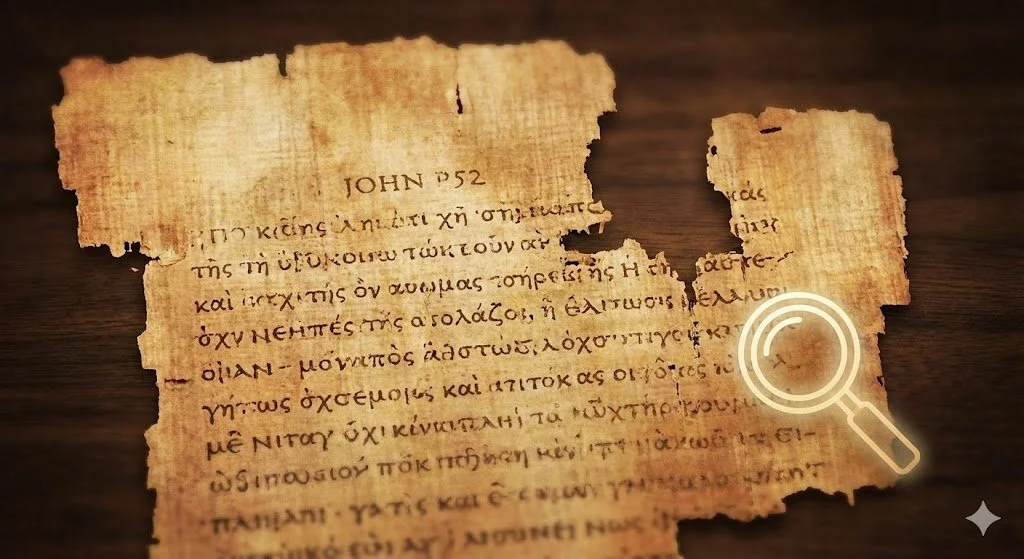
TEXTURAL CRITICISM OF THE BIBLE (PART 1)
How do we know the Bible we read today is what was actually written? Explore the staggering manuscript evidence that makes the Bible the most historically reliable document of the ancient world.
What to Know
This article emphasizes that before exploring the deeper teachings of the Bible and Jesus Christ’s identity, one must first establish the Bible’s historical reliability.
Textual criticism is key: scholars reconstruct original New Testament writings by comparing thousands of existing handwritten copies—far more than what exists for most other ancient works.
The New Testament boasts about 5,800 Greek manuscripts (some within 200 years of the events), which is unparalleled in ancient literature. The Old Testament also has extensive manuscript support, highlighted by the Dead Sea Scrolls, which pushed textual evidence back nearly 2,000 years.
Given the Bible’s vast and early manuscript evidence, questioning its reliability would mean questioning the reliability of all other ancient historical documents as well as historical figures like Alexander the Great.
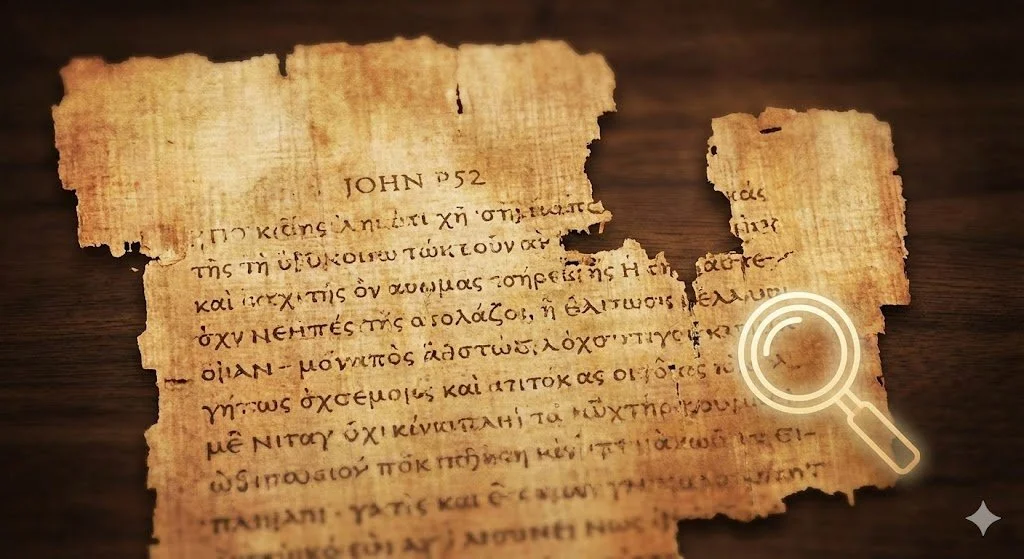
Before exploring the Bible's true teachings and scriptural truths — often obscured by tradition and diluted interpretations — we must first establish its authenticity, historical accuracy, and the truth of Jesus Christ as the Son of God.
We will begin on this journey by first examining the New Testament, specifically through textual criticism, rather than focusing on the specific writings. The New Testament was originally written in Koine Greek, the common language of the time. Today, we don't have the original manuscripts, known as autographs, of the New Testament books. Instead, we rely on handwritten copies and copies of those copies. Textual criticism is the scholarly practice of reconstructing the original text by comparing these various copies.
It's important to note that textual criticism isn't limited to the New Testament or to only biblical books. It's applied to nearly all classical works because no originals exist for any Greek or Latin classic, including the Bible. This is mainly because ancient people wrote on papyrus, a highly perishable material that can only survive in dry, airy climates. It's actually remarkable we have any surviving papyrus fragments today, considering how easily they degrade.
In 1900, only about nine known papyrus fragments contained parts of the New Testament had been discovered. Today, that number has grown to approximately 115. Among these, 45 papyrus fragments date back to before 300 AD. Collectively, these 45 manuscripts represent about two-thirds of the New Testament, dating to within 200 years of the eyewitness accounts of Jesus. In the context of ancient writings, this is incredibly close to the actual events. In fact, no other ancient document has such early and abundant manuscript evidence.
Beyond these 115 significant and larger manuscripts, there are approximately another 5,800 Greek manuscripts, 10,000 Latin manuscripts, and 9,300 manuscripts in other languages. Some scholars estimate that the number of textual references could exceed one million if we include citations from early church fathers who quoted Scripture in sermons and writings. These numbers are extraordinarily high for ancient texts, underscoring the New Testament's unique position in historical documentation.
The difference is stark when we compare the 5,800 Greek New Testament manuscripts to other classical works. Consider critical editions of works like The Iliad, Caesar's Gallic War, and Beowulf — these are classic texts widely taught in schools, and their authenticity is rarely questioned. However, the number of manuscripts that survive these works is nowhere near the New Testament. The Iliad, for example, has about 650 copies, which is sufficient to produce critical editions but pales in comparison to the New Testament. The earliest complete edition of The Iliad dates from the 10th century A.D., even though the text was written around the 8th century BC. In contrast, we have complete editions of the New Testament from the 4th century A.D., with large fragments dating back to before 300 A.D.—much closer to the events described.
To illustrate this point further, scholars have dated a small fragment containing portions of John, known as fragment P90, to the early 2nd century A.D. Another fragment, known as fragment P104, contains Scripture from Matthew and is dated to the late 1st century A.D. These fragments are incredibly close in time to the events they record, enhancing their reliability.
As briefly explained before with The Iliad, the New Testament's manuscript evidence far surpasses that of any other ancient document. For instance, we have about a dozen copies of Caesar's Gallic War, the earliest dating nearly a thousand years after the events it describes. Tacitus's Histories and Annals are preserved in three manuscripts, and Beowulf survives in only one. The New Testament, by contrast, was widely distributed across the Roman Empire and into North Africa. It was translated into multiple languages, and manuscripts of these translations have been found in numbers that far exceed those of any other ancient document.
While this discussion has focused on the New Testament, similar observations can be made about the Old Testament. Although pinpointing the exact number of Old Testament manuscripts is challenging due to its age, size, and the fact that it was written over a thousand years, estimates suggest there are around 2,000 fragments of Old Testament scripture. Considering the age of these texts, this is truly remarkable.
Some of the oldest complete Old Testament manuscripts include the Aleppo Codex, dating back to 920 A.D., and the Leningrad Codex, dating to 1008 A.D. Both were discovered before the Dead Sea Scrolls, which dates from the 1st to 3rd century B.C. The discovery of the Dead Sea Scrolls pushed back the date of the oldest Old Testament manuscripts by nearly 2,000 years.
When considering both the New and Old Testaments, no other ancient document comes close to this level of manuscript evidence. Despite this, many people still question the accuracy of the Bible and the events it describes. However, if one doubts the reliability of the Bible, they would also have to call in question the reliability of all other ancient historical documents as well.
Table of Contents
Textual Criticism of the Bible (Part 1)
The Evidence of Jesus Christ Outside the Bible (Part 2)
The Evidence of Jesus Christ Through the Darkening of the Sun (Part 3)
When was the First New Testament Book Written and by whom? (Part 4)
The Historical Reliability of the New Testament and Gospels (Part 5)
Proving the Accuracy of the Bible Through Prophecy (Part 6)
Proof of the Bible Through the Crucifixtion and Ressurection (Part 7)
A New Beginning - What does this Mean for Us? (Part 8)
Sources
1. Metzger, Bruce M., and Bart D. Ehrman. The Text of the New Testament: Its Transmission, Corruption, and Restoration. Oxford University Press, 2005.
2. Comfort, Philip Wesley, and David P. Barrett. The Text of the Earliest New Testament Greek Manuscripts. Tyndale House Publishers, 2001.
3. Geisler, Norman L., and William E. Nix. A General Introduction to the Bible. Moody Publishers, 1986.
4. Wallace, Daniel B. "The Reliability of the New Testament Manuscripts." Bible.org, 2012.
5. Kenyon, Frederic G. Our Bible and the Ancient Manuscripts. Eyre & Spottiswoode, 1895.
6. Greenlee, J. Harold. Introduction to New Testament Textual Criticism. Hendrickson Publishers, 1995.

THE EVIDENCE OF JESUS OUTSIDE THE BIBLE (PART 2)
What did the enemies of the early Church say about Jesus? Explore the "hostile witnesses" of history—from Roman governors to Greek satirists—who confirmed the life, crucifixion, and worship of Jesus Christ long before the New Testament was finalized.
What to Know
Several early non-Christian writers—Josephus, Tacitus, Mara bar Serapion, Pliny the Younger, Lucian—reference Jesus, despite generally hostile views of Christianity, lending credibility to the Gospel accounts.
These sources support three main points: Jesus lived when the Gospels say He did, was executed by crucifixion under Pontius Pilate, and was worshipped as divine by His followers.
Josephus, a Jewish historian, mentioned Jesus within 60 years of His death; Tacitus, a Roman historian, describes His execution during the reign of Emperor Tiberius.
Pliny the Younger details early Christians’ worship practices, explicitly noting they sang hymns to Christ “as to a god,” reinforcing the idea that Jesus was viewed as divine soon after His crucifixion.

Now, let's explore another way to demonstrate the historical reliability of the Bible by examining references to Jesus Christ in early non-Christian sources. These references are particularly significant because they come from writers who were generally hostile to Christianity, making their accounts all the more noteworthy. We'll focus on establishing three main points through these sources:
1) Jesus Christ was a real person who lived during the time described in the Gospels and had a public ministry.
2) He was condemned to death by crucifixion under the authority of Pontius Pilate.
3) Jesus was worshipped as a God by His followers after His crucifixion.
We'll review references to Jesus from various sources such as Josephus, Thallus, Suetonius, Tacitus, Pliny the Younger, Mara bar Serapion, Lucian, and certain Talmudic texts (in this post and future posts on the topic). These accounts will confirm to you key elements of the synoptic Gospels, including Jesus' birth out of wedlock through the power of God’s Holy Spirit, His connection with John the Baptist, the existence of His brother James, His gathering of disciples, His disagreements with Jewish leaders over the interpretation of the law, His performance of miraculous feats, His crucifixion by Pilate, and the belief among His followers that He was the Messiah who was resurrected after death.
First, in this post, we will use non-Christian sources, to establish that Jesus Christ lived during the time the Bible claims. The first mention of Jesus comes from the Jewish historian Flavius Josephus, who lived from around 37 to 100 A.D. In his work Jewish Antiquities, written in 93 A.D., Josephus refers to Jesus within 60 years of his death.
The Roman historian Tacitus, who lived from 56 to 120 A.D., also mentioned Jesus in his book Annals. He wrote,
"The Christians, you know, worship a man to this day – the distinguished personage who introduced their novel rites and was crucified on that account."
He later adds, "Nero fastened the guilt and inflicted the most exquisite tortures on a class hated for their abominations, called 'Christians' by the populace. Christus [Christ], from whom the name originated, suffered the extreme penalty during the reign of Tiberius at the hands of one of our procurators, Pontius Pilate."
Although Tacitus was not sympathetic to Christians, he provided clear evidence of their existence and worship of Christ, including his crucifixion under Tiberius at the hands of Pontius Pilate, exactly as the Bible portrays.
Mara bar Serapion, a Stoic philosopher writing around 73 A.D., referred to Jesus in a letter to his son, saying,
"On the eve of the Passover, Yeshua was hanged," using a synonym for crucifixion.
Pliny the Younger, a governor in Asia Minor, wrote to Emperor Trajan around 112 A.D., describing how Christians worshipped Jesus as a God:
"They [Christians] were in the habit of meeting on a certain fixed day before it was light, when they sang in alternate verses a hymn to Christ, as to a god, and bound themselves by a solemn oath, not to any wicked deeds, but never to commit any fraud, theft or adultery, never to falsify their word, nor deny a trust when they should be called upon to deliver it up."
Lucian of Samosata, a Greek satirist who lived from 120 to 195 A.D., mentioned Jesus in his work Death of Peregrine, stating,
"Or what advantage came to the Jews by the murder of their Wise King, seeing that from that very time their kingdom was driven away from them?"
These non-Biblical references, along with others, align closely with what we know about Jesus from the New Testament, providing strong evidence that Jesus was a real historical figure. The fact that so many different sources mention Him is remarkable, especially given the relative scarcity of such records from that time, and these sources’ general hostility toward Christianity.
Table of Contents
Textual Criticism of the Bible (Part 1)
The Evidence of Jesus Christ Outside the Bible (Part 2)
The Evidence of Jesus Christ Through the Darkening of the Sun (Part 3)
When was the First New Testament Book Written and by whom? (Part 4)
The Historical Reliability of the New Testament and Gospels (Part 5)
Proving the Accuracy of the Bible Through Prophecy (Part 6)
Proof of the Bible Through the Crucifixtion and Ressurection (Part 7)
A New Beginning - What does this Mean for Us? (Part 8)
Sources
Flavius Josephus: "Jewish Antiquities," Book 18, Chapter 3, Section 3.
Tacitus: "Annals," Book 15, Chapter 44.Mara bar Serapion: Letter to his son, dated around 73 AD.
Pliny the Younger: "Letters," Book 10, Letter 96.
Lucian of Samosata: "Death of Peregrine," Chapter 11.

THE EVIDENCE OF JESUS OUTSIDE THROUGH THE DARKENING OF THE SUN (PART 3)
History and science agree: the darkness at the crucifixion was no ordinary eclipse. Discover the ancient Roman archives and non-Biblical historians that corroborate the supernatural "portent" recorded in the Gospels.
What to Know
Multiple Outside Accounts: Rufinus, Phlegon of Tralles, and Tertullian—all non-biblical writers—corroborate the biblical narrative of a sudden darkness immediately following Jesus’ crucifixion, underscoring its historicity.
Significance of Darkness: For the ancient Jewish audience, darkness often symbolized God’s judgment (e.g., Genesis 1:2, Exodus 10:22). This alignment with Jewish tradition amplifies the event’s importance, especially surrounding Jesus’ controversial death.
Roman Archive References: Tertullian mentions that Roman records documented this phenomenon. Although those archives were likely destroyed in the Roman sacking of Jerusalem (70 A.D.), his testimony shows the official recognition of the crucifixion’s extraordinary circumstances.
Not a Natural Eclipse: Phlegon describes an eclipse during a full moon—impossible for a standard solar eclipse—while Tertullian highlights the same timing, reaffirming the supernatural nature of the darkness and cementing its consistency with the biblical accounts.

Let's now look at a particularly remarkable and supernatural event recorded in the Gospels immediately after Jesus' death. While we'll reference the Bible to highlight this event, our primary aim is to examine it from a historical perspective through non-Biblical sources and accounts. We'll compare the biblical account to other non-biblical sources to demonstrate that this event wasn't only recorded in the Scriptures — others witnessed and documented it as well making it indisputable, historical fact.
We'll examine the darkness that covered the land right after Jesus Christ died. This event, occurring immediately after the death of someone as controversial as Jesus, is highly significant. For ancient peoples, notably the Jews, darkness often symbolized divine judgment on the Earth. This is seen in biblical examples such as Genesis 1:2, where the Earth was formless and dark, and Exodus 10:22, where darkness served as a judgment against the Egyptians. These examples underscore that the concept of darkness as a sign of judgment was well-established and would have been especially meaningful to the people of that time, especially the Jews. Historical records show that this event did not go unnoticed; it was recorded exactly as it happened.
The Greek historian Rufinus notes:
"Search your writings, and you shall find that in Pilate's time, when Christ suffered, the sun was suddenly withdrawn and darkness followed."
This account corresponds precisely with what is written in Matthew 27:45-46:
"Now from the sixth hour (Noon) until the ninth hour (3 p.m.), there was darkness over all the land. And about the ninth hour, Jesus cried out with a loud voice, saying, 'Eli, Eli, lama sabachthani?' that is, 'My God, My God, why have You forsaken Me?'"
Phlegon of Tralles, a historian from the reign of Tiberius Caesar, provides a second-century record describing a solar eclipse during the time of the full moon, "from the sixth to the ninth hour," just as the Gospels record. He states:
"This eclipse was visible from Jerusalem at moonrise… first visible from Jerusalem at about 6:20 p.m. (the start of the Jewish Sabbath and also the start of Passover day in 33 AD) with about 20% of its disc in the umbra of the earth's shadow… the eclipse finished thirty minutes later, at 6:50 p.m."
Quintus Septimius Florens Tertullian, in his work Apologeticus, comments that many witnesses of Jesus's crucifixion were unaware of the prophecies in Amos and Isaiah predicting darkness and thus believed the darkness was an eclipse. Tertullian wrote that evidence of this event was still available in the Roman archives. This claim is particularly significant, suggesting that records of Jesus's life, death, and resurrection were documented in Rome as early as the first century. These documents would have most likely been destroyed when Rome burned Jerusalem to the ground during the Jewish revolt in 70 A.D. However, before that occurred we have historical proof from Tertullian that such documents existed and were being stored there.
In another writing, Tertullian describes the darkness surrounding the crucifixion as occurring precisely when Jesus was on the cross. He writes:
"In the same hour (as the crucifixion), too, the light of day was withdrawn, when the sun at that very time was in his meridian blaze. Those unaware that this had been prophesied about Christ no doubt thought it an eclipse. You yourselves have an account of the world portent still in your archives."
Tertullian's acknowledgment that this event could not have been an eclipse is crucial, especially in light of the record from Julius Africanus, who stated that a solar eclipse could not have caused the darkness. The Passover Feast is always observed on the 14th day of Nisan, during a full moon. An eclipse can only occur when the moon is new and under the sun, making it scientifically impossible for a total solar eclipse to coincide with a full moon. This crucial detail as acknowledged by Tertullian and Julius Africanus through the historical record, shows that this darkness following Jesus Christ’s crucifixion was truly remarkable and miraculous. Despite the widespread persecution and hostility toward Christianity during this time period, the accounts of these non-biblical sources align perfectly with that of the Bible and synoptic Gospels.
Table of Contents
Textual Criticism of the Bible (Part 1)
The Evidence of Jesus Christ Outside the Bible (Part 2)
The Evidence of Jesus Christ Through the Darkening of the Sun (Part 3)
When was the First New Testament Book Written and by whom? (Part 4)
The Historical Reliability of the New Testament and Gospels (Part 5)
Proving the Accuracy of the Bible Through Prophecy (Part 6)
Proof of the Bible Through the Crucifixtion and Ressurection (Part 7)
A New Beginning - What does this Mean for Us? (Part 8)
Sources
Rufinus of Aquileia: Rufinus's Ecclesiastical History contains references to events surrounding early Christian history, including the supernatural events reported at the time of Jesus’s crucifixion. His work is particularly noted for continuing Eusebius's Historia Ecclesiastica, and it's a valuable source for understanding how early Christians perceived these events(Tertullian) (Wikipedia).
Phlegon of Tralles: Phlegon, a historian during the reign of Tiberius Caesar, is known for his Chronicles, where he mentions unusual astronomical phenomena, including the darkness during the crucifixion. This account is often cited in discussions about non-Christian references to events described in the Gospels (Princeton University Library Catalog).
Tertullian: Tertullian, in his Apologeticus and other writings, discusses the darkness at the crucifixion and asserts that records of this event were kept in Roman archives. His works are among the earliest to argue for the historicity of Jesus's life and the supernatural events surrounding His death from a non-biblical perspective (academic.oup).
Julius Africanus: Julius Africanus, in his Chronographiae, critiques the idea that the darkness was caused by a solar eclipse, noting the impossibility of such an event during a full moon, which is when Passover is observed. This argument is crucial for establishing the event's supernatural nature rather than a natural phenomenon (Princeton University Library Catalog).
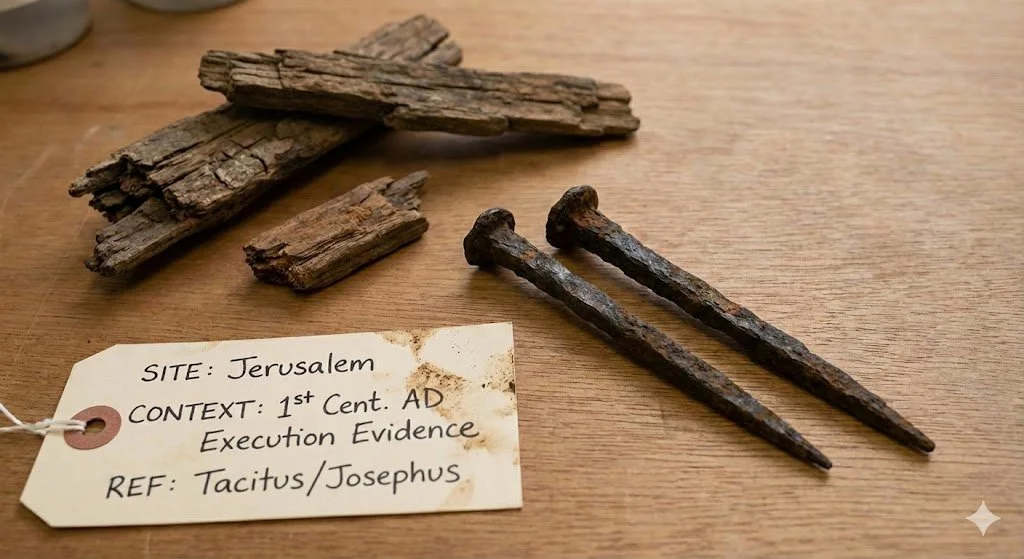
THE HISTORICAL RELIABILITY OF THE NEW TESTAMENT AND GOSPELS (PART 5)
Why would a people waiting for a conquering King invent a story about a crucified criminal? Discover why the "improbability" of a dying Messiah is one of the strongest proofs that the New Testament accounts are true. It’s a message that defied every Jewish expectation of the time.
What to Know
Jewish Expectations of the Messiah: The Jewish people anticipated a triumphant, eternal ruler as their Messiah. Scriptures such as 2 Samuel 7:12-13 and Daniel 7:14 describe a reigning, everlasting king, making the idea of a suffering, dying Messiah unthinkable at that time. Even the disciples initially struggled to reconcile this concept, as seen in Peter’s reaction in Matthew 16:22 and the crowd’s confusion in John 12:33-34.
The Paradox of the Crucifixion: Crucifixion was a symbol of being cursed by God, according to Deuteronomy 21:23, and was reserved for criminals. Despite this, Jesus’s death on the cross became the centerpiece of the gospel message, as Paul explains in Galatians 3:13-14. The unlikely nature of this event underlines the sincerity of the disciples’ proclamation—they believed it truly happened.
Abandonment and Unlikely Burial: All of Jesus’s disciples fled during His arrest and crucifixion (Matthew 26:35; Mark 14:50). His body was buried not by His followers, but by Joseph of Arimathea and Nicodemus — members of the Sanhedrin, the council that condemned Him. This unexpected detail strengthens the credibility of the accounts, as these prominent figures would have publicly refuted a fabricated story.
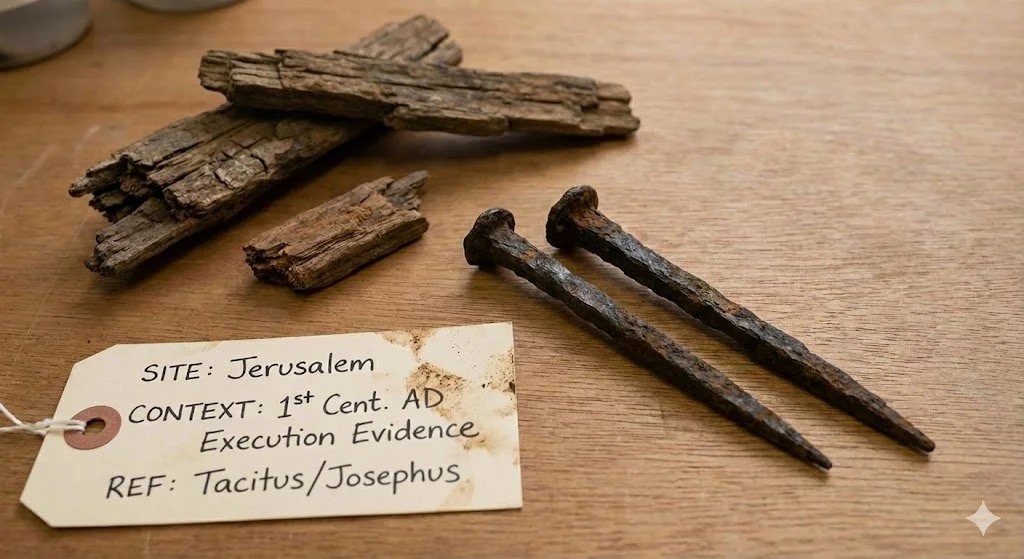
In this post, we will reference Biblical passages to highlight why it is remarkable that the disciples and other Jews of Jesus's time responded as they did. These individuals were deeply familiar with the Scriptures and well-versed in its teachings. Therefore, understanding what the Bible says on this matter is essential, as it underscores how improbable it would have been for someone of Jewish heritage to fabricate these events, given their significant implications.
A Suffering and Dying Deliverer: The idea of a suffering and dying Messiah, especially one mocked by the religious leaders of the time, would have been unthinkable to Jews of that era. The Jewish people anticipated a Messiah who would reign eternally, as seen in passages like 2 Samuel 7:12-13: "I will establish the throne of His kingdom forever." Likewise, in Daniel 7:14, the "Son of Man" — a title Jesus frequently used for Himself — is described as being given "dominion and glory and a kingdom, that all peoples, nations, and languages should serve Him. His dominion is an everlasting dominion, which shall not pass away, and His kingdom shall not be destroyed." The Jewish people, including Jesus's followers, expected a triumphant Messiah, not one who would die, particularly in a public and humiliating manner. This is evident in Peter's reaction before Jesus's crucifixion: "Peter took Him aside and began to rebuke Him, saying, 'God forbid it, Lord! This shall never happen to you! (Matthew 16:22)'" Similarly, the crowd's confusion is recorded in John 12:33-34: "We have heard from the Law that the Christ is to remain forever; and how is it that You say, 'The Son of Man must be lifted up'?"
While the Old Testament, notably in Isaiah 53, did foretell the Messiah's death, it is clear from these passages that the Jews of Jesus's time struggled to reconcile these prophecies with their expectations. They did not grasp that these promises would be fulfilled in stages. Given this context, why would Jesus predict His own humiliating death at the hands of Jewish leaders? Why would His disciples continue to proclaim this message after His death, even to the point of enduring their own excruciating deaths? The most plausible answer is that they believed it to be true.
2. The Nature of Jesus's Death: The crucifixion of Jesus Christ adds another layer of improbability to the idea that this story was fabricated. Dying on a cross was a symbol of being cursed by God and was reserved by the Romans for criminals. Deuteronomy 21:23 states, "...for he who is hanged is accursed of God." Paul echoes this in Galatians 3:13, acknowledging how contradictory it might seem for the Messiah, who claimed to be sent by God, to die such a death. This paradox likely contributed to Paul's initial persecution of the church, yet it later became central to his message. Paul explains its significance: "Christ has redeemed us from the curse of the law, having become a curse for us (for it is written, 'Cursed is everyone who hangs on a tree'), that the blessing of Abraham might come upon the Gentiles in Christ Jesus, that we might receive the promise of the Spirit through faith" (Galatians 3:13-14).
Table of Contents
Textual Criticism of the Bible (Part 1)
The Evidence of Jesus Christ Outside the Bible (Part 2)
The Evidence of Jesus Christ Through the Darkening of the Sun (Part 3)
When was the First New Testament Book Written and by whom? (Part 4)
The Historical Reliability of the New Testament and Gospels (Part 5)
Proving the Accuracy of the Bible Through Prophecy (Part 6)
Proof of the Bible Through the Crucifixtion and Ressurection (Part 7)
A New Beginning - What does this Mean for Us? (Part 8)
Sources
2 Samuel 7:12-13 - Bible passage referring to the Messiah's eternal reign.
Daniel 7:14 - Describes the everlasting dominion of the "Son of Man."
Matthew 16:22 - Peter's reaction to Jesus predicting His death.
John 12:33-34 - The crowd's confusion over the Messiah's predicted death.
Isaiah 53 - Prophecy of the suffering servant.
Deuteronomy 21:23 - The curse associated with hanging on a tree.
Galatians 3:13-14 - Paul’s explanation of the significance of Christ’s crucifixion.
Matthew 26:35; Mark 14:50 - The disciples abandoning Jesus.
John 19:38-42; Mark 15:43; John 3:1 - The burial of Jesus by Joseph of Arimathea and Nicodemus.