


THE MEANING
OF LIFE

How to Define “Walking in the Spirit
Is walking in the Spirit a feeling or a lifestyle? Discover the "Battle of the Nature" between the carnal mind and the Spirit of God. Learn why the Holy Spirit wasn't given to replace the Law, but to provide the power to finally obey it.

How do we actually "walk in the Spirit" in our daily lives? It’s a question many believers struggle with, often because it is taught as a subjective feeling rather than a scriptural directive. Without a clear definition, we are left to our own interpretations, which may feel "spiritual" but often lack a biblical foundation.
The Bible, however, provides a grounded blueprint. Walking in the Spirit isn’t a vague emotional state, but an active choice to live in harmony with God’s will, as expressed through His laws and commandments. To understand how to walk this path, we must first recognize the one that leads away from it.
Let’s start by defining what it truly means to walk in the flesh, the works of the flesh, and the fruits of the Spirit as defined by Scripture.
Galatians 5:16-18 - The Battle Between Flesh and Spirit
“I say then: Walk in the Spirit, and you shall not fulfill the lust of the flesh. For the flesh lusts against the Spirit, and the Spirit against the flesh; and these are contrary to one another, so that you do not do the things that you wish. But if you are led by the Spirit, you are not under the law.”
Galatians 5:19-21 - The Works of the Flesh
“Now the works of the flesh are evident, which are: adultery, fornication, uncleanness, lewdness, idolatry, sorcery, hatred, contentions, jealousies, outbursts of wrath, selfish ambitions, dissensions, heresies, envy, murders, drunkenness, revelries, and the like; of which I tell you beforehand, just as I also told you in time past, that those who practice such things will not inherit the kingdom of God.”
Galatians 5:22-23 - The Fruit of the Spirit
But the fruit of the Spirit is love, joy, peace, longsuffering, kindness, goodness, faithfulness, gentleness, self-control.
Against such there is no law. And those who are Christ's have crucified the flesh with its passions and desires. If we live in the Spirit, let us also walk in the Spirit. Let us not become conceited, provoking one another, envying one another.
In these verses, Paul draws a sharp line between two opposing ways of living: the "works of the flesh" and the "fruit of the Spirit."
The works of the flesh, such as idolatry, jealousy, and hatred, are tangible behaviors that reflect a life disconnected from God and in direct opposition to His commandments. In contrast, the fruit of the Spirit, love, joy, peace, and self-control, is the righteous character that grows when a life is aligned with God’s will. To be led by the Spirit is to move away from the chaos of the flesh and into a life that actively reflects God’s instructions.

Romans 8:1-5 - No Condemnation for Those in Christ
“But the fruit of the Spirit is love, joy, peace, longsuffering, kindness, goodness, faithfulness, gentleness, self-control. Against such there is no law. And those who are Christ's have crucified the flesh with its passions and desires. If we live in the Spirit, let us also walk in the Spirit. Let us not become conceited, provoking one another, envying one another.”
In Romans 8, Paul defines the vital contrast between a life led by the Spirit and one driven by the flesh. The "Spirit of life" is the promise of resurrection and eternal life made possible through Jesus Christ. However, it is crucial to understand that being set free from the "law of sin and death" is not a license to sin. To the contrary, it is freedom from the penalty that sin and death carry.
This distinction is the key to understanding the "Sojourner" path. Jesus did not come to abolish the Law, but to fulfill it. The Law itself remains holy and good, but "in the flesh"—within our human imperfection — it is weak because we lack the ability to keep it perfectly. Jesus Christ succeeded where we failed. He lived the Law perfectly, conquering sin on our behalf and providing the strength for us to walk in His footsteps.
Romans 8:6-10 - The Flesh is Hostile toward God
“For to be carnally minded is death, but to be spiritually minded is life and peace. Because the carnal mind is enmity against God; for it is not subject to the law of God, nor indeed can be. So then, those who are in the flesh cannot please God. But you are not in the flesh but in the Spirit, if indeed the Spirit of God dwells in you. Now if anyone does not have the Spirit of Christ, he is not His. And if Christ is in you, the body is dead because of sin, but the Spirit is life because of righteousness.
The Bible presents a stark reality: being "carnally minded,” or consumed by fleshly desires, is a path that leads to death. A carnal mind is inherently at enmity with God. It refuses to submit to His Law and, in fact, cannot do so. To walk in the flesh is to walk in death because it is a fundamental rejection of God’s life-giving commandments.
In contrast, walking in the Spirit leads to life and peace. This isn't a vague feeling, but a life lived in alignment with God’s Law, which Psalm 119:142 defines as Truth. Because the Law defines true righteousness, the Spirit dwells within those who seek to obey.
Life and peace are not just abstract concepts, they are the foundational promises of God’s covenant throughout the entire Bible.
Ezekiel 36: 24-31 - A New Heart and Spirit
“For I will take you from among the nations, gather you out of all countries, and bring you into your own land. Then I will sprinkle clean water on you, and you shall be clean; I will cleanse you from all your filthiness and from all your idols.
I will give you a new heart and put a new spirit within you; I will take the heart of stone out of your flesh and give you a heart of flesh. I will put My Spirit within you and cause you to walk in My statutes, and you will keep My judgments and do them. Then you shall dwell in the land that I gave to your fathers; you shall be My people, and I will be your God.
I will deliver you from all your uncleanness. I will call for the grain and multiply it, and bring no famine upon you. And I will multiply the fruit of your trees and the increase of your fields, so that you need never again bear the reproach of famine among the nations.
Then you will remember your evil ways and your deeds that were not good; and you will loathe yourselves in your own sight, for your iniquities and your abominations.”
Ezekiel 36:27 provides the definitive link between the Holy Spirit and the Law:
"I will put My Spirit within you and cause you to walk in My statutes, and you will keep My judgments and do them."
This passage illustrates a divine transformation. God promises to cleanse us, give us a new heart, and empower us with His Spirit specifically so that we can follow His statutes and judgments. Walking in the Spirit, therefore, is not a replacement for the Law, but is the power that enables us to obey it.
This prophecy also points toward our ultimate redemption. In the resurrection, this transformation reaches its full potential: we will be entirely free from our carnal nature and fully empowered to live in perfect alignment with God’s will, finally and forever free from sin.
Ezekiel 11:17-20 Walking in God’s Statutes
“Therefore say, 'Thus says the Lord God: "I will gather you from the peoples, assemble you from the countries where you have been scattered, and I will give you the land of Israel.
And they will go there, and they will take away all its detestable things and all its abominations from there. Then I will give them one heart, and I will put a new spirit within them, and take the stony heart out of their flesh, and give them a heart of flesh, that they may walk in My statutes and keep My judgments and do them; and they shall be My people, and I will be their God.”
In this passage, God promises a dual transformation, both physical and spiritual, for His people. He declares that He will gather the dispersed and return them to their own land. Then, in verses 19 and 20, the promise deepens: God will provide a "new spirit" that empowers us to walk in His statutes and honor His judgments.
This foreshadows a future where God’s people are fully aligned with His will, living in active obedience through the power of His indwelling Spirit.
Romans 7:11-14 Sin Exposed Through the Law
“For sin, taking occasion by the commandment, deceived me, and by it killed me. Therefore the law is holy, and the commandment holy and just and good.
Has then what is good become death to me? Certainly not!
But sin, that it might appear sin, was producing death in me through what is good, so that sin through the commandment might become exceedingly sinful. For we know that the law is spiritual, but I am carnal, sold under sin.
In these verses, Paul clarifies the relationship between the Law and sin. He affirms that God’s Law is spiritual, holy, and good; the conflict arises from our carnal nature. Sin exploits the weakness of our flesh to lead us astray, highlighting the vast gap between the purity of God's standard and our natural human state. Walking in the Spirit begins with recognizing that while the Law reflects God’s holiness, our sinful nature is naturally bound to the flesh.
Walking in the Spirit is not a subjective or abstract feeling; it is a practical lifestyle of obedience. The Bible provides a clear boundary: the flesh represents the sinful nature and worldly desires that oppose God’s Law and lead to death. To walk in the flesh is to be driven by desires that separate us from our Creator.
In contrast, walking in the Spirit means living in alignment with God’s commandments. The Holy Spirit acts as the "power source" that enables us to produce godly character—such as love, peace, and righteousness—which the flesh could never achieve on its own.
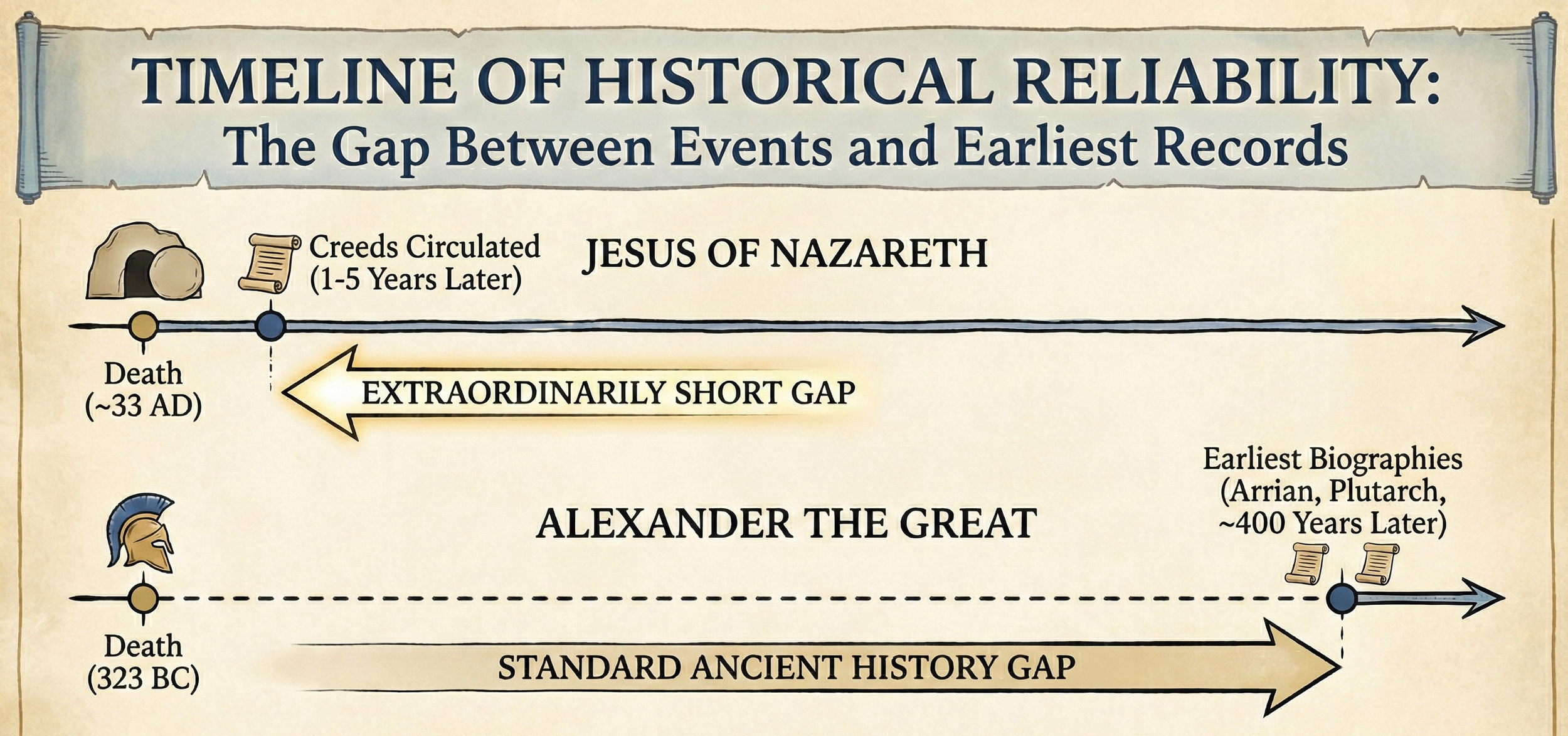
WHEN WAS THE FIRST NEW TESTAMENT WRITTEN? AND BY WHOM? (PART 4)
How soon after the crucifixion did the first reports of the Resurrection appear? While most ancient biographies were written centuries after their subjects died, the "creeds" of the New Testament circulated within months.
What to Know
Extraordinary Proximity: Unlike most ancient figures, the records for Jesus Christ’s life began circulating within 1–5 years of the events. In historical scholarship, this is an extraordinarily short gap that makes the New Testament more reliable than the biographies of Alexander the Great or Socrates.
The Power of Early Creeds: Scholars have identified "creeds"—succinct statements of faith—in the New Testament (like 1 Corinthians 15) that were formulated within months of the crucifixion. These early records were shared while eyewitnesses were still alive to either verify or disprove the claims.
A Shield Against Legend: Historians note that it typically takes two generations for legends to replace historical facts. Because the claims of Jesus’s death and resurrection circulated immediately, there was no time for "legendary embellishments" to wipe out the hard core of truth.
The Criterion of Embarrassment: Secular scholars use the "criterion of embarrassment" to verify authenticity. The fact that the New Testament includes details that would have been socially or politically embarrassing to the early Church suggests the authors were committed to recording actual events rather than inventing a myth.
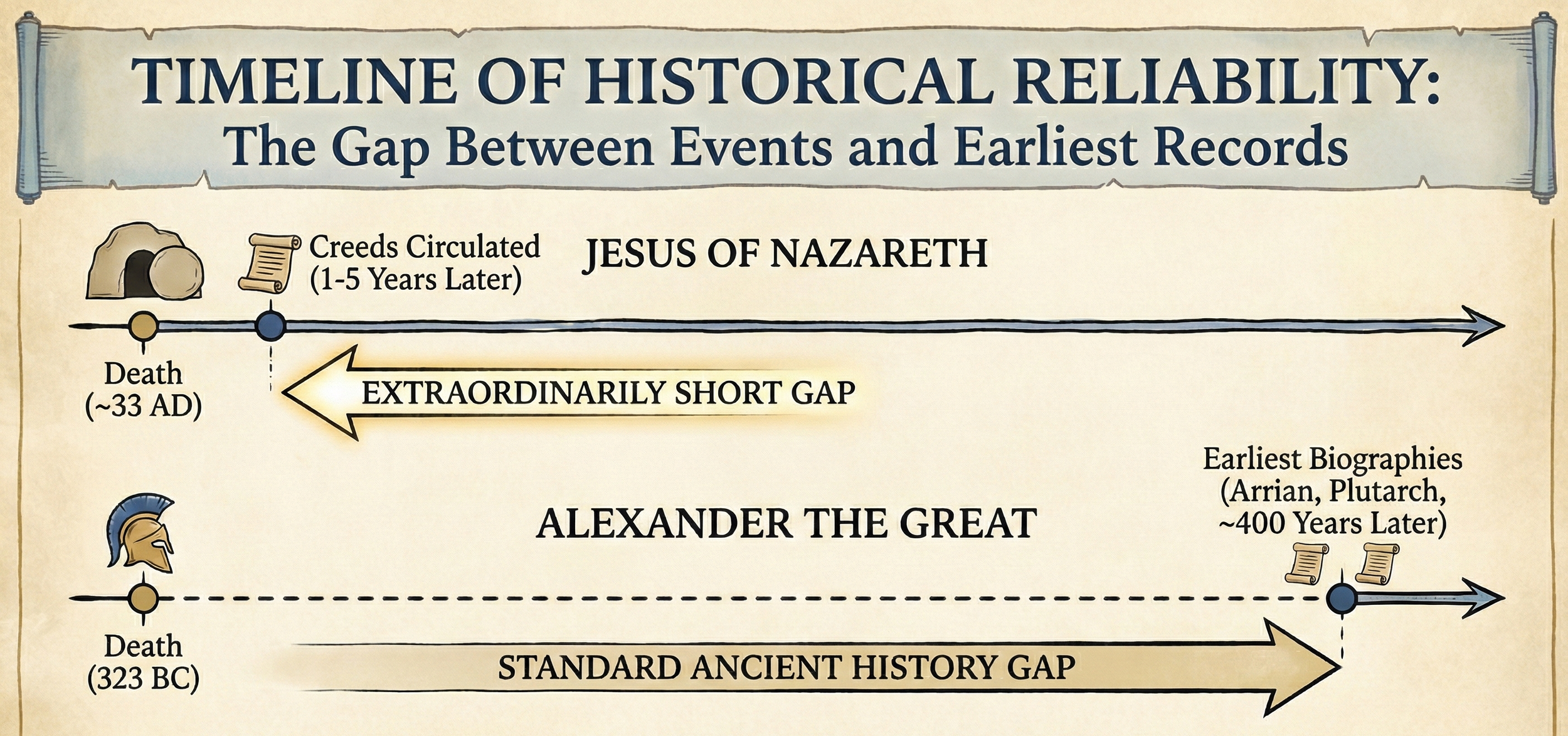
Historical records and non-Biblical sources affirm that Jesus Christ lived, had a ministry, was crucified, and was believed to have been resurrected. These essential points, central to the New Testament, are also documented in historical records outside the Bible. Remarkably, even supernatural events such as the darkening of the sun after Jesus's crucifixion (as explained in the previous post), are extensively recorded.
We've previously discussed the widespread circulation of New Testament copies throughout the Roman Empire and their proximity to the events they describe. Some fragments date back to as early as 50–60 A.D., a period when eyewitnesses would have still been alive. However, even earlier evidence exists beyond the New Testament. Critical scholars have identified sermon summaries in Acts (2:22-36, 3:13-16; 4:8-10; 5:29-32; 10:39-43; 13:28-31) and creeds—succinct statements of faith—found in Romans 4:25; Philippians 2:8; 1 Peter 3:18; Galatians 3:13; and 1 Corinthians 15:3, which all mention Jesus's death. The most famous is the creed in 1 Corinthians 15:3-8, which scholars believe circulated within 1-5 years of Jesus's death.
The German atheist and critic Gerd Lüdemann asserts that "the elements in the tradition are to be dated to the first two years after the crucifixion of Jesus…not later than three years." Respected scholar James D.G. Dunn similarly states, "This tradition, we can be entirely confident, was formulated as tradition within months of Jesus's death."
To grasp the significance of how early these creeds circulated, consider the example of Alexander the Great. Historians generally agree on the major events of Alexander's life, yet the earliest reports come from Arrian and Plutarch, nearly 400 years after Alexander died in 323 B.C. In historical scholarship, a 400-year gap is considered quite close to the actual events, which is why scholars are confident about Alexander's life. In contrast, the documentation of Jesus's life and death, within just a few years or months of the events, is extraordinary in the context of ancient history. This comparison highlights the strong evidence for the accuracy and reliability of the New Testament. To reject the Bible's accuracy would imply questioning the existence of other historical figures like Alexander the Great, Aristotle, or Socrates.
The early circulation of these creeds is significant for two key reasons. First, the claims about Jesus's death by crucifixion and other events were made at the same time and place they occurred. If these claims were false, eyewitnesses could have easily disproven them. Furthermore, crucifixions were public events intended to serve as a deterrent, and Jesus's crucifixion was witnessed by a large assembly of Jewish leaders and a crowd, as described in Luke 23:1-4. This event is later referenced in Acts 2:36, a sermon that critical scholars believe began circulating within months of Jesus's crucifixion. Yet, there is no record of anyone denying Jesus's death at that time.
Second, the short timeframe between the events and the circulation of these creeds prevents the possibility of legendary embellishments replacing the actual events, as some critics claim. A.N. Sherwin-White, a classical historian from Oxford University, states that "the span of two generations [or less] is too short to allow legendary tendencies to wipe out the hard core of historical fact."
Additionally, the criterion of embarrassment further supports the authenticity of the accounts of Jesus's crucifixion. This criterion suggests that authors are unlikely to invent details that would embarrass their message unless those details were accurate. Although primarily applied to the Bible, this criterion is also used by scholars to analyze other historical documents. For example, Jan Nattier employs this method in her analysis of Buddhist texts in her work "A Few Good Men: The Bodhisattva Path according to The Inquiry of Ugra (Ugraparipṛcchā)" (University of Hawaii Press, 2005).
Table of Contents
Textual Criticism of the Bible (Part 1)
The Evidence of Jesus Christ Outside the Bible (Part 2)
The Evidence of Jesus Christ Through the Darkening of the Sun (Part 3)
When was the First New Testament Book Written and by whom? (Part 4)
The Historical Reliability of the New Testament and Gospels (Part 5)
Proving the Accuracy of the Bible Through Prophecy (Part 6)
Proof of the Bible Through the Crucifixtion and Ressurection (Part 7)
A New Beginning - What does this Mean for Us? (Part 8)
Sources
Josephus, Flavius - Antiquities of the Jews (Book 18, Chapter 3) - Provides a non-Christian reference to Jesus, mentioning his crucifixion under Pontius Pilate.
Tacitus, Cornelius - Annals (Book 15, Chapter 44) - Refers to Jesus's execution during the reign of Tiberius by the procurator Pontius Pilate.
Lüdemann, Gerd - The Resurrection of Christ: A Historical Inquiry (2004) - Discusses the early dating of Christian creeds and Lüdemann's views as a critical scholar.
Dunn, James D.G. - Jesus Remembered (2003) - Provides evidence and analysis on the early tradition of Jesus’s resurrection and the formation of creeds.
Sherwin-White, A.N. - Roman Society and Roman Law in the New Testament (1963) - Analyzes the historical reliability of the New Testament using comparisons with other historical figures.
Nattier, Jan - A Few Good Men: The Bodhisattva Path according to The Inquiry of Ugra (Ugraparipṛcchā)(University of Hawaii Press, 2005) - Uses the "principle of embarrassment" to analyze Buddhist texts.
Saturday Sabbath vs. Sunday Sacredness
Why did the Sabbath move from Saturday to Sunday? Discover the "bad seed" of Laodicea and the 4th-century council that officially outlawed the biblical Sabbath. Learn why the Catholic Church admits this was an act of human authority—and why the Reformation never changed it back.
“And to the angel of the church of the Laodiceans write, “These things says the Amen, the Faithful and True Witness, the Beginning of the creation of God:
I know your works, that you are neither cold nor hot. I could wish you were cold or hot.
So then, because you are lukewarm, and neither cold nor hot, I will vomit you out of My mouth.” (Revelation 3:14-16)
The warning to the church in Laodicea was a stark indictment of "lukewarm" faith, a call for urgent repentance. While we often wonder if these biblical churches heeded such warnings, history suggests that Laodicea did not change. Instead, its influence evolved, sowing a "bad seed" that has taken root in much of modern Christianity.
Historically, the church in Laodicea outlasted most of its neighbors in Asia Minor. In approximately A.D. 336, it became the site of a pivotal governing body: The Council of Laodicea. Among its 60 rulings, or "canons," was a decision that would fundamentally alter the course and rhythm of Christian worship: the official mandate to shift the Sabbath from Saturday to Sunday.
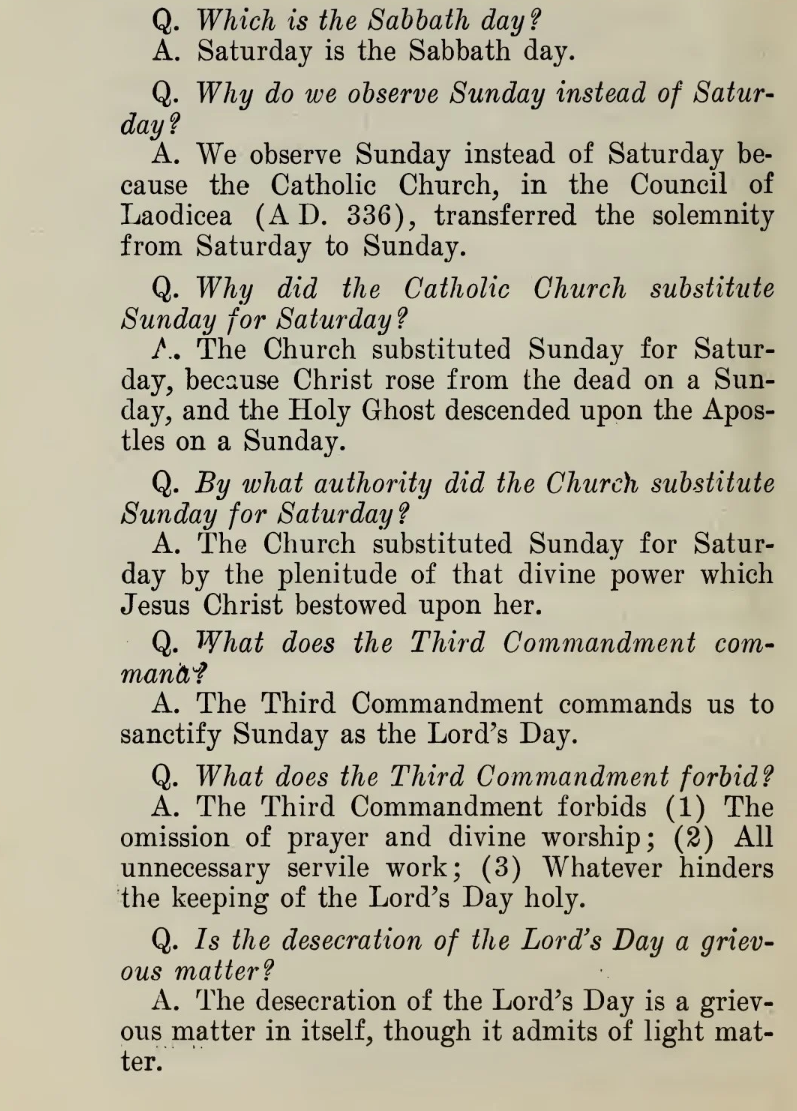
An excerpt from The Convert’s Catechism of Catholic Doctrine explicitly admitting transferring the seventh-day Sabbath to Sunday.
This shift was not a scriptural evolution, but a calculated ecclesiastical change. Even The Convert’s Catechism of Catholic Doctrine explicitly admits this transition, stating that the church exercised its own authority to move the solemnity from the seventh day to the first.
Key Takeaways from the Council of Laodicea
(c. A.D. 336)
Canon 29: This specific ruling explicitly forbade Christians from "Judaizing" by resting on the Sabbath (Saturday), commanding them instead to work on that day and honor the Lord’s Day (Sunday) if possible.
The Legacy: Rather than repenting of its lukewarm nature, Laodicea used its influence to codify a departure from the "blueprint" of the early Church.
The Admission: Catholic doctrine openly acknowledges that the change from the seventh-day Sabbath to Sunday was an act of the Church, not a command found in Scripture.
The Catholic Church is transparent about its role in shifting the Sabbath from Saturday to Sunday, asserting that it exercised its own ecclesiastical authority to make the change. This admission underscores a vital historical reality: for centuries after the resurrection, the followers of Jesus Christ continued to honor the seventh-day Sabbath, right up until this institutional shift.
When Protestant churches later branched off during the Reformation, they broke away from many doctrines but chose to retain this specific tradition of "the Lord’s Day" (Sunday) rather than returning to the biblical Sabbath. This creates a significant conflict, as it prioritizes a man-made tradition over a divine decree. Jesus spoke directly to this tendency, reserving some of His harshest warnings for those who elevate human tradition above the commandments of God:
“He answered and said to them,
”Well did Isaiah prophesy of you hypocrites, as it is written: 'This people honors Me with their lips, But their heart is far from Me. And in vain they worship Me, teaching as doctrines the commandments of men.'"For laying aside the commandment of God, you hold the tradition of men making the word of God of no effect through your tradition which you have handed down. And many such things you do." (Mark 7:16 & Mark 7:13)
Jesus was vehemently opposed to changing God's commandments and elevating man's doctrine above God’s word.

A NEW BEGINNING - WHAT DOES JESUS’ CRUCIFIXION AND RESURRECTION MEAN FOR US? (PART 8)
Does the meaning of life come down to a single historical question? Discover the six factual pillars of the life of Jesus, from the empty tomb to the martyrdom of the Apostles. Explore why world-class scholars and Oxford philosophers calculate a 97% probability of the resurrection—and what that truth means for your purpose today.
What to Know
The crucifixion and resurrection of Jesus Christ are historically reliable: Supported by biblical, historical, archaeological, and extra-biblical evidence, these events stand among the best-documented in ancient history.
Scholarly consensus affirms Jesus’ historicity: The overwhelming majority of historians and scholars agree that Jesus existed, was crucified, and that His followers genuinely believed He rose from the dead.
Evidence supports the resurrection: The crucifixion, burial, empty tomb, post-resurrection appearances, and the disciples’ transformation are well attested. Early Christian creeds and extra-biblical accounts corroborate the New Testament narrative.
Alternative explanations fail: Theories like the Stolen Body, Swoon, Hallucination, Legend, Wrong Tomb, and Conspiracy theories cannot adequately account for the evidence and are critically flawed.
The resurrection validates Jesus’ identity: It confirms His claim to be the Messiah and Son of God, offering profound implications for the meaning of life and the human search for purpose.
The resurrection offers hope and purpose: In a world marked by despair and disconnection, the resurrection of Jesus is a beacon of hope and calls humanity to follow His teachings—love, service, forgiveness, and a transformative relationship with God.
The ultimate meaning of life is found in Jesus Christ: Through His resurrection, He offers eternal life and a clear purpose—living in alignment with God’s plan and reflecting His light in a dark world.

To conclude, the following points about Jesus’ life, death, and resurrection have been established as factual based on the biblical account, supported by historical evidence, archaeological discoveries, and secular (non-biblical) accounts:
Crucifixion: The crucifixion of Jesus is a historically reliable event.
Burial: The burial account fits with all available historical evidence.
Empty Tomb: The empty tomb is attested by multiple sources, with no contradictory accounts.
Post-Resurrection Appearances: The apostles claimed to have personally encountered the resurrected Jesus.
Martyrdom of Apostles: The apostles were willing to suffer and die for their belief in the resurrection.
Conversion of Skeptics: Even those unlikely to believe were converted through personal experiences with the resurrected Christ.
While absolute certainty is difficult to accomplish, the overwhelming evidence supports the historical existence of Jesus Christ. The crucifixion and resurrection of Jesus Christ stand as some of the most well-documented events in ancient history. The convergence of biblical narratives, extra-biblical accounts, archaeological discoveries, and historical scholarship provides a compelling case for these cornerstone events of Christianity. Lee Strobel captures the weight of these findings and their significance: “It didn't take long for me to conclude that the truth or falsity of all world religions — and the ultimate meaning of life itself — comes down to just one key question: did Jesus, or did He not, return from the dead?" The resurrection is pivotal because it validates Jesus’ claims of being the Messiah and carries profound implications for the meaning of life.
Can we confidently assert that Jesus Christ existed approximately 2,000 years ago, was crucified, and was resurrected from the dead? These are bold claims and while absolute certainty may be elusive, the overwhelming consensus among scholars affirms these key points. Philosopher Richard Swinburne of Oxford University, after analyzing the evidence using a strictly factual approach, argued that there is a 97% probability that Jesus rose from the dead. This conclusion underscores the strength of the historical and archaeological evidence. Eric Meyers, emeritus professor of Judaic studies at Duke University, states, "I don't know many mainstream scholars who doubt the historicity of Jesus. The details have been debated for centuries, but no serious scholar doubts that he was a historical figure." The extensive evidence from the Bible and numerous extra-biblical sources affirms not only that Jesus was a real historical figure, but also that He was crucified, and rose from the dead.
If Jesus truly rose from the dead, His claims about Himself demand serious consideration. Jesus foretold His death and resurrection (Matthew 16:21; Mark 8:31) — a feat impossible without divine authority. The resurrection confirms Jesus’ identity as the Son of God and His message of salvation for humanity. N.T. Wright offers a profound reflection: “Why didn't the early Church follow the patterns of other messianic movements after their leaders were executed? Why did it consider Jesus its leader and the fulfillment of Israel's destiny? The unique organization and missionary zeal of the early Church, despite the public humiliation and execution of its leader, points to the profound impact of the post-resurrection appearances of Jesus and the work of the Holy Spirit.”
So, what is the meaning of life? This question, which has echoed through centuries of human thought, finds its ultimate answer in the life, death, and resurrection of Jesus Christ. As we have seen, the resurrection is not merely a religious claim, but a historical event, supported by robust evidence from biblical accounts, historical records, and archaeological findings. The empty tomb, the post-resurrection appearances, and the transformation of the disciples all point to one inescapable conclusion: Jesus Christ rose from the dead, validating His identity as the Messiah and Son of God.
This truth has profound implications for humanity’s enduring search for purpose. In a world marked by existential despair, rising mental health crises, and a growing sense of spiritual disconnection, the resurrection offers a beacon of hope. Jesus declared, "I am the way, the truth, and the life" (John 14:6), revealing that life's ultimate purpose is found in Him. His teachings call us not to superficial religiosity, but to a transformative way of living that aligns with God’s greater plan for humanity.
Now that we have established the reliability of the Bible and the truth of Jesus Christ through the historical record, the question shifts from "What is the meaning of life?" to "What will we do with the meaning that Jesus offers?" Humanity's greatest calling is to live as Christ taught — to love, serve, forgive, and reflect God’s light in a world often overshadowed by darkness. Through His resurrection, Jesus not only conquered death, but opened the door for all to share in eternal life and to have a profound relationship with God, if they choose to follow.
The meaning of life is clear: it is found in Jesus Christ. As Paul writes in Colossians 1:27, “Christ in you, the hope of glory.” Embracing Him means embracing purpose, hope, and the true meaning of life.
But how do we connect with Jesus Christ and His teachings? To find the answers, we must turn to the Bible and uncover what Jesus and Scripture truly teach about the “narrow path” God asks of us which leads to eternal life. We can begin to see that path through God’s established Feast and Holy Days.
Table of Contents
Textual Criticism of the Bible (Part 1)
The Evidence of Jesus Christ Outside the Bible (Part 2)
The Evidence of Jesus Christ Through the Darkening of the Sun (Part 3)
When was the First New Testament Book Written and by whom? (Part 4)
The Historical Reliability of the New Testament and Gospels (Part 5)
Proving the Accuracy of the Bible Through Prophecy (Part 6)
Proof of the Bible Through the Crucifixtion and Ressurection (Part 7)
A New Beginning - What does this Mean for Us? (Part 8)
Sources
Dr. Simon Gathercole on Pauline Epistles: Simon Gathercole, "The Gospel of Paul: What’s the Good News?" The Good Book Company, 2021.
Archaeological Evidence on Judean Life: Byron McCane, "Death in Roman Palestine: Archaeology and the Historical Jesus," Bible Review, 1998.
Byron McCane on Jesus in Historical Context: National Geographic Interview, The Real Jesus, March 2017.
Crucifixion as Historical Fact: John Dominic Crossan, "Jesus: A Revolutionary Biography," HarperOne, 1994.
Women as Witnesses: Josephus, "Antiquities of the Jews," Book IV.
Chuck Colson on the Resurrection: Chuck Colson, "Born Again," Chosen Books, 1976.
N.T. Wright on the Early Church: N.T. Wright, "The Resurrection of the Son of God," Fortress Press, 2003.
Richard Swinburne on the Probability of the Resurrection: Richard Swinburne, "The Resurrection of God Incarnate," Clarendon Press, 2003.
Eric Meyers on the Historicity of Jesus: Eric Meyers, Interview, CNN, "Archaeologists Unearth New Clues About Jesus," 2014.

PROOF OF THE BIBLE THROUGH THE CRUCIFIXION AND RESURRECTION OF JESUS CHRIST (PART 7)
Is the Resurrection a matter of blind faith or historical fact? Explore the overwhelming evidence for the death and rising of Jesus Christ. From the admission of skeptical scholars to the forensic failure of "stolen body" theories, discover why the empty tomb remains the most secure fact of ancient history.
What to Know
The crucifixion and resurrection of Jesus Christ are historically reliable events: Supported by extensive archaeological, historical, and textual evidence, even skeptical scholars like John Dominic Crossan and Bart Ehrman affirm the certainty of Jesus’ crucifixion.
The earliest Christian writings affirm the resurrection: Paul’s epistles (A.D. 50–60) and the Gospels (A.D. 70–100) are based on eyewitness accounts and consistently emphasize the resurrection as central to the Christian faith.
Archaeological evidence supports the Gospels: Excavations in first-century Judea validate the presence of large crowds and widespread diseases, consistent with Jesus’ ministry to the sick and marginalized.
Extra-biblical sources confirm the crucifixion: Roman historian Tacitus, Jewish historian Josephus, and Pliny the Younger independently affirm Jesus’ execution and early Christian worship of Him as God.
Alternative theories fail to explain the resurrection: Theories like the Stolen Body, Swoon, Hallucination, Legend, Wrong Tomb, and Conspiracy theories all face critical flaws and cannot account for the empty tomb and post-resurrection appearances.
The empty tomb and resurrection appearances are credible: Women discovered the empty tomb, an unlikely fabrication in first-century Judea, and the disciples’ transformation from fear to bold proclamation confirms their genuine belief.
The resurrection fueled Christianity’s rapid expansion: The disciples’ unwavering testimony and willingness to endure persecution demonstrate their firm conviction that Jesus truly rose from the dead.
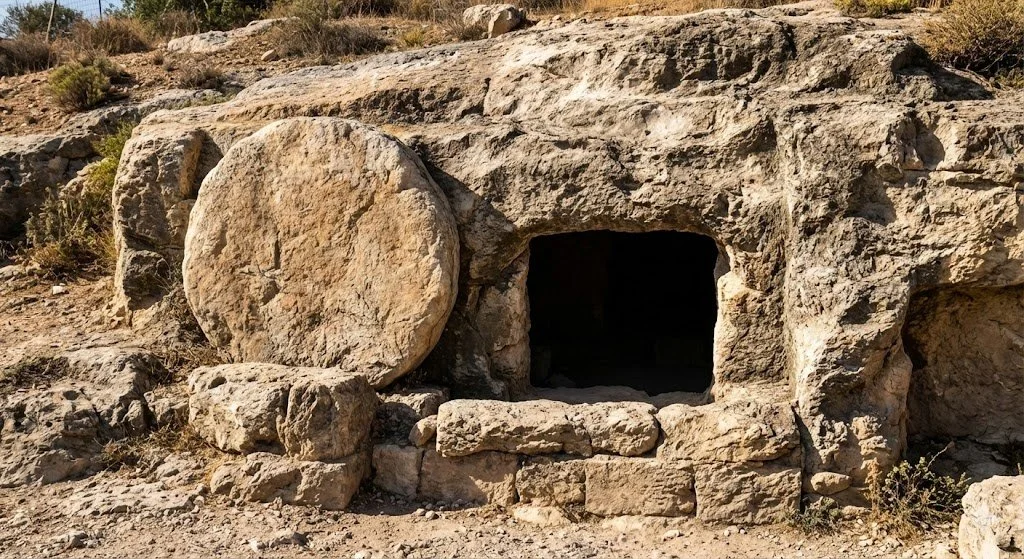
Let’s take a deeper look at the crucifixion and resurrection of Jesus Christ, supported by extensive archaeological, historical, and textual evidence from first-century Judea. Dr. Simon Gathercole, a leading biblical scholar, emphasizes that the earliest Christian writings about Jesus are found in Paul’s epistles, written approximately 25 years after Jesus’ death (A.D. 50–60). These letters provide a window into the beliefs of the early Christian church and underscore the fundamental nature of Jesus’ death and resurrection in the Christian faith. Additionally, the biographical accounts in the New Testament — composed about 40 years after Jesus’ death — are widely believed by scholars to have been written by individuals who either personally knew Jesus or had direct access to eyewitness testimony.
The New Testament narrative aligns closely with archaeological and historical evidence from first-century Judea, providing a well-grounded context for the events they describe. For example, archaeological findings validate the presence of large crowds, as depicted in the Gospels. The widespread prevalence of diseases such as leprosy and tuberculosis in the region would have drawn many to Jesus, who was revered as a healer. These details, corroborated by historical and archaeological data, lend credibility to the Gospel portrayal of Jesus as someone who ministered to the sick and marginalized.
Further insights into the harsh realities of life in Roman Palestine come from archaeologist Byron McCane’s studies of burial practices, which reveal that two-thirds to three-quarters of graves from this period contained the remains of children and adolescents. This grim statistic underscores the challenges of survival in first-century Judea and deepens the understanding of Jesus’ ministry, which was marked by compassion for the afflicted and vulnerable. Together, these layers of evidence reinforce the authenticity of the biblical account, providing a solid foundation for examining the life, crucifixion, and resurrection of Jesus Christ.
The crucifixion itself is among the best-attested events in ancient history. Even skeptical scholars, such as John Dominic Crossan, affirm that "Jesus' crucifixion is as sure as anything historical can ever be." Similarly, Bart Ehrman, critical scholar of the New Testament and agnostic, concedes similarly by stating, “The crucifixion of Jesus by the Romans is one of the most secure facts we have about His life.”
Supporting these statements by modern critical scholars is an abundance of extra-biblical sources that reference Jesus’ crucifixion. Roman historian Tacitus, for example, confirms that “Christus, from whom the name [Christian] had its origin, suffered the extreme penalty during the reign of Tiberius at the hands of Pontius Pilate.” Pliny the Younger, a Roman governor, offers additional insights into the early Christian church. In a letter to Emperor Trajan, dated around A.D. 112, he describes Christians meeting regularly to worship Christ “as to a god,” emphasizing their unwavering devotion to Jesus’ divinity and His status as the Son of God. This worship of Jesus as God is striking, given the cultural context of strict monotheism in Judaism and the Roman Empire's general suspicion of new religions. Lucian, a second-century Greek satirist, also mentions the Christians’ devotion to their “crucified sage,” further corroborating their early belief in Jesus’ resurrection and divine nature. Even Jewish historian Josephus writes of Jesus as a wise man who performed extraordinary deeds and was crucified under Pilate. These accounts provide independent corroborations of the New Testament narrative.
This primary historical evidence, among other support, has led the majority scholar consensus to regard the crucifixion and resurrection of Jesus Christ as historically reliable. In fact, most scholars agree that:
Jesus was crucified and buried in a tomb.
The tomb was found empty.
The disciples had experiences they believed were encounters with the risen Jesus.
The disciples’ belief in the resurrection transformed them and spread rapidly, even amid intense persecution.
We have already established the first point regarding Jesus’ crucifixion and will now examine the remaining elements to demonstrate their credibility as historical facts. Fundamental to the New Testament’s account of Jesus’ resurrection is the discovery of the empty tomb, which serves as a central cornerstone of its narrative. Notably, all four Gospels consistently report that women were the first to discover the empty tomb. This detail is particularly striking given the cultural context of first-century Jewish society, where women’s testimony was often disregarded. The Jewish historian Josephus wrote, "Let not the testimony of women be admitted, on account of the levity and boldness of their sex." The inclusion of women as key witnesses in the Gospel accounts — despite the risk of undermining their credibility within their cultural setting — adds significant weight to the authenticity of the Gospels’ reports.
Before we proceed further, it is important to address alternative theories proposed by some modern scholars to explain the empty tomb. These theories acknowledge the historical evidence for the tomb’s emptiness, but offer various explanations that diverge from the New Testament’s claim of resurrection. Evaluating these alternative hypotheses is crucial to understanding the full scope of the evidence and why the resurrection remains the most compelling explanation.
1. The Stolen Body Theory – One of the most commonly proposed alternative theories is the idea that the disciples—or someone else—stole Jesus’ body to fabricate His resurrection. While this theory attempts to explain the empty tomb, it has significant weaknesses that challenge its plausibility.
First, the tomb was sealed and guarded by Roman soldiers under orders from Pontius Pilate and the Jewish Sanhedrin. Roman military protocol for guarding high-priority locations typically involved a “guard,” or a group of 4 to 16 soldiers, depending on the importance of the task. Given the high-profile nature of this assignment—ensuring that no tampering occurred with the tomb of Jesus, whom some already claimed would rise—the maximum number of guards was likely deployed. Furthermore, Roman guards faced severe consequences, including public execution, for failing in their duties. It is highly improbable that all 16 guards would have simultaneously fallen asleep or allowed anyone to breach the tomb, knowing that failure would cost them their lives in a painful and disgraceful fashion.
Second, the psychological state of the disciples at the time casts significant doubt on this theory. According to Mark 14:50, the disciples were terrified and scattered after Jesus' arrest. In their initial fear and despair, it seems unlikely they would have had the courage or motivation to orchestrate a bold plan to steal the body. Moreover, such an act would have carried immense personal risk, as they would have faced execution if caught. It is difficult to reconcile their initial fear and disarray with the idea that they would suddenly become emboldened enough to take on Roman guards and fabricate a resurrection narrative.
Lastly, this theory fails to account for the disciples’ subsequent behavior. After claiming to witness the resurrected Jesus, these same disciples underwent a dramatic transformation, boldly proclaiming His resurrection even in the face of intense persecution and martyrdom. Would they risk their lives and endure such suffering to propagate a lie? The stolen body theory struggles to provide a coherent explanation for the empty tomb and the disciples' profound change.
2. The Swoon Theory – This theory suggests that Jesus did not actually die on the cross, but merely lost consciousness. While this explanation attempts to account for the empty tomb—proposing that Jesus regained consciousness after being placed there—it faces several significant issues that render it implausible.
First, crucifixion was a method of execution explicitly designed to ensure death through prolonged suffering and physical trauma. Roman soldiers were highly trained in carrying out executions and confirming death. The Gospels record such confirmation in John 19:34, where a soldier pierced Jesus' side with a spear, causing blood and water to flow—a likely indicator of death due to cardiac rupture or pleural effusion. This level of attention to detail undermines the suggestion that Jesus could have survived the cross.
Second, even if one were to hypothesize that Jesus somehow survived the crucifixion, the physical condition resulting from His ordeal would have made escape from the tomb nearly impossible. Jesus had endured severe scourging, significant blood loss, and the trauma of crucifixion. For Him to regain consciousness, remove the burial linens, roll away the massive stone sealing the tomb, evade the Roman guard (comprising 4 to 16 soldiers), and then appear to His disciples in a state that inspired worship and belief in His resurrection as the glorified Messiah stretches any sensible belief.
Finally, the disciples’ testimony and subsequent behavior contradict this theory entirely. The disciples proclaimed a risen and glorified Jesus, not a wounded and barely surviving figure. They preached with unwavering conviction, even under the threat of intense persecution and martyrdom, that Jesus had triumphed over death, not merely survived it. Such profound transformation and unwavering commitment would be inexplicable if their belief was based on encountering a severely injured, mortal man rather than a resurrected, glorified Savior. Therefore, the swoon theory fails to align with both the physical realities of crucifixion and the nature of the disciples’ testimony, rendering it an untenable explanation for the resurrection of Jesus.
3. The Hallucination Theory – The hallucination theory posits that the disciples and others who claimed to see Jesus after His resurrection were experiencing hallucinations brought on by grief, psychological stress, or trauma. While this theory attempts to account for the post-resurrection appearances of Jesus, it fails to address a critical point: the empty tomb.
Moreover, hallucinations are typically individual and subjective experiences, arising from a person's internal emotional or psychological state. It is highly improbable for multiple individuals to share identical hallucinations, especially in varying contexts and groups. Yet, the accounts of Jesus’ post-resurrection appearances include Him appearing to all the disciples together, to individuals like Mary Magdalene and Peter, and even to groups outside the immediate circle of disciples. Notably, 1 Corinthians 15:6 records that Jesus appeared to over 500 people at one time—a collective experience that defies the nature of personal hallucinations.
Additionally, the theory cannot explain Jesus’ appearance to Paul, a former persecutor of Christians, who encountered the risen Christ on the road to Damascus. Paul’s transformation from a staunch opponent of Christianity to one of its most fervent advocates and martyrs is difficult to attribute to a hallucination, especially given his lack of prior emotional attachment to Jesus.
Finally, those who claimed to witness the risen Christ remained steadfast in their testimony, enduring intense persecution and even martyrdom for their belief. It is implausible that such diverse individuals, some of whom had initially doubted or opposed Jesus, would endure suffering and death for what could be dismissed as mere hallucinations. This theory, therefore, fails to adequately explain the evidence surrounding the resurrection of Jesus.
4. The Legend Theory – This theory suggests that the resurrection story is a myth that evolved over time, attempting to explain both the empty tomb and the post-resurrection appearances of Jesus. However, it fails to account for critical evidence, such as the early creeds found in 1 Corinthians 15:3-8, which affirm that belief in Jesus' resurrection was firmly established within a few years of His death. This short timeframe leaves little opportunity for a legend to develop, especially given the proximity of these events to the eyewitnesses themselves.
Additionally, the substantial historical evidence for the empty tomb and the post-resurrection appearances challenges this theory and often contradicts it outright. Myths and legends typically emerge in regions far removed from the locations where the described events supposedly took place. In contrast, the resurrection of Jesus was proclaimed in Jerusalem and its surrounding areas—the very place where He was crucified and buried. If the resurrection were merely a legend, it would have been easily disproven by those familiar with the events, yet no such refutation succeeded, further undermining this theory.
5. The Wrong Tomb Theory – As the name implies, this theory suggests that the women and disciples mistakenly went to the wrong tomb, found it empty, and assumed that Jesus had risen. While this might explain the empty tomb, it fails to address several critical issues. Jewish and Roman authorities, who had a vested interest in disproving the resurrection, could have simply directed people to the correct tomb, instantly refuting the disciples' claims.
Additionally, this theory does not account for the numerous post-resurrection appearances of Jesus, as described in the Gospels and early Christian writings. Nor does it explain why the disciples were willing to face intense persecution and even martyrdom for their unwavering belief in the resurrection—an extraordinary commitment unlikely to stem from a simple mistake.
6. The Conspiracy Theory – This theory suggests that the resurrection was a hoax deliberately fabricated by Jesus’ followers. While it offers a straightforward explanation for the resurrection narrative, it fails to address several key issues. First, it does not adequately explain the empty tomb or the numerous post-resurrection appearances of Jesus reported by multiple individuals and groups, including skeptics like Paul. Second, it overlooks the extraordinary commitment of the disciples, who were willing to face persecution and even execution for their unwavering belief in the resurrection. For this theory to hold, all the disciples would have needed to maintain a coordinated and lifelong deception under relentless pressure, an implausible scenario given the circumstances.
Over the decades, numerous alternative theories have been suggested to explain Jesus' resurrection. However, like those previously discussed, each encounters significant flaws and is easily refuted. The simple truth is that, no matter how improbable it may seem to some, the historical evidence overwhelmingly points to the resurrection of Jesus as the only plausible explanation. No other theory comes close to accounting for all the historical facts. As Sherlock Holmes famously stated in The Sign of the Four: "When you have eliminated the impossible, whatever remains, however improbable, must be the truth."
Now, turning to the post-resurrection appearances of Jesus, we find extensive documentation in both biblical and extra-biblical sources. Paul’s letters, especially 1 Corinthians 15:3–8, offer a detailed account of multiple eyewitnesses to the risen Christ, including Peter, James, and a group of over 500 individuals. Notably, many of these witnesses were still alive when Paul penned these words, effectively inviting his contemporaries to verify the claims.
Furthermore, the early creeds of the Church, such as the one recorded in 1 Corinthians 15, were formulated within just a few years of Jesus’ death. These creeds emphasized the resurrection as the cornerstone of Christian faith, reflecting its foundational importance to the early believers. When combined with the writings of the early Church and the unwavering testimony of the apostles, these accounts form a consistent and compelling narrative. Despite centuries of scrutiny, this narrative has withstood critical examination, underscoring the enduring significance and reliability of the resurrection testimony.
Even skeptical scholars acknowledge the significance of these testimonies. German scholar Gerd Lüdemann, for instance, concedes, “It may be taken as historically certain that Peter and the disciples had experiences after Jesus’ death in which Jesus appeared to them as the risen Christ.” This widespread and unified testimony resists dismissal as legend or hallucination, especially given its early dissemination and the transformative impact it had on those who bore witness.
Third, the transformation of the apostles and the rapid expansion of Christianity are compelling evidence for the resurrection. Before Jesus’ death, the Gospels portray His disciples as fearful, doubtful, and uncertain. Yet, after the resurrection, these same individuals boldly proclaimed Jesus' triumph over death, even at the risk of their lives. Their remarkable shift from fear to unwavering courage demands explanation.
Chuck Colson, reflecting on his experience during the Watergate scandal, offered a profound insight: "I know the resurrection is a fact, and Watergate proved it to me. How? Because 12 men testified, they had seen Jesus raised from the dead, then proclaimed that truth for 40 years, never once denying it. They would not have endured that if it weren't true." The apostles faced intense persecution, torture, and martyrdom, yet they remained steadfast in their testimony. Such resolve strongly suggests they genuinely believed in the resurrection, making it unlikely to be a fabricated story or a delusion. Their conviction transformed the course of history, fueling the rapid spread of Christianity in the face of adversity.
Table of Contents
Textual Criticism of the Bible (Part 1)
The Evidence of Jesus Christ Outside the Bible (Part 2)
The Evidence of Jesus Christ Through the Darkening of the Sun (Part 3)
When was the First New Testament Book Written and by whom? (Part 4)
The Historical Reliability of the New Testament and Gospels (Part 5)
Proving the Accuracy of the Bible Through Prophecy (Part 6)
Proof of the Bible Through the Crucifixtion and Ressurection (Part 7)
A New Beginning - What does this Mean for Us? (Part 8)
Sources
Dr. Simon Gathercole (2018). The Gospel and the Gospels.
The New Testament Gospels (A.D. 70-100).
Blue Letter BibleByron R. McCane (2003). Roll Back the Stone: Death and Burial in the World of Jesus.
John Dominic Crossan (1994). Jesus: A Revolutionary Biography.
HarperCollinsBart D. Ehrman (2000). The New Testament: A Historical Introduction to the Early Christian Writings.
Ancient Roman Historian: Publius Cornelius Tacitus (early 2nd century). Annals 15.44.
Project Gutenberg (Scroll to Book XV)Pliny the Younger (A.D. 112). Epistles 10.96-97.
Internet Ancient History SourcebookLucian of Samasata (A.D. 2nd century). The Passing of Peregrinus.
The Tertullian ProjectJosephus (c. A.D. 93–94). Antiquities of the Jews 18.3.3, 20.9.1.
Perseus Digital LibraryMajority Scholar Consensus (Various Works). Representative Scholarly Treatments: N.T. Wright, The Resurrection of the Son of God
(Fortress Press, 2003); Gary Habermas & Michael Licona, The Case for the Resurrection of Jesus (Kregel, 2004)Gerd Lüdemann (1995). What Really Happened to Jesus? A Historical Approach to the Resurrection.

PROVING THE ACCURACY AND RELIABILITY OF THE BIBLE THROUGH PROPHECY (PART 6)
What are the odds of one man fulfilling 332 specific prophecies written centuries before His birth? Explore the staggering mathematics of Messianic prophecy. From the "Texas Silver Dollar" analogy to the incomprehensible 1 in $10^{157}$ probability, discover why the life of Jesus Christ is the ultimate proof of the Bible's divine authorship.
What to Know
Prophecy distinguishes the Bible as inspired by God: The Bible itself states that prophecy is a sign from God (Isaiah 46:9-10), setting it apart from other religious texts. Unlike vague predictions, biblical prophecies are precise, detailed, and historically verifiable.
Hundreds of Messianic prophecies were fulfilled in Jesus: The Old Testament contains over 300 prophecies about the Messiah, including His birth in Bethlehem (Micah 5:2), His crucifixion (Psalm 22), and the exact timeline of His arrival (Daniel 9). The Dead Sea Scrolls confirm these were written centuries before Jesus, ruling out later manipulation.
The mathematical impossibility of fulfillment by chance: Professor Peter Stoner calculated the probability of one person fulfilling just eight major prophecies as 1 in 10¹⁷— comparable to covering Texas in silver dollars two feet deep, marking one, and having a blindfolded person pick it at random. For 48 prophecies, the odds are 1 in 10¹⁵⁷, a number beyond comprehension.
Many prophecies defied human expectations: Messianic prophecies foretold a suffering servant (Isaiah 53), contradicting Jewish expectations of a conquering ruler. Events beyond human control — such as being betrayed for 30 pieces of silver (Zechariah 11:12) and having His executioners gamble for His clothing (Psalm 22:18) — further prove divine authorship.
Prophecy validates the Bible’s authority and Jesus’ identity: The fulfillment of these prophecies with such precision leaves no room for coincidence. This evidence demands a response—either Jesus is who He claimed to be, or the statistical impossibility of prophecy fulfillment must be ignored.

Another essential point to highlight, in that it underscores the accuracy of the Bible and sets it apart from other religious texts, is biblical prophecy. Biblical prophecy is crucial because it points to the divine authorship of the Scriptures, reinforcing the trustworthiness of the Bible's message due to the extremely low probability of these predictions being fulfilled by chance. The Bible itself speaks to this point that prophecy is a sign from God and shows that the Bible is divinely inspired. God speaks through the prophet Isaiah, "Remember the former things of old, for I am God, and there is no other; I am God, and there is none like Me, declaring the end from the beginning, and from ancient times things that are not yet done… (Isaiah 46:9-10 NKJV)"
God challenges us to test Him by making predictions about the future that will come to pass. Approximately one-third of the Bible consists of prophecies, many of which concern the promised Messiah and foretell details about His identity and actions. By one count, there are 332 Messianic prophecies in the Hebrew Bible (Old Testament) that Jesus fulfilled. This is why the Dead Sea Scrolls are so significant: they date back to 100 years before Jesus' birth, confirming that the prophecies Jesus fulfilled were written before His birth and were not added or altered later.
While anyone can make predictions, having them come true is an entirely different matter. In fact, the more detailed and numerous the predictions, the less likely they are to be fulfilled precisely. For instance, consider the improbability of someone today predicting the exact city where a future leader would be born in the 22nd century. Yet, this is precisely what the prophet Micah did, foretelling the Messiah's birth in Bethlehem 700 years in advance. Similarly, what are the chances of predicting the manner of death for a new, unknown religious leader a thousand years from now, especially when that method of execution is currently unknown and won't be practiced for centuries? This is precisely what David did in 1,000 B.C. Furthermore, the prophet Daniel predicted the exact time of the Messiah's arrival, approximately 530 years before His eventual arrival.
Imagine making 50 specific prophecies about a person you will never meet. What are the odds that this person will fulfill all 50 predictions? The likelihood diminishes significantly if 25 of these prophecies concern actions taken by others beyond the person's control. For example, how could someone "arrange" to be born into a specific family or in a specific city where their parents don't live? How could one orchestrate their own death by crucifixion, alongside two others, and have the executioners gamble for their clothing, as described in John 16:19 and Psalms 22:18? How could someone "arrange" to be betrayed, to avoid having their legs broken during execution, and to escape from a grave after being killed? It might be conceivable for someone to fake one or two Messianic prophecies, but for any one person to fulfill all these prophecies is impossible without divine intervention.
The science of probability attempts to determine the likelihood of a given event occurring. A professor at Westmont College, Peter W. Stoner, calculated the probability of one man fulfilling the major prophecies concerning the Messiah. These estimates were derived by twelve different classes, totaling about 600 university students. The students meticulously considered each prophecy, the circumstances, and any possibility that men could conspire to fulfill these prophecies. Their estimates were conservative, and even the most skeptical students unanimously agreed. The professor then made these estimates even more conservative and encouraged other skeptics or scientists to review them. Finally, he submitted his findings to a committee of the American Scientific Affiliation. H. Harold Hartzler, PhD, of the American Scientific Affiliation, Goshen College, wrote in the forward of Stoner’s book:
“The manuscript for Science Speaks has been carefully reviewed by a committee of the American Scientific Affiliation members and by the Executive Council of the same group and has been found, in general, to be dependable and accurate in regards to the scientific material presented. The mathematical analysis included is based upon principles of probability which are thoroughly sound and Professor Stoner has applied these principles in a proper and convincing way.”
For example, in Micah 5:2, where it's stated that the Messiah would be born in Bethlehem, the professor and his students calculated the average population of Bethlehem from Micah's time to the present and compared it to the average world population during the same period. They concluded that the chance of one man being born in Bethlehem was 1 in 300,000. After examining just eight different prophecies, they conservatively estimated the probability of one man fulfilling all eight as 1 in 10^17. To illustrate the magnitude of this number, Professor Stoner used this analogy: If you mark one of ten tickets, place them all in a hat, and ask a blindfolded person to pick one, the chance of choosing the correct ticket is 1 in 10. Now, imagine covering the state of Texas with 10^17 silver dollars, two feet deep. Now mark one of these silver dollars and stir the whole mass. Finally, blindfold a man and tell him he can travel as far as he wishes, but he must pick up the one marked silver dollar. The odds of him finding the correct one are the same as those of the prophets writing these eight prophecies and having them all fulfilled in one person.
In financial terms, would anyone hesitate to invest in a venture with only a 1 in 10^17 chance of failure? Of course not.
However, this is the kind of certainty offered by God through faith in His Messiah. Based on these calculations, the professor concluded that the fulfillment of these eight prophecies alone demonstrates divine inspiration in writing the prophecies, as the likelihood of mere chance is only 1 in 10^17. Dismissing or ignoring the significance of these biblical signs concerning the Messiah would be foolish.
Moreover, there are far more than just eight prophecies (as previously mentioned, some calculations have the total number of prophecies in the Old Testament at 332). In another calculation, Professor Stoner considered 48 prophecies and arrived at the highly conservative estimate that the probability of one person fulfilling all 48 prophecies is 1 in 10^157 — a number so large it's incomprehensible. To find a comparable illustration, we would need to look at the vastness of the universe. Astronomers estimate that the universe contains up to one septillion stars – that’s a one followed by 24 zeroes. This is the total number of stars in the entire observable universe, and the probability of all the Messianic prophecies happening by chance is still orders of magnitude greater (another 125 zeroes added!).
If you're skeptical about the number of prophecies concerning the Messiah in the Old Testament, you can review the 48 prophecies here that Professor Stoner and his students used to calculate the odds of these all occurring along with their fulfillment through Jesus Christ.
Many of these prophecies were contrary to Jewish expectations at the time, making their writing even more remarkable. For instance, the sacrificial system and sin offerings were deeply ingrained in Jewish culture throughout the Old Testament. Even in the New Testament, we see how highly the Jewish people regarded the sacrificial system and their understanding of sin. Yet, centuries earlier, prophecies foretold that sin would ultimately be cleansed and forgiven by a person — the Messiah. The New Testament reveals that this Messiah was Jesus Christ, though such a concept would have been almost offensive to people when the prophecies were written.
Table of Contents
Textual Criticism of the Bible (Part 1)
The Evidence of Jesus Christ Outside the Bible (Part 2)
The Evidence of Jesus Christ Through the Darkening of the Sun (Part 3)
When was the First New Testament Book Written and by whom? (Part 4)
The Historical Reliability of the New Testament and Gospels (Part 5)
Proving the Accuracy of the Bible Through Prophecy (Part 6)
Proof of the Bible Through the Crucifixtion and Ressurection (Part 7)
A New Beginning - What does this Mean for Us? (Part 8)
Sources
1) Peter W. Stoner (1958). Science Speaks: An Evaluation of Certain Christian Evidences. This book discusses the probability of prophecies being fulfilled in Christ.
2) Micah 5:2 - A prophecy predicting the Messiah’s birth in Bethlehem.
3) Psalms 22:16-18 - A description of the Messiah’s crucifixion and the gambling for his clothing.
4) Daniel 9:24-26 - A prophecy about the timing of the Messiah's arrival.
5) John 19:33-36 - Reference to the crucifixion and the fact that Jesus' legs were not broken, fulfilling prophecy.
6) American Scientific Affiliation - This organization reviewed and validated the probability calculations made by Stoner.
7) List of prophecies and their fulfillment compiled and edited by James George for New Disciples Class
https://www.linkedin.com/pulse/advent-statistical-probability-jesus-fulfilling-messianic-george/
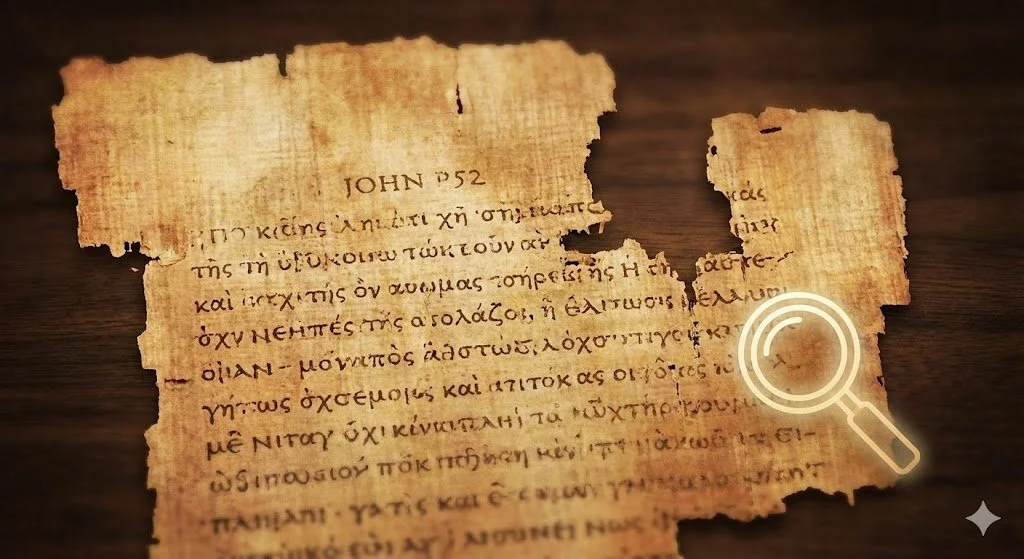
TEXTURAL CRITICISM OF THE BIBLE (PART 1)
How do we know the Bible we read today is what was actually written? Explore the staggering manuscript evidence that makes the Bible the most historically reliable document of the ancient world.
What to Know
This article emphasizes that before exploring the deeper teachings of the Bible and Jesus Christ’s identity, one must first establish the Bible’s historical reliability.
Textual criticism is key: scholars reconstruct original New Testament writings by comparing thousands of existing handwritten copies—far more than what exists for most other ancient works.
The New Testament boasts about 5,800 Greek manuscripts (some within 200 years of the events), which is unparalleled in ancient literature. The Old Testament also has extensive manuscript support, highlighted by the Dead Sea Scrolls, which pushed textual evidence back nearly 2,000 years.
Given the Bible’s vast and early manuscript evidence, questioning its reliability would mean questioning the reliability of all other ancient historical documents as well as historical figures like Alexander the Great.
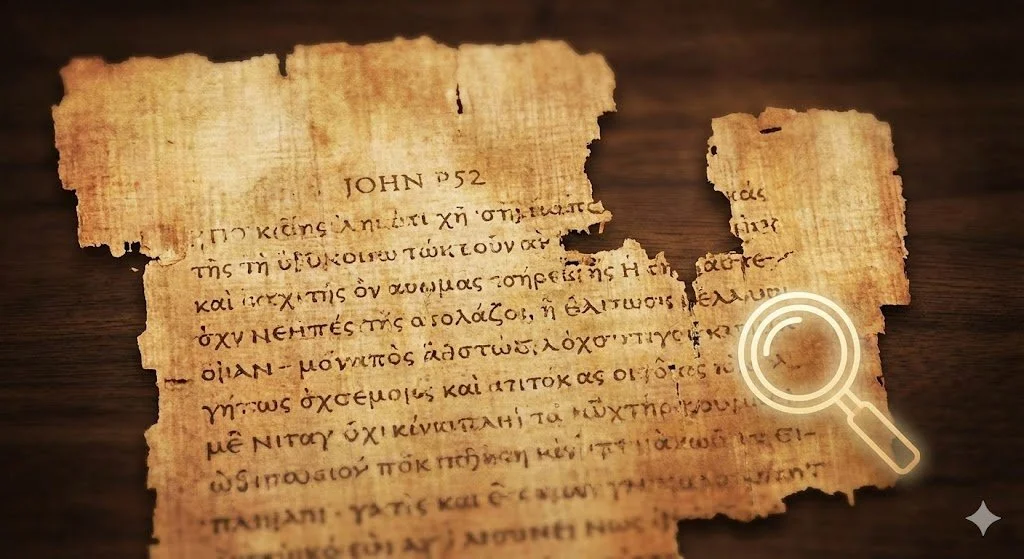
Before exploring the Bible's true teachings and scriptural truths — often obscured by tradition and diluted interpretations — we must first establish its authenticity, historical accuracy, and the truth of Jesus Christ as the Son of God.
We will begin on this journey by first examining the New Testament, specifically through textual criticism, rather than focusing on the specific writings. The New Testament was originally written in Koine Greek, the common language of the time. Today, we don't have the original manuscripts, known as autographs, of the New Testament books. Instead, we rely on handwritten copies and copies of those copies. Textual criticism is the scholarly practice of reconstructing the original text by comparing these various copies.
It's important to note that textual criticism isn't limited to the New Testament or to only biblical books. It's applied to nearly all classical works because no originals exist for any Greek or Latin classic, including the Bible. This is mainly because ancient people wrote on papyrus, a highly perishable material that can only survive in dry, airy climates. It's actually remarkable we have any surviving papyrus fragments today, considering how easily they degrade.
In 1900, only about nine known papyrus fragments contained parts of the New Testament had been discovered. Today, that number has grown to approximately 115. Among these, 45 papyrus fragments date back to before 300 AD. Collectively, these 45 manuscripts represent about two-thirds of the New Testament, dating to within 200 years of the eyewitness accounts of Jesus. In the context of ancient writings, this is incredibly close to the actual events. In fact, no other ancient document has such early and abundant manuscript evidence.
Beyond these 115 significant and larger manuscripts, there are approximately another 5,800 Greek manuscripts, 10,000 Latin manuscripts, and 9,300 manuscripts in other languages. Some scholars estimate that the number of textual references could exceed one million if we include citations from early church fathers who quoted Scripture in sermons and writings. These numbers are extraordinarily high for ancient texts, underscoring the New Testament's unique position in historical documentation.
The difference is stark when we compare the 5,800 Greek New Testament manuscripts to other classical works. Consider critical editions of works like The Iliad, Caesar's Gallic War, and Beowulf — these are classic texts widely taught in schools, and their authenticity is rarely questioned. However, the number of manuscripts that survive these works is nowhere near the New Testament. The Iliad, for example, has about 650 copies, which is sufficient to produce critical editions but pales in comparison to the New Testament. The earliest complete edition of The Iliad dates from the 10th century A.D., even though the text was written around the 8th century BC. In contrast, we have complete editions of the New Testament from the 4th century A.D., with large fragments dating back to before 300 A.D.—much closer to the events described.
To illustrate this point further, scholars have dated a small fragment containing portions of John, known as fragment P90, to the early 2nd century A.D. Another fragment, known as fragment P104, contains Scripture from Matthew and is dated to the late 1st century A.D. These fragments are incredibly close in time to the events they record, enhancing their reliability.
As briefly explained before with The Iliad, the New Testament's manuscript evidence far surpasses that of any other ancient document. For instance, we have about a dozen copies of Caesar's Gallic War, the earliest dating nearly a thousand years after the events it describes. Tacitus's Histories and Annals are preserved in three manuscripts, and Beowulf survives in only one. The New Testament, by contrast, was widely distributed across the Roman Empire and into North Africa. It was translated into multiple languages, and manuscripts of these translations have been found in numbers that far exceed those of any other ancient document.
While this discussion has focused on the New Testament, similar observations can be made about the Old Testament. Although pinpointing the exact number of Old Testament manuscripts is challenging due to its age, size, and the fact that it was written over a thousand years, estimates suggest there are around 2,000 fragments of Old Testament scripture. Considering the age of these texts, this is truly remarkable.
Some of the oldest complete Old Testament manuscripts include the Aleppo Codex, dating back to 920 A.D., and the Leningrad Codex, dating to 1008 A.D. Both were discovered before the Dead Sea Scrolls, which dates from the 1st to 3rd century B.C. The discovery of the Dead Sea Scrolls pushed back the date of the oldest Old Testament manuscripts by nearly 2,000 years.
When considering both the New and Old Testaments, no other ancient document comes close to this level of manuscript evidence. Despite this, many people still question the accuracy of the Bible and the events it describes. However, if one doubts the reliability of the Bible, they would also have to call in question the reliability of all other ancient historical documents as well.
Table of Contents
Textual Criticism of the Bible (Part 1)
The Evidence of Jesus Christ Outside the Bible (Part 2)
The Evidence of Jesus Christ Through the Darkening of the Sun (Part 3)
When was the First New Testament Book Written and by whom? (Part 4)
The Historical Reliability of the New Testament and Gospels (Part 5)
Proving the Accuracy of the Bible Through Prophecy (Part 6)
Proof of the Bible Through the Crucifixtion and Ressurection (Part 7)
A New Beginning - What does this Mean for Us? (Part 8)
Sources
1. Metzger, Bruce M., and Bart D. Ehrman. The Text of the New Testament: Its Transmission, Corruption, and Restoration. Oxford University Press, 2005.
2. Comfort, Philip Wesley, and David P. Barrett. The Text of the Earliest New Testament Greek Manuscripts. Tyndale House Publishers, 2001.
3. Geisler, Norman L., and William E. Nix. A General Introduction to the Bible. Moody Publishers, 1986.
4. Wallace, Daniel B. "The Reliability of the New Testament Manuscripts." Bible.org, 2012.
5. Kenyon, Frederic G. Our Bible and the Ancient Manuscripts. Eyre & Spottiswoode, 1895.
6. Greenlee, J. Harold. Introduction to New Testament Textual Criticism. Hendrickson Publishers, 1995.
THE CONCLUSION – THE HOPE WE HAVE IN WHAT WAS PROMISED TO US
Why is Jesus called the "Living Hope"? Beyond the ritual of the Mikveh lies a promise made before time began. Discover how the "imperfect" waterpots of the Old Covenant were filled by Christ to bring life and immortality to light through the Gospel.
What to Know
What It Is – Mikveh, Baptism, and the Unfolding of God’s Plan - A simple question — why baptism is not defined at the start of the Gospels — leads to a profound discovery: the significance of mikveh in Scripture. The evolving meaning of mikveh, from “a collection of waters” to “hope”, reveals that both mikveh and baptism were designed as foreshadowings of Jesus Christ, pointing directly to the hope found in Him. While modern archaeology is helping us recover details that were once unfamiliar, the people of the New Testament era understood mikveh’s symbolic depth well—its cleansing, its hope, and its prophetic purpose.
Jesus Christ as the Fulfillment of Mikveh — Our True Hope - New Testament writers — especially Paul — saw Jesus Christ as the fulfillment of the Old Testament mikveh imagery. Paul calls God the “God of hope” (Romans 15:13) and reminds believers that “hope does not put us to shame” because it is rooted in Christ Himself (Romans 5:5). This echoes Jeremiah’s declaration that God is the “Mikveh of Israel” — the true Hope of His people (Jeremiah 14:8).
The Six Waterpots — Imperfection Made Complete in Christ - John 2:6 records “six waterpots of stone” used for ritual purification at the wedding in Cana. The number six symbolizes incompleteness in Scripture. These jars represented the incomplete purification of the Old Covenant — ritual washings that pointed to something greater. When Jesus transforms the purification water into wine, He reveals that He completes what the law could only foreshadow. As Paul explains, Christ brought life, immortality, and grace that had been planned “before time began” (2 Timothy 1:9–10). Christ fills what was lacking — He completes the meaning of mikveh and fulfills the law, not by abolishing it, but by giving it its full purpose (Matthew 5:17).
Jesus Christ as Our Living Hope - The New Testament connects hope — not to sentiment, but to the resurrection of Jesus Christ. Peter says believers are “born again to a living hope through the resurrection of Jesus Christ from the dead” (1 Peter 1:3). This living hope is “foreordained from the foundation of the world” (1 Peter 1:20); anchored in Christ’s death and resurrection; proof that God will grant eternal life to those who follow Him. Through Jesus, hope becomes active, assured, and eternal — no longer symbolic, but living.
The Hope of Eternal Life — God’s Promise From the Beginning - The promise of eternal life appears repeatedly in the New Testament and was part of God’s plan from the beginning (Titus 1:2). Peter, Paul, and the other apostles understood that Christ’s sacrifice and resurrection were the means through which humanity could inherit this promise. Because Christ was raised, our hope is secure, and we are assured that God will one day do the same for us. Jesus is not only the fulfillment of mikveh but the pathway to immortality, the One through whom believers receive the eternal inheritance promised before the world began.
Baptism as the Entrance Into This Hope - Baptism is the God-ordained way to enter this living hope and the coming Kingdom of God. It unites believers with Jesus Christ’s death and resurrection and grants access to the eternal life He promised. It is through baptism—and the faith it represents—that we are prepared to hear His words at the end of the age:
“Come, you blessed of My Father, inherit the Kingdom prepared for you from the foundation of the world…”(Matthew 25:34)
What began from the simple question and observation of why the term baptism isn’t defined at the beginning of the Gospels led us to the significance of the word mikveh. Through this word, we have seen how mikveh, and ultimately baptism, was actually a foreshadowing of Jesus Christ, revealing the hope we have in Him and the hope He freely offered to others during His ministry. As we continue to discover new things through archaeology, our understanding of the Bible and the time it was written continues to expand. However, it’s important to remember that although God inspired the New Testament for us to learn from and apply to our lives today, the authors of the New Testament wrote directly to the people and culture of their time. The things we are now discovering that may have been “lost” to us previously were not to the people of the time of the New Testament. These people were familiar with all of the aspects of hope and mikveh that we are only beginning to uncover today.
We can see all these aspects of mikveh and how they relate to Jesus Christ throughout the New Testament. Paul, when writing to the early church in Rome, says such in Romans 15:13,
“May the God of hope fill you with all joy and peace in believing...” In this verse, Paul refers back to Jeremiah 14:8, which declares the hope and mikveh that is Jesus Christ. Later in Romans, Paul also writes,
“…and hope does not put us to shame, because God’s love has been poured into our hearts through the Holy Spirit which has been given to us.” (Romans 5:5)
Paul tells us in the preceding verses that character actually produces hope, and it’s this hope that we should have no shame in.
Why should we have no shame in this hope? Because it’s Jesus Christ.
“For the Scripture says [referring to Isaiah 28:16], ‘Everyone who believes in Him will not be put to shame.’ (Romans 10:11)
New Testament authors understood not only how Jesus Christ was our hope (or Mikveh) but, more importantly, what that hope “foreordained before the foundation of the world” truly meant for them and, thus, humanity. As mentioned earlier, Jesus’ miracle of turning water into wine showed the whole purpose and plan of God. There is one other detail in this account that wasn’t elaborated on but is an important note for this point. John 2:6 records that “six waterpots of stone” were present at that wedding, representing the ritual purification required by the Old Testament. The number six is prominent throughout the Bible. According to online sources including Steppes of Faith, the number six is used primarily to describe imperfection or incompleteness. When addressing the multitudes that came to see Him, Jesus Christ says about the law,
“Do not think I came to destroy the Law or the Prophets. I did not come to destroy but to fulfill.” (Matthew 5:17)
Those six waterpots representing the purification of the Old Testament were incomplete and imperfect because they were missing something essential.
What was needed for these waterpots to be filled up? Paul tells us in 2 Timothy,
“…Who [speaking of Jesus Christ] has saved us and called us with a holy calling, not according to our works, but according to His purpose and grace which was given to us in Christ Jesus before time began, but has now been revealed by the appearing of our Savior Jesus Christ, who has abolished death and brought life and immortality to light through the gospel…” (2 Timothy 1:9-10)
Jesus Christ’s manifestation and sacrifice filled up and gave the true meaning of the law, making those waterpots containing only water complete. Only because of Jesus Christ were the things foreshadowing Him from the Old Testament completed and made perfect, finally bringing forth the hope of healing that God promised us from the beginning.
When looking at the life of Jesus Christ and the example that He set for us, there is one last aspect of hope that is revealed to us, and perhaps the most important. Paul first alludes to this aspect of hope in his epistle to Titus:
… in the hope of eternal life, which God, who never lies, promised before the ages began and at the proper time manifested in His word through the preaching with which I have been entrusted by the command of God our Savior…” (Titus 1:2)
From the very beginning in the Garden of Eden, God had a purpose and promise for humanity, which was the promise of eternal life if we follow His way. The promise of eternal life is a prominent theme in the New Testament, as it is referred to 41 times by name. Peter recognizes the importance of eternal life and how Jesus Christ played a crucial role in this fundamental promise from God to humanity. Notice what Peter says in 1 Peter:
“Blessed be the God and Father of Lord Jesus Christ! According to His great mercy, He has caused us to be born again to a living hope through the resurrection of Jesus Christ from the dead, to an inheritance that is imperishable, undefiled, and unfading…” (1 Peter 1:3-6)
Peter sees Jesus Christ as not only the hope or mikveh from the Old Testament but now in a new light as our living hope. We are not only saved by Jesus Christ’s willful laying down of His life for us, but we are also assured of God’s promise that He will do the same for us through the example we see through Jesus as our living hope. Later in the same chapter, Peter talks about this new hope that we see through Jesus Christ when he says,
“He [Jesus Christ] indeed was foreordained before the foundation of the world, but was manifest in these last times for you who through Him believe in God, who raised Him from the dead and gave Him glory so that your faith and hope are in God.” (1 Peter 1:20-21)
From the very beginning, it was God’s plan for Jesus Christ to come and die for our sins, allowing humanity a pathway to eternal life. Likewise, from the beginning, it was planned that Jesus Christ would have to be raised from the dead, so our faith would become a living hope from the example we see of Jesus Christ. Peter and other New Testament authors understood and showed us they saw all these aspects of Jesus Christ and how He was truly our hope in everything throughout their writing. Only through the hope of Jesus Christ coming and dying for our sins can we have the hope of eternal life that was promised to us. Baptism, and all it represents through Jesus Christ, is the only means of gaining that promise, entering the Kingdom of God, and hearing the words from Jesus on that day, as he says in Matthew 25:34,
“Come, you blessed of My Father, inherit the kingdom prepared for you from the foundation of the world…”
Table of Contents
1. The Beginning: The Origins of Baptism (Part 1)
2. The Washing Away of Sin (Part 2)
3. Mikeveh – A New Meaning (Part 3)
4. The Intertestamental Period: The Silent Years (Part 4)
5. The Hope in Jesus Christ’s Healings (Part 5)
6. Did Jesus Just Turn Water into Wine? (Part 6)
7. The Conclusion: The Hope We Have in What was Promised to Us (Part 7)
DID JESUS JUST TURN WATER INTO WINE?
Was the miracle at Cana more than just a wedding gift? Discover why the "six stone water jars" were actually instruments of ritual purification and how Christ turning water into wine signaled the end of temporary rituals and the birth of an everlasting covenant.
What to Know
What It Is – The First Miracle of Jesus Christ - The account of Jesus turning water into wine in John 2 is the first recorded miracle of Jesus Christ and marks the official beginning of His public ministry (John 2:11). Unique to the Gospel of John — called the “spiritual gospel”— this miracle stands apart from the other gospel accounts and is intentionally placed early to reveal Christ’s divine identity and mission.
A Miracle Rooted in Ritual Purification - John emphasizes that the six stone water jars used in the miracle were mikvoth — large stone vessels used for Jewish rites of purification and, specifically, pre-wedding cleansing. Archaeology confirms that stone jars of this size (20–30 gallons each) match those used for ritual immersion during the Second Temple period. Their presence means this wedding had undergone the traditional mikveh purification performed days prior.
Why the Stone Jars Matter - These stone jars represent the old system of ceremonial cleansing, essential in Jewish life but temporary in effect. When Jesus transforms the water of purification into wine, He symbolically replaces the old covenant — centered on repeated washings and sacrifices — with the new covenant sealed in His blood (Luke 22:20). The act reveals Jesus as the true source of cleansing, hope, and spiritual renewal.
Wine as Covenant Symbolism - Throughout Scripture, wine symbolizes joy, blessing, sacrifice, and covenant. In the Old Testament, wine accompanied offerings and holy days; In the New Testament, Jesus identifies wine as representing His blood poured out for the forgiveness of sins. By turning water used for ritual cleansing into wine, Jesus foreshadows His role as the ultimate purification, accomplishing eternally what water and sacrifices could only temporarily provide (Hebrews 9:14–15; 10:1–4).
The “Third Day” and Prophetic Imagery - John notes that the miracle occurred on the third day (John 2:1), a detail rich with biblical symbolism. The third day often signifies divine presence, preparation, or resurrection—seen in Exodus 19, the sign of Jonah, and Christ’s own resurrection. That Jesus performs His first miracle on the third day at a wedding highlights the prophetic trajectory toward the future marriage of the Lamb (Revelation 19:7).
A Revelation of Jesus’ Purpose - This miracle is far more than a display of supernatural power or compassion for a family. It reveals Jesus’ true character and mission — He is the fulfillment of the mikveh, the Hope of Israel, and the source of cleansing; He transforms the old into the new; He inaugurates His ministry with a symbolic act pointing to His sacrificial blood; He sets the stage for the New Covenant and the future wedding between Christ and His Bride.
Jesus’ first miracle is not merely a moment of provision — it is the unveiling of God’s plan, the transition from ritual purification to eternal redemption, and a preview of the ultimate wedding to come.
The Book of John is written from the perspective of showing Jesus Christ as both the Son of God and a human, someone who, like us, had to resist sin and the same temptations while in a mortal body. The symbolism and themes throughout the Book of John, such as John’s contrast of light and darkness to belief and unbelief are distinct from the other gospels, whose primary focus is on Jesus Christ’s teachings, parables, and life. As a result of these distinct and differing perspectives, the early church referred to the Gospel of John as “the spiritual gospel.” This distinction makes it noteworthy that an account of Jesus Christ is given in John, which is not referenced in other gospels. The account is significant because it happens near the beginning of Jesus Christ’s ministry. According to many scholars and even the Bible, as stated in John 2:11, this event marks the beginning of Jesus Christ’s public ministry. The account is recorded in John 2 when Jesus turns water into wine.
A typical mikveh pool that would be used for the pre-wedding cleansing in the Jewish faith.

A typical mikveh pool that would be used for the pre-wedding cleansing in the Jewish faith.
Many online sources and scholars explain the meaning of this miracle as Jesus Christ showing His power over all things down to the atomic level. Others think this miracle is included to show Jesus Christ’s personal side, where He takes an interest in the honor of the family and acts to prevent any shame from happening to them. While both explanations hold some weight and are true to an extent, the miracle’s actual meaning and distinction of being Jesus Christ’s first publicly may be far more profound. You are now familiar with the importance of mikvoth in ancient Israel, and their widespread use for the ritualistic cleansing of sin and the hope of physical healing. There was another important use for mikvoth, and in fact, it is still used in the Jewish faith today. According to the publication Jewish Rhode Island, mikvoth were and still are used before weddings to symbolize the washing away of the bride or groom’s previous sins so both can enter the marriage cleansed. Like other ritual cleansings that mikvoth were used for during the intertestamental period, this pre-wedding mikvothwashing also dates back to roughly the 2nd century B.C., with its roots going back to the Old Testament, as previously reviewed. With mikvoth being important to even Jewish weddings, it should not be surprising to learn that modern archaeology believes the six waterpots described in John 2:7 were actually mikvoth. This is further demonstrated within Scripture since the preceding verse, John 2:6, records these six stone water jars as being there “for the Jewish rites of purification, each holding twenty or thirty gallons.”
These six water jars, discovered during recent archaeological excavations, provide you with an idea of what the water jars would have looked like. These water jars would be a similar shape and size to the ones described in John 2:6.
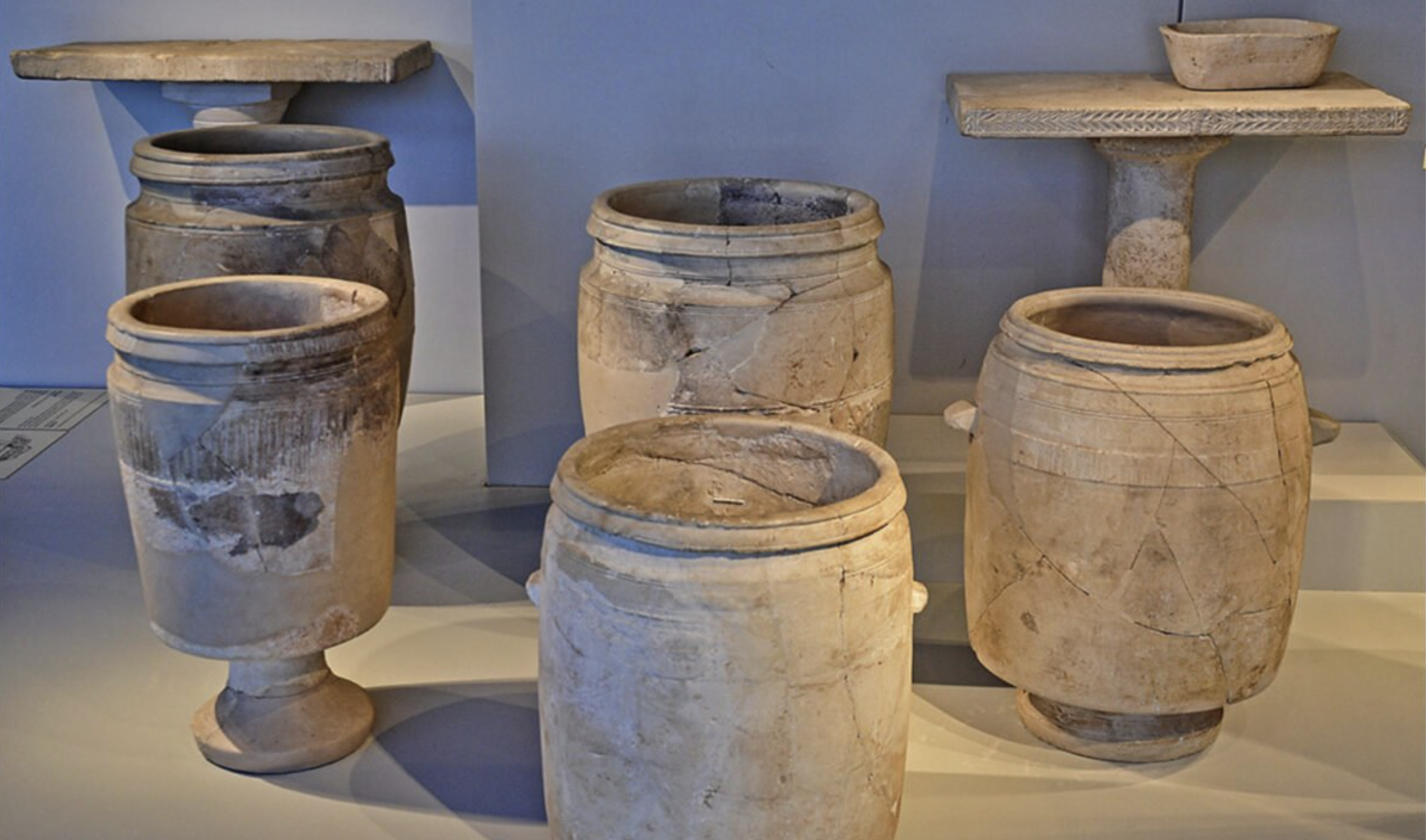
These six water jars, discovered during recent archaeological excavations, provide you with an idea of what the water jars would have looked like. These water jars would be a similar shape and size to the ones described in John 2:6.
The jars would have had to be present for the pre-marital cleansing, which would have occurred within four days prior to the wedding. Interestingly, the amount of water that each jar holds (twenty or thirty gallons) is also recorded in John. This is important because these jars would have had to be large enough for total immersion according to the Jewish ritual practices, but they would also have to hold enough water to satisfy the guests for the remainder of the wedding. Considering that Jewish weddings during Jesus’s time could last up to 7 days, a large amount of water, and thus wine, would be needed.
The implications and symbolism of this miracle are remarkable to our understanding. From what we now know, mikveh was originally associated with water and was later used to mean “hope” and to represent Jesus Christ as our hope, as we have seen recorded in the prophets of the Old Testament. With this understanding, do we see the entirety of God’s plan present in this first miracle, which began Jesus Christ’s public ministry? When Jesus Christ turned the ritually cleansing, purifying water from the stone jars into wine, which would represent His blood?
Throughout the Bible, wine is used to symbolize various things and plays a significant role. In the Old Testament, wine is used in the sacrificial system through drink offerings (where wine was poured out on the altar with the sacrifice) and was required on most annual holy days. In the New Testament, we learn what wine represents and why it is integral to the sacrificial system. Jesus plainly states in Luke 22:20,
“This cup is the new covenant in My blood, which is shed for you.”
No longer is the water of the Old Testament needed, which merely covered sin temporarily. Through Jesus Christ’s blood, we now have access to something far greater as the author of Hebrew states,
“How much more will the blood of Christ, who through the eternal Spirit offered Himself without blemish to God, purify our conscience from dead works to serve the living God. Therefore, He is the Mediator of a new covenant, so that those who are called may receive the promised eternal inheritance, since a death has occurred that redeems them from the transgressions committed under the first covenant.” (Hebrews 9:14-15)
Another noteworthy detail is mentioned within John's account. That is the miracle of turning water into wine happened on the third day (John 2:1). With this miracle happening on the third day and at a wedding, the parallels are once again striking and show us the tremendous symbolism to both Jesus Christ and the Father’s plan. Three days is prominent throughout Jesus's parables and the Old Testament. We reviewed an example of this earlier in Exodus 19:10 when the children of Israel had to wash their clothes and prepare to be in the presence of God for three days. However, the most well-known example of this third day is the sign of Jonah that Jesus gave to the Pharisees as Him being the Messiah (Matthew 12:40).
Through Jesus Christ's first miracle, the plan of God and Jesus's total purpose is revealed to us. Even though the ancient Israelites did not fully understand the mikveh’s (or mikvoth) purpose and usage in their language, they were practicing their hope in God and the One who would come as Jesus Christ. The sacrifices and water purification rituals of the Old Testament could only temporarily cleanse them from their sin, as alluded to in Hebrew 10:14. Jesus Christ's coming, and willful shedding of His blood for us turned the old purification rituals of the Old Testament into an everlasting covenant, symbolized to us through mikveh and thus baptism. We should also remember that all of this happened at a wedding. This miracle symbolizes the whole of God's plan, including its ending, eventually leading to and culminating in the marriage of the Lamb to His Bride as Revelations shows us:
"Let us rejoice and exult and give Him the glory, for the marriage of the Lamb has come, and His Bride has made herself ready…" (Revelation 19:7)
Table of Contents
1. The Beginning: The Origins of Baptism (Part 1)
2. The Washing Away of Sin (Part 2)
3. Mikeveh – A New Meaning (Part 3)
4. The Intertestamental Period: The Silent Years (Part 4)
5. The Hope in Jesus Christ’s Healings (Part 5)
6. Did Jesus Just Turn Water into Wine? (Part 6)
7. The Conclusion: The Hope We Have in What was Promised to Us (Part 7)
THE HOPE IN JESUS CHRIST’s HEALINGS
Were Jesus Christ’s miracles at the Pools of Bethesda and Siloam a coincidence? Archaeology reveals these were actually ancient Mikveh pools. Discover how Jesus used these "collections of water" to prove He was the living fulfillment of Jeremiah’s prophecy: the true Hope of Israel.
What to Know
What It Is – Jesus’ Healings at the Pools - Two of Jesus Christ’s most significant miracles — the healing of the man lame for 38 years (John 5) and the healing of the man blind from birth (John 9) — take place at or involving ancient pools. Recent archaeological discoveries confirm that both Bethesda and Siloam were mikveh pools, ritual baths used for purification and associated with hope and healing in Jewish tradition.
Why These Miracles Are Uniquely Important - John tells us that Jesus performed countless miracles, far more than could be written (John 21:25). Therefore, the ones preserved in Scripture are intentionally chosen. The miracles at Bethesda and Siloam are recorded not only because of the healings themselves but because of the symbolic setting — these were not ordinary pools, but mikvoth deeply tied to Jewish expectations of cleansing, restoration, and spiritual hope.
Pools as Symbols of Hope — and Jesus as the True Source - In John 5, the lame man places his faith in the pool to heal him, waiting decades for the water to be stirred. Jesus corrects this misplaced hope by healing him instantly, showing that no pool— no ritual — holds the power to save. Only Christ does. In John 9, Jesus instructs the blind man to wash in the Pool of Siloam, requiring him to take action. Even then, the pool is only symbolic — the healing still comes from Christ. In both cases, the pools serve as visual lessons: Jesus is the true Mikveh, the true Hope, and the true Healer.
The Archaeological Link to Mikveh Pools - Modern archaeological work — including findings published by the Biblical Archaeology Society — confirms that both pools tied to these miracles were mikvoth. Once seen as places where purity and hope could be found, these ritual baths now become the settings for Christ to reveal that He Himself is the fulfillment of what mikveh represents: cleansing, hope, renewal, and salvation.
From “Waters” to “Hope” — Fulfilled in Christ - In the Old Testament, mikveh originally meant “a collection of waters,” but later prophets — especially Jeremiah — used it to mean “hope” and even applied it directly to God (Jeremiah 14:8; 17:13). Jesus’ miracles at the mikveh pools make this symbolism unmistakable. The pools represented the hope of healing;
Jesus is the true Hope of Israel who actually heals; the physical mikvoth pointed toward cleansing and renewal; Jesus is the One who cleanses spiritually and restores fully.
The True Mikveh of Israel - These miracles reveal that Jesus Christ — “the Lord who heals you” (Exodus 15:26)— is the fulfillment of everything the mikveh symbolized. The lame man and blind man encountered not just water, but the living Mikveh, the Hope of Israel, the Savior who brings complete healing and spiritual renewal.
With this background of mikvoth and their importance to Judaism, some passages in the New Testament begin to take on new meaning and can be seen from a different perspective.
During Jesus Christ’s ministry, He healed many lame, blind, and deaf people. In fact, there are so many of these healings that John tells us:
“Now there are also many other things that Jesus did. Were every one of them to be written, I suppose the world itself could not contain the books that would be written (John 21:25).”
If Jesus Christ performed this many miracles as John wrote, then the ones recorded for us in the New Testament have been included for specific reasons.
Two examples of these healings, and Jesus Christ’s most well-known, are found in the book of John when He heals a man who could not walk for 38 years (John 5:1-8) and a blind man from birth (John 9:7). In reading both of these accounts, notice we are told both of these healings happened at pools, and those pools were directly involved in the healing or mentioned by Jesus. In the first healing, the man who could not walk says to Jesus,
“Sir, I have no one to put me into the pool when the water is stirred up, and while I am going another steps down before me (John 5:6).”
The man is placing his faith in the pool to heal him, but Jesus’ response is direct. The pool will not provide the hope or healing the man seeks, but only the One the man is talking to can do so. Unlike the pool the man is putting his hope into, Jesus Christ only needs to tell the man, “Rise, take up your bed and walk” (John 5:8), and immediately he can. In the second healing, the blind man is not around a pool. Jesus Christ is the one who references the pool in this healing when He tells the blind man, “Go, wash in the pool of Siloam (John 9:7).” Notice in the first healing, Jesus says the pool is not needed for healing and performs the healing Himself; however, in the second healing He asks the blind man to take action by washing and uses the pool in the healing. Even though the pool is directly used in the second healing, the healing the blind man experiences still ultimately comes from Jesus.
Why is it significant that these two healings were performed near pools? Recently, according to Biblical Archaeology Society and other archaeological finds, it has been discovered that both pools mentioned in the healing accounts in John (Bethesda and Siloam) were mikvoth (or mikveh pools). Immediately, the symbolism of what Jesus Christ conveyed in these healings and miracles should become striking. The man who could not walk had been waiting at one of these mikveh most of his life, putting his hope there. Jesus Christ came and became that mikveh for him. The blind man from birth had to take action and use a mikveh to complete his healing in the thing that represented the hope of Jesus Christ. In both of these instances, we begin to see how and why the word initially used as “a collection [of waters]” was inspired by God to be used as “hope” later when the prophets wrote. Eventually these mikvoth would become prevalent around Israel, with their roots based in the hope of physical healing for chronic conditions, representing the future Messiah. Now these mikveh pools had become the places of Jesus Christ’s first public miracles of healing, showing that He was the Mikveh and Savior that Israel had been waiting for as Jeremiah stated,
“O you Hope of Israel, its Savior in time of trouble… (Jeremiah 14:8).”
Jesus Christ, the God of the Old Testament, was Israel’s and is our true “Lord who heals you (Exodus 15:27).”
Table of Contents
1. The Beginning: The Origins of Baptism (Part 1)
2. The Washing Away of Sin (Part 2)
3. Mikeveh – A New Meaning (Part 3)
4. The Intertestamental Period: The Silent Years (Part 4)
5. The Hope in Jesus Christ’s Healings (Part 5)
6. Did Jesus Just Turn Water into Wine? (Part 6)
7. The Conclusion: The Hope We Have in What was Promised to Us (Part 7)
THE INTERTESTAMENTAL PERIOD - THE SILENT YEARS
Between the prophets and the Gospels lie 400 years of silence—but the archaeology speaks volumes. Discover why hundreds of ritual immersion pools began appearing across Israel just before Jesus arrived, and how the "Mikveh" became the physical precursor to Christian baptism.
What to Know
What It Is – Mikveh’s Changing Meaning - The Hebrew word mikveh carries two key meanings in the Old Testament: a “collection of waters” in early writings and “hope” in later prophetic texts. These dual meanings reveal God’s layered use of mikveh to teach both physical purification and spiritual expectation — concepts essential for understanding the origins of baptism.
The Silent Years and the Rise of Ritual Immersion - Between Malachi and the ministry of John the Baptist lies a period of roughly 400 years without prophetic writings. Known as the intertestamental period, this era profoundly shaped Jewish religious life. During this time, the practice of ritual immersion became firmly established through the widespread use of mikveh pools across Israel.
Mikveh Pools in Jewish Life - Beginning in the 2nd century B.C., mikveh pools — stone baths used for ritual purity through immersion — became a defining feature of Jewish communities. Archaeologists have discovered more than 700 mikvoth in Israel alone, with 200 in Jerusalem and 50 near the Temple Mount. Their concentration around the Temple emphasizes their centrality, as countless Jewish pilgrims required ritual cleansing before participating in sacrifices and worship.
Why Mikveh Pools Matter for Understanding Baptism - The strong cultural presence of mikveh pools meant that ritual immersion was already deeply woven into Jewish life by the time Jesus and John the Baptist began their ministries. This explains why the New Testament does not introduce or define baptism at the outset—its foundations were already understood through centuries of ritual immersion tied to purity, repentance, and preparation to approach God.
A Key Connection to Baptism - When the New Testament speaks of baptism, it builds on the established imagery of the mikveh: immersion in water leading to spiritual cleansing and renewed hope. Recognizing mikveh’s development—from “waters,” to “hope,” to ritual immersion—helps reveal the full significance of baptism as both a physical act and a spiritual symbol rooted in ancient Israel.
We have reviewed the term mikveh and see that it has the meaning of “a collection [of waters]” in early Old Testament writings, but “hope” in later Old Testament writings. Both definitions and their usage give us a deeper understanding to what God was conveying when he inspired mikveh to be used in these varying ways. However, although it is not stated in the Old Testament and only came later during the time between the Old and New Testament, another usage of mikveh needs to be understood to recognize its significance and how it relates to baptism entirely. For roughly four hundred years, spanning the ministry of Malachi to John the Baptist, Jewish tradition says no prophet spoke in the land of Israel. Jewish tradition considers this time the silent years from God and scholars refer to this period as the intertestamental period. Even though there were no Biblical writings during this time, many important events happened during this period, which influenced Jewish thinking and prepared the world for Jesus Christ’s arrival and His gospel.
An ancient ritual bath (mikveh pool) outside of Jerusalem.
One such important event from this period was the adoption of the mikveh pool into Jewish life. Only found in Israel, mikveh pools (or mikvoth) began to appear throughout the land of Israel and in historic communities of the Jewish diaspora, starting in the 2nd century B.C. According to the Britannica Encyclopedia, mikvoth are baths used for ritual immersion in Judaism to achieve ritual purity. They can be found in almost any ancient Jewish community due to their strong ties to ritual purity within the Jewish faith. To give you a sense of their importance, according to the publication The Times of Israel, 700 mikvoth have been discovered throughout Israel. Of the 700 mikvoth discovered so far, 200 are found in Jerusalem, and of these, 50 are located near the Temple Mount. The location of these mikvoth, and their strong presence in Jerusalem and near the Temple Mount, clearly show their role and importance. Jerusalem, and especially the Temple Mount, was the center of the sacrificial system during the Old Testament and through the intertestamental period. As a result, there could be thousands of Jewish pilgrims in need of ritual cleansing at any time of the day, with many more thousands above that in need around the holy days.
Interactive Map of Excavated Mikvehs
For those interested in exploring the full distribution of known and excavated mikvehs in West Bank and East Jerusalem, view the interactive map available here.
Table of Contents
1. The Beginning: The Origins of Baptism (Part 1)
2. The Washing Away of Sin (Part 2)
3. Mikeveh – A New Meaning (Part 3)
4. The Intertestamental Period: The Silent Years (Part 4)
5. The Hope in Jesus Christ’s Healings (Part 5)
6. Did Jesus Just Turn Water into Wine? (Part 6)
7. The Conclusion: The Hope We Have in What was Promised to Us (Part 7)
MIKVEH - A NEW MEANING
How can a word for "a collection of water" also mean "hope"? Explore the fascinating Hebrew word mikveh and discover how its transformation from Genesis to Jeremiah reveals the true purpose of baptism and our relationship with the Hope of Israel.
What to Know
What It Is – The Meaning of Mikveh - The Hebrew word mikveh first appears in Genesis 1:10, where God gathers the waters into one place. Traditionally, mikveh means a “collection of waters,” a definition consistently seen throughout the Pentateuch, Chronicles, and Wisdom literature. Verses like Leviticus 11:36 show that a gathered, abundant body of water was considered inherently clean, reinforcing mikveh as a symbol of purity, cleansing, and ritual readiness.
A Term That Evolves Beyond Water - As the Old Testament progresses, mikveh begins to take on a new and surprising meaning. In Ezra 10:2, after Israel’s sin of taking pagan wives, the word appears in a different sense: “now there is hope in Israel.” Here, mikveh shifts from describing waters to expressing the idea of hope — a striking transformation given its long-established connection with cleansing.
Mikveh as “Hope” — A Title of God Himself - Jeremiah expands this meaning even further. Twice he calls God “the Hope (Mikveh) of Israel” (Jeremiah 14:8; 17:13). Instead of using the standard Hebrew word for “hope,” tikveh, Jeremiah assigns the term mikveh to God, revealing a deeper theological truth: God Himself is the source of cleansing, restoration, and true hope.
Why Mikveh Shifts in Meaning - The shift from “collection of waters” to “hope” is deliberate. Throughout Scripture, water symbolizes purification, renewal, and restoration — all qualities that ultimately come from God. As Israel returns from exile and confronts its sin, the use of mikveh highlights that the same God who cleanses is the One who gives hope.
The Connection to Baptism - Understanding mikveh is essential for understanding baptism. The word links cleansing water with spiritual hope, tying the physical symbol to the deeper reality it represents. Baptism unites both meanings: it is immersion in water (a mikveh) and an expression of hope in God’s cleansing, saving work.
The first time that mikveh is used in the Bible is in Genesis 1:10, when “God called the dry land Earth, and the gathering together of the waters He called Seas.” According to many online sources, including Strong’s Concordance, the word “gathering together” used in this verse is mikveh and means “a collection.” Most online sources, such as Blue Letter Bible, and various Hebrew sources like Mikvah.org, define mikveh as “a collection [of waters]” due to the word’s strong and repeated connection with water. Throughout the Pentateuch (the first five books of the Bible), the Chronicles of the Kings, (1st and 2nd Chronicles and Kings), and the Books of Wisdom (Job, Psalms, and Proverbs) we see mikveh used in a similar way to mean “a collection [of water].” We see a noticeable example of the usage of mikveh in Leviticus 11:36:

An artistic representation of a cistern filled with clear, “living” water. Surrounded by lush greenery, this scene reflects the biblical setting of ritual cleansing described in Leviticus 11:36, where a natural “collection of waters” is considered clean.
“Nevertheless a spring or a cistern, in which there is plenty of water, shall be clean, but whatever touches any such carcass becomes unclean.” (Leviticus 11:36)
This verse is referring to the cleanliness laws found in the Old Testament and when something should be deemed clean or unclean. Notice that a collection of waters (or, as the verse says, ‘plenty of water’) is always clean. Throughout the early books of the Old Testament, we see the same imagery being conveyed of mikveh as it relates to water. However, as we progress through the Old Testament, we see mikveh used in a different and interesting way. In Ezra, we see a clear example of the different way mikveh begins to be used. At the end of the verse, Shekaniah is recorded as saying,
“…we have trespassed against our God, and have taken pagan wives from the people of the land; yet now there is hope in Israel in spite of this.” (Ezra 10:2)
(Note: although Ezra is near the beginning of the Bible in most versions, Ezra was written after the exile of Israel from the land by the Babylonians, closer to the writings of the major prophets).
At the time this book was written, the people with Ezra clearly understood they did wrong against God with their actions. However, with all their work in restoring the Temple and Jerusalem, the remark of “now there is hope in Israel in spite of this” is a peculiar usage of mikveh in this context. Why is mikveh, previously only used to mean “a collection [of waters],” now being used in a context to mean “hope?” Jeremiah gives us a more striking example of mikveh being used in this new manner and relates this word directly to God. In order to gain the proper context for what Jeremiah is talking about in these verses, we will begin with the preceding verse,
“O LORD, though our iniquities testify against us, do it for Your name’s sake; for our backslidings are many, we have sinned against You. O the Hope of Israel, his Savior in times of trouble…” (Jeremiah 14:7-8)
Similar to the verses we read in Ezra, these verses in Jeremiah talk about the iniquities and sins that the people have committed against God. Moreover, similar to Ezra, Jeremiah also incorporates this new meaning of mikveh by calling God “The Hope (Mikveh) of Israel.” This is not a one-time occurrence either, as Jeremiah also makes use of the different meaning of mikveh again later on,
“LORD, You are the Hope (Mikveh) of Israel; all who forsake You will be put to shame.” (Jeremiah 17:13)
According to the Blue Letter Bible and various online sources, the Old Testament already had a word for “hope” that appears 32 times. This word is tikveh, meaning “an expectation” or “to hope for.” This discovery and the preceding verses related to mikveh prompt several important questions. What does it mean that God is the Mikveh of Israel and, therefore, our Mikveh, as Jeremiah says in Jeremiah 14:8? Why does mikveh change from “a collection [of waters] to “hope” rather than employing “tikveh?” Moreover, what connection does mikveh have to the concept of baptism?
Table of Contents
1. The Beginning: The Origins of Baptism (Part 1)
2. The Washing Away of Sin (Part 2)
3. Mikeveh – A New Meaning (Part 3)
4. The Intertestamental Period: The Silent Years (Part 4)
5. The Hope in Jesus Christ’s Healings (Part 5)
6. Did Jesus Just Turn Water into Wine? (Part 6)
7. The Conclusion: The Hope We Have in What was Promised to Us (Part 7)
THE WASHING AWAY OF SIN
Before there was "Baptism," there was the ritual washing of the Hebrews. Discover why God commanded three-day cleansings at Sinai and how the ancient Israelites understood the link between physical water and spiritual purity long before the New Testament was written.
What to Know
What It Is – Ritual Cleansing in Scripture - The practice of washing with water for ritual purification is woven throughout the Old and New Testaments. From the cleansing of Israel before meeting God at Sinai (Exodus 19:10) to David’s plea for spiritual washing (Psalm 51:7), Scripture consistently presents water as a symbol of consecration, purity, and preparation to meet God.
A Symbol of Readiness to Enter God’s Presence - Ritual cleansing was not superficial — It often required multiple days of washing and preparation. These washings signified that approaching God required purification of both body and heart. Even in Revelation 7:14, those who endure the Great Tribulation are described as having “washed their robes…in the blood of the Lamb,” showing that spiritual cleansing remains central in God’s plan.
A Practice Deeply Rooted in Israel’s Daily Life - Biblical law required washing in numerous situations — after a woman’s monthly cycle (Leviticus 15:21-22); after healing from disease or skin conditions (Leviticus 14:7-9); after contact with a dead body (Numbers 19:11-13); before offering sacrifices (Exodus 29:4). For priests, failure to wash properly—especially on holy days—could even result in death, demonstrating how seriously God regarded this act of purification.
Physical Cleansing Pointing to Spiritual Cleansing - Although ritual washing symbolized purification, God always desired inner cleansing above external ceremony. David recognized this when he connected washing with the removal of sin (Psalm 51). Jesus confronted the Pharisees for appearing outwardly clean but being inwardly corrupt (Matthew 23:27), reinforcing that true cleansing must be spiritual, sincere, and transformative.
Washing as a Foundation for Understanding Baptism - Because ritual washing was central to Israel’s worship and identity, the concept of cleansing through water was already deeply understood long before John the Baptist or Jesus Christ appeared. This explains why baptism is not defined at the start of the New Testament—its symbolism had already been introduced through centuries of ritual purifications in the Old Testament.
The Missing Link – The Meaning Behind Washing - All ritual washing pointed to a greater spiritual reality. To understand baptism’s full symbolism, we must examine a single key Hebrew word: mikveh—a term that reveals the deeper meaning behind washing, purity, hope, and God’s plan for spiritual renewal.
The use of water for ritual cleansing was important to the Hebrews. In fact, the practice can be seen throughout Scripture in both the Old and New Testaments. God commanded Moses in Exodus 19:10:
“Go to the people and consecrate them today and tomorrow; and let them wash their clothes. And let them be ready for the third day. For on the third day the LORD will come down upon Mount Sinai in the sight of all the people.”
This wasn’t a simple process either, but a thorough cleansing as the process would last three days. David alluded to a cleansing like this in Psalms 51:7 when he says,
“Purge me with hyssop, and I shall be clean: wash me, and I shall be whiter than snow.”
Jesus Christ also references the cleansing that is required for His followers through The Great Tribulation when He says,
“These are the ones who come out of the Great Tribulation and washed their robes and made them white in the blood of the Lamb.” (Revelation 7:14)
The practice of ritual cleansing through water to come into God’s presence was not only applied to the washing of clothes. The practice was similarly applied to the washing of oneself to become ritually cleansed as well. In Leviticus 15:21-22, we see that women were commanded to wash themselves after their monthly cycle. Leviticus 14:7-9 shows us that the act of washing was also required after recovering from a skin disease, like leprosy, or when coming into contact with a corpse, as mentioned in Numbers 19:11-13. The act of washing oneself in water was so significant and important to God, that it was even commanded of Aaron and of his sons. In Exodus we read,
“And Aaron and his sons you shall bring to the door of the tabernacle of meeting, and you shall wash them with water.” (Exodus 29:4)
Aaron and his sons were required to wash themselves before offering any sacrifices to God, especially on the High Day of Atonement. This washing was so important that failure to not wash properly would result in death.
The symbolism of immersing oneself in water to become ritually, and thus, spiritually cleansed was well understood to the ancient Israelites as this concept is pervasive throughout the Old Testament. However, even though God wanted the Israelites to practice this ritual cleansing for what it symbolized (just like how God commanded the Israelites to keep the Passover even though the full meaning wouldn’t be revealed to them until nearly 1,200 years later), He was more interested in their spiritual cleansing. Although Psalm 51:7 was mentioned earlier, washing oneself from sin was on David’s mind throughout Psalm 51 as he correlates this washing to burnt sacrifices and the removal of sin. Jesus Christ also elaborates on the spiritual cleansing He desires from His followers, when He tells the Pharisees,
“Woe to you, scribes and Pharisees, hypocrites! For you are like whitewashed tombs which indeed appear beautiful outwardly, but inside are full of dead men’s bones and all uncleanness.” (Matthew 23:27)
Even though on the outside the Pharisees appeared righteous and interested in following God’s law, on the inside they were actually ‘whitewashed.’ Their true interest in following God’s law was primarily for their own personal gain. Likewise, major prophets such as Jeremiah, Ezra, and Zechariah also allude to this symbolism throughout their writings.
So, with this background and seeing the pervasiveness of washing throughout the Old Testament, are we now able to begin to see why the concept of baptism, and what it symbolized, was not defined at the beginning of the New Testament? Perhaps, but there is still a missing, and very important piece, related to washing and its link to baptism. After all, we know that the act of washing was only symbolic of the type of spiritual cleansing that Jesus Christ desires of His Followers.
So, what does it symbolize?
We can begin to understand the symbolism more fully through a single Hebrew word – mikveh.
Table of Contents
1. The Beginning: The Origins of Baptism (Part 1)
2. The Washing Away of Sin (Part 2)
3. Mikeveh – A New Meaning (Part 3)
4. The Intertestamental Period: The Silent Years (Part 4)
5. The Hope in Jesus Christ’s Healings (Part 5)
6. Did Jesus Just Turn Water into Wine? (Part 6)
7. The Conclusion: The Hope We Have in What was Promised to Us (Part 7)
THE BEGINNING: THE ORIGINS OF BAPTISM
Why did the Pharisees recognize baptism before it was ever explained in the New Testament? Discover the "missing" history of this sacred rite and why Jesus Christ’s immersion was a monumental turning point in God’s plan for humanity.
What to Know
What It Is – The Baptism of Jesus Christ is a defining moment recorded in three gospels (Matthew, Mark, Luke) and referenced in John — a rare fourfold witness emphasizing its central role in the New Testament and the plan of God. At Christ’s baptism, the Holy Spirit descended upon Him, confirming Jesus as the Son of God and the One who would baptize with the Holy Spirit (John 1:33–35).
A Pivotal Event in God’s Plan - Scripture shows that Jesus’ baptism was foreordained before the foundation of the world (1 Peter 1:20). God highlights this event multiple times because it marks the beginning of Christ’s public ministry and reveals His divine identity and purpose.
The First Introduction to Baptism in the Bible - When reading the Bible from beginning to end, Jesus’ baptism is the first major appearance of baptism — before its meaning is ever explained. The gospel writers present it as inherently significant, assuming readers recognize its importance, even though its spiritual meaning is clarified later.
Baptism’s Meaning Explained Later in Scripture - The purpose of baptism is first hinted at in John 3, where Jesus describes its connection to being “born again.” The full explanation comes after Christ’s resurrection in Acts 2:38 and Acts 22:16, identifying baptism as the moment of repentance, forgiveness, and the washing away of sins. Paul later summarizes baptism’s meaning: it symbolizes being buried with Christ and rising to walk in newness of life (Romans 6:3–4).
Why the Pharisees Already Understood Baptism - In John 1:25–26, the Pharisees never ask what baptism is. Instead, they ask John why he is baptizing — showing that ritual washing and purification were already well understood in Jewish culture. Only someone with prophetic authority was expected to baptize, which is why John’s actions demanded explanation.
Old Testament Roots and Cultural Background - While the practice of baptism doesn’t formally appear in the Old Testament, its conceptual foundation — cleansing, repentance, purification, and renewal — runs throughout Scripture. The Hebrew language itself reflects a culture centered on God’s law, containing multiple nuanced terms for sin, purification, and love. These linguistic roots help illuminate the deeper meaning of baptism as it unfolds in the New Testament.
In the first book of the New Testament, an important event takes place – Jesus Christ’s baptism. This event is so significant that not only is it recorded in the first book of the New Testament (Matthew), but directly in three of the four gospels (Matthew, Mark, and Luke). Further, reference to Jesus’s baptism is also made in the fourth gospel, John, where he says,
“I did not know Him, but He who sent me to baptize with water said to me, ‘Upon whom you see the Sprit descending, and remaining on Him, this is He, who baptizes with the Holy Spirit.’ And I have seen and testified that this is the Son of God.” (John 1:33-35)
When God states something in the Bible twice, we know it’s important for us to take notice and action, if applicable. When God inspires something to be repeated four times to give abundant witness, we know it is something truly significant, and in this case, a monumental moment in the plan of God. Peter alludes to why this event was so significant in his first epistle,
“He [Jesus Christ] indeed was foreordained before the foundation of the world, but was manifest in these last times for you…”
(1 Peter 1:20)
Part of God’s plan is being shown to us through Jesus Christ’s baptism.
Reading through the various accounts of Jesus Christ’s baptism in the gospels, you may notice something perplexing, but noteworthy which occurs with baptism in general. If you had no prior knowledge of the Bible and read through it for the first time from beginning to end, Jesus’s baptism would be the first time you would be formally introduced to the concept and practice. The definition of baptism, what it means, and its representation within the plan of God isn’t explained beforehand, but only after.
The first such instance in the Bible where the purpose of baptism is alluded to is in John 3. Jesus, while talking to Nicodemus, expounds on baptism’s role as being vital for the new spiritual birth that must take place for believers to enter the Kingdom of God. However, the role of baptism isn’t specifically defined until after Jesus’s crucifixion in Acts where we are told that baptism represents “the remission of sins” (Acts 2:38; 22:16).
These verses illustrating the role of baptism were not inspired and written until some 20-30 years after Jesus’s crucifixion. In spite of this, at the time we read about Jesus Christ’s baptism in the gospels, the authors intend for us to immediately understand its significance, importance, and meaning. This is illustrated to us in John, where it says,
“They [the Pharisees] asked him [John the Baptist], ‘Then why are you baptizing, if you are neither the Christ, nor Elijah, nor the Prophet?’ John answered them, ‘I baptize with water, but among you stands one you do not know, even He who comes after me, the strap of whose sandal I am not worthy to untie.” (John 1:25-26)
The Pharisees don’t ask John what baptizing is or its significance. They grasp the importance since to them only someone of prominence like a prophet or the Messiah has the authority to baptize. They instead ask him why he is baptizing.
This is puzzling because although baptism’s origins can begin to be traced back to the Old Testament, the full concept of burying your old self and becoming a new person through baptism is first recorded by Paul, some 20-30 years after Jesus’ crucifixion. Paul explains baptism’s role to the believers in Rome in his epistle to them,
“Or do you not know that as many of us as were baptized into Christ Jesus were baptized into His death? Therefore, we were buried with Him through baptism into death, that just as Christ was raised from the dead by the glory of the Father, even so we also should walk in newness of life.” (Romans 6:3-4)
These examples force us to ask ourselves, why did this occur this way in the Biblical narrative? Is it simply because the authors of the New Testament forgot to explain baptism’s importance? Or perhaps it was because the practice was only adopted right before Jesus Christ, so as a result didn’t appear in the Old Testament? Regardless, we will look at these questions and others. While looking, we will discover that there is so much more to baptism, and its true meaning, then what we may have originally thought.
To fully understand the importance of baptism and its origins, we need to go back to the Old Testament. The practice of baptism doesn’t show up in the Old Testament, but the concept and roots go all the way back to Genesis. However, before preceding it’s important to point out something necessary to our understanding of this topic. Through language, we are able to see what topics are important to different cultures. For example, if you look at present-day English you can see topics that we hold important in our society with the recent creation of more words and phrases revolving around technology. The same concept can be applied to any society or language, and this is especially true of ancient Hebrew. The Hebrew language revolves around God and His law. Such things were an important aspect of their life, so their language was developed and evolved to represent that. Similar to our earlier example regarding present-day English, if we do the same with Hebrew, we see there are three different Hebrew words for describing both sin and love. Both of these words are important to construct a proper relationship with God (contrast this to English where there is only one word for “love”, and ancient Greek where there are four different words for “love” - showing us the priority of these cultures). Knowing what beliefs are important to different cultures at different times will be especially important, as we will see with this concept throughout the Old Testament. The meaning of certain words changes, which gives us a clearer understanding to their original intent, and eventually to their complete meaning.
Table of Contents
1. The Beginning: The Origins of Baptism (Part 1)
2. The Washing Away of Sin (Part 2)
3. Mikeveh – A New Meaning (Part 3)
4. The Intertestamental Period: The Silent Years (Part 4)
5. The Hope in Jesus Christ’s Healings (Part 5)
6. Did Jesus Just Turn Water into Wine? (Part 6)
7. The Conclusion: The Hope We Have in What was Promised to Us (Part 7)

THE EIGHTH DAY
What happens after the Millennium? Discover "The Eighth Day"—the final step in God’s plan that offers every human being who ever lived a fair and just opportunity for salvation. Explore the mystery of the Great White Throne Judgment and the moment death itself is defeated forever.
What to Know
What It Is – The Eighth Day, also called The Last Great Day, is a separate and distinct holy day that follows the seven days of The Feast of Tabernacles (Leviticus 23:36). Though closely connected in timing, it represents the final step in God’s redemptive plan, looking beyond the Millennial reign of Christ to the ultimate fulfillment of God’s purpose for humanity.
A Distinct Celebration of Renewal – While The Feast of Tabernacles pictures Christ’s thousand-year reign, The Eighth Day looks beyond it — to a time when all who have ever lived will be resurrected and given the opportunity to know God. It reveals God’s perfect justice and mercy, offering salvation to all and symbolizing the completion of His plan for mankind.
Biblical and Spiritual Meaning – The number eight in Scripture signifies new beginnings and eternal life. Circumcision on the eighth day (Genesis 17:12) and the dedication of the Tabernacle after seven days of preparation both point to renewal and covenant relationship. Likewise, The Eighth Day symbolizes the ultimate renewal of creation and the beginning of eternal fellowship between God and His redeemed family.
Resurrection and Judgment – In Revelation 20:11–15, The Eighth Day corresponds to the Great White Throne Judgment, when the dead are raised and judged according to their works. This time reveals God’s fairness and mercy, granting every person the chance to know Him. When this judgment is complete, sin and death are eradicated forever — “Death and Hades were cast into the lake of fire” (Revelation 20:14).
God Dwelling with Humanity – The Eighth Day culminates in the vision of Revelation 21:1–4, where God the Father Himself comes to dwell — literally to “tabernacle” — with humanity. For the first time, both the Father and the Son live eternally with their redeemed family. This marks the completion of God’s plan, when sorrow, pain, and death are no more.
Spiritual Meaning for Believers Today – The Eighth Day celebrates the hope of final redemption, the end of sin and death, and the eternal unity of God and His people. It reminds believers of God’s desire “to bring many sons to glory” (Hebrews 2:10) and of His promise to make all things new. Far from being an ancient custom, it points to the ultimate renewal of creation and the everlasting joy of dwelling with God forever.
Just as Passover and the Days of Unleavened Bread are often perceived as one continuous celebration, a similar misconception occurs with The Feast of Tabernacles and The Eighth Day, also known as the Last Great Day. Despite their close timing, The Eighth Day is a distinct holy day, separate from the Feast of Tabernacles, and holds profound and special significance as it symbolizes the final step in God’s redemptive plan for humanity.
While many Christians are either unfamiliar with The Eighth Day or dismiss it as merely a Jewish tradition or holy day, The Eighth Day uniquely reveals the culmination of God’s plan, emphasizing His justice, fairness, and mercy to all humanity. Unlike mainstream Christian teachings, The Eighth Day highlights God’s comprehensive plan for salvation, offering the hope of resurrection and the opportunity for eternal life to all who choose His way. Observing this day allows believers to reflect deeply on the hope it represents, the inclusivity of God’s Kingdom, and the final fulfillment of His redemptive work for humanity.
The Eighth Day, like the other holy days, is introduced in Leviticus 23:36, where it is described as a sacred assembly following the seven-day Feast of Tabernacles. However, unlike other holy days that often commemorate historical events or agricultural milestones in the Old Testament, The Eighth Day exclusively points toward the future, symbolizing the completion of God’s plan for humanity. It is a day of solemn reflection and rejoicing, distinct from the preceding Feasts and set apart as a unique celebration in God’s holy calendar.
The number eight holds profound symbolic meaning in the Bible, often representing new beginnings, renewal, and eternal life. For instance, circumcision, the sign of God’s covenant with Abraham, was performed on the eighth day (Genesis 17:12), signifying entry into a covenant relationship with God. Similarly, the Tabernacle was dedicated to God on the eighth day following seven days of preparation, a concept mirrored by the preceding Feast of Tabernacles. The Eighth Day, or Last Great Day, therefore, encapsulates the ultimate renewal of creation and the establishment of an eternal relationship between God and all humanity. This holy day reminds believers of God’s promise to complete His redemptive work, offering hope and assurance of a future where His presence and Kingdom are fully realized.
The deeper significance of The Eighth Day becomes evident in the New Testament, where it is closely tied to themes of resurrection, judgment, and the ultimate fulfillment of God’s redemptive plan. In Revelation 20:11-15, the apostle John describes the Great White Throne Judgment, where all the dead are resurrected and judged according to their deeds. This pivotal event occurs after Christ’s millennial reign, symbolizing the final phase of God’s plan for humanity. The Eighth Day represents this monumental resurrection and judgment, offering those who have never had the opportunity to know God the chance to learn His ways and choose salvation. This period underscores God’s perfect justice and mercy, granting all humanity the opportunity to be reconciled to Him.
Following this judgement, the Bible makes clear that sin and its influence will be entirely eradicated from God’s renewed creation. Revelation 20:11-15 reveals that those whose names are not found in the Book of Life are cast into the lake of fire, along with Death and Hades, symbolizing the second death. Earlier, Satan — the original instigator of sin — is also thrown into the lake of fire (Revelation 20:10). With the removal of Satan and unrepentant sinners, no source will remain to perpetuate sin. This is further supported in the description of the New Jerusalem in Revelation 21:27, which states, “But there shall by no means enter it anything that defiles, or causes an abomination or a lie.” Additionally, Revelation 22:3 declares, “And there shall be no more curse,” referring to the curse introduced by sin in Genesis 3:17–19.
For the first time since the fall of man, sin and its curse will no longer exist in any form. The wages of sin is death (Romans 6:23); and with death itself cast into the lake of fire, the very evidence of sin’s existence will vanish forever. Freed from corruption, creation will at last reflect the perfect righteousness and eternal life that God intended from the beginning.
The connection between The Eighth Day and resurrection is also highlighted in John 7:37-39, where Jesus stood on the final day of the Feast of Tabernacles and declared, “If anyone thirsts, let him come to Me and drink. Whoever believes in Me, as the Scripture has said, ‘Out of his heart will flow rivers of living water.’” John clarifies that Jesus was referring to the Holy Spirit, which would later be given to believers. This powerful declaration on the final day of the Feast of Tabernacles connects to The Eighth Day. It prophesied that God’s Spirit would be poured out on all flesh (Joel 2:28-29), enabling all humanity to come to a saving knowledge of God. The imagery of living water reflects the ultimate fulfillment of God’s plan: a time when spiritual thirst will be quenched, and humanity will dwell in perfect harmony with God.
The prophetic significance of The Eighth Day reaches far beyond resurrection and judgment — it points to the ultimate fulfillment of God’s plan: the creation of a new heaven and a new earth. In Revelation 21:1–4, John describes a breathtaking vision of the New Jerusalem, where God the Father Himself will finally come down to dwell — literally to “tabernacle” — with humanity. No longer will His presence be mediated solely through Jesus Christ; rather, both the Father and the Son will dwell together with their redeemed people.
“Behold, the tabernacle of God is with men, and He will dwell with them, and they shall be His people, and God Himself will be with them and be their God.” This marks the first time the Father personally dwells with His spiritual family, completing His divine purpose to live among His children forever.
“He will wipe away every tear from their eyes, and death shall be no more; neither shall there be mourning, nor crying, nor pain anymore, for the former things have passed away.”
The Eighth Day thus represents this final renewal — when sin and death are completely eradicated, the curse is lifted, and God’s Kingdom is fully established as both the Father and Christ share their eternal presence with humanity. Jesus Christ Himself alluded to this ultimate relationship in John 17:3, declaring, “This is eternal life, that they may know You, the only true God, and Jesus Christ whom You have sent.”
The Eighth Day celebrates the culmination of God’s redemptive plan and the dawn of a new chapter in His relationship with humanity. The apostle Paul captures this transition in 1 Corinthians 15:24–28, where he explains: “Then comes the end, when He [Christ] delivers the Kingdom to the Father after destroying every rule and every authority and power. For He must reign until He has put all enemies under His feet. The last enemy to be destroyed is death.” When all things are finally subdued under Christ’s authority, He will deliver the perfected Kingdom to the Father, “that God may be all in all.”
John’s vision in Revelation harmonizes perfectly with Paul’s words. In Revelation 20:14, John records, “Then Death and Hades were cast into the lake of fire,” signifying the complete and final defeat of death. At that moment, all things are placed under Christ’s dominion and then presented to the Father. Finally, as Revelation 21:3 declares, “God Himself will be with them and be their God,” revealing the eternal union between God and humanity — a relationship perfected in love, peace, and everlasting life.
The Eighth Day celebrates this ultimate renewal, the final victory over sin and death, and the beginning of an everlasting relationship with God. It encapsulates the hope, promise, and fulfillment of God’s redemptive plan.
The Eighth Day stands as the crowning jewel of God’s redemptive plan, symbolizing the fulfillment of His purpose to bring salvation to all humanity and restore creation to its intended glory. Far from being an outdated Jewish holy day, The Eighth Day encapsulates the culmination of the profound themes woven throughout God’s holy days: redemption through the Passover; sanctification through The Days of Unleavened Bread; empowerment through the giving of the Holy Spirit at Pentecost; judgment through the Feast of Trumpets; atonement through the Day of Atonement; and restoration and joy through The Feast of Tabernacles. The Eighth Day unites these elements, pointing to the final realization of God’s eternal plan— a state of everlasting peace and joy where all of creation will dwell in harmony with its Creator.
No other religion offers a concept as extraordinary as The Eighth Day — a divine symbol of fairness, justice, and opportunity, extending God’s invitation to every human being to become part of His family and the chance to inherit eternal life. Unlike the man-made holidays most Christians observe, which often lack spiritual depth and divine mandate, God’s holy days — including The Eighth Day — are commanded by God and are rich with meaning. They not only provide believers with an opportunity to reflect on God’s redemptive plan, but also invites them to actively participate in it, rehearsing the steps of salvation and transformation year after year.
The Eighth Day (and all the other Feasts of God) is more than just a celebration; it is a profound declaration of God’s justice, mercy, and love, offering a hope that no other faith or philosophy can match. The Eighth Day points to the ultimate fulfillment of God’s promise to “bring many sons to glory” (Hebrews 2:10) and to establish His eternal Kingdom where righteousness and peace will reign. As followers of Christ, we are called not to dismiss these holy days, but to embrace them as a living expression of our faith and a reminder of the glorious future that awaits all who choose God’s way. The Eighth Day is not merely a commandment — it is an unparalleled gift, an invitation to rejoice in the boundless hope of God’s eternal plan.

THE FEAST OF TABERNACLES
Why did Jesus Christ "pitch His tent" among us? Discover the joy of the Feast of Tabernacles—the seven-day celebration of God’s dwelling with man.
What to Know
What It Is – The Feast of Tabernacles (Sukkot) is a seven-day feast beginning on the fifteenth day of the seventh month (Leviticus 23:33–43). It is the most joyous of God’s appointed times, celebrating His provision, presence, and the ultimate hope of His Kingdom.
A Time of Rejoicing and Thanksgiving – God commands His people to rejoice during the Feast of Tabernacles (Leviticus 23:40; Deuteronomy 16:13–15). It marked the final harvest of the year and reminded Israel of God’s faithful provision during their wilderness journey, when they lived in temporary shelters and depended completely on Him.
God’s Presence Among His People – The Feast of Tabernacles commemorates God’s desire to dwell with His people. The Tabernacle in the wilderness symbolized His presence, later fulfilled through Jesus Christ, who “became flesh and dwelt [tabernacled] among us” (John 1:14). Through Him, God’s presence is no longer distant but personal and transformative.
Prophetic Meaning – The Feast of Tabernacles points to the coming Kingdom of God, when Christ will reign on Earth and all nations will worship Him. Zechariah 14:16–19 and Ezekiel 45:25 reveal that this Feast will be observed during the Millennial Reign of Christ, symbolizing the unity and peace of all humanity under His rule.
Foreshadowing God’s Eternal Kingdom – The Feast of Tabernacles looks forward to the ultimate fulfillment of God’s promise: “Behold, the dwelling place of God is with man” (Revelation 21:3). It represents the time when sin, sorrow, and death will be no more, and God will dwell eternally with His redeemed creation.
A Lesson in Temporary Dwelling – By living in booths, believers are reminded of life’s temporary nature and their dependence on God. As Hebrews 11:13–16 teaches, God’s people are “strangers and pilgrims on the earth,” looking toward a better, heavenly country and the permanence of God’s eternal Kingdom.
Spiritual Meaning for Believers Today – The Feast of Tabernacles invites followers of Christ to rejoice in God’s blessings, trust in His provision, and look forward to His ultimate return. It celebrates the coming restoration of all things and the time when God’s Kingdom will fill the earth with righteousness and peace.

The Feast of Tabernacles, or Sukkot, is described in the Bible as the most joyful of God’s appointed holy days, rich with prophetic and spiritual meaning for Christians today. The Feast of Tabernacles symbolizes God’s provision, His abiding presence, and His ultimate plan to dwell with His people. While many Christians today regard the Feast of Tabernacles as merely a Jewish custom or outdated under the New Covenant, it is in fact central to God’s receptive plan for all humanity - foreshadowing the establishment of Jesus Christ’s Kingdom as prophesied throughout Scripture. Observing the Feast of Tabernacles provides a powerful opportunity to express gratitude, celebrate God’s blessings, and look forward to the glorious future of His Kingdom when His presence will dwell with us forever.
The Feast of Tabernacles, introduced in Leviticus 23:33-43, is a seven-day Feast and celebration beginning on the 15th day of the seventh month. In the Old Testament, this Feast marked the end of the agricultural year, celebrating the final harvest and God’s abundant provision for the Israelites. It was also a time for the nation to remember and reflect on their wilderness journey, during which they lived in temporary shelters and relied entirely on God for their sustenance. As part of this observance, God instructed His people to dwell in booths (temporary structures) during the Feast of Tabernacles as a reminder of their dependence on Him and His faithfulness in delivering them from Egypt and sustaining them in the wilderness. Furthermore, God commanded that this Feast be a time of rejoicing and thanksgiving, as seen in Leviticus 23:40 and Deuteronomy 16:13-15, emphasizing the joy and gratitude for His blessings.
The Feast of Tabernacles carries a deeper meaning in the Old Testament, centering on God’s presence with His people. The wilderness journey not only tested the Israelites’ faith, but also demonstrated God’s desire to dwell among them. The Tabernacle, or tent of meeting, was a temporary structure that symbolized His presence during this time (Exodus 25:8-9). Later, this temporary dwelling was replaced by the permanent Temple built by Solomon, as Solomon declared in 1 Kings 8:13, “I have surely built You an exalted house, and a place for You to dwell in forever.” The Feast of Tabernacles, therefore, celebrates the reality that God is not distant, but intimately involved in the lives of His people. It also serves as a powerful reminder of the temporary nature of earthly life and the importance of trusting in God’s eternal promises.
In the New Testament, the Feast of Tabernacles takes on even greater significance through its connection to Jesus Christ and the future Kingdom of God. John 1:14 uses imagery tied to the Tabernacle to describe Christ’s incarnation: “The Word became flesh and made His dwelling among us.” The Greek word for “dwelling” (skēnoō) means “to pitch a tent” or “tabernacle.” This language illustrates that Jesus Christ, the Word, “tabernacled” among humanity, directly linking Him to the Old Testament Tabernacle. This verse reveals that Jesus, as the fulfillment of God’s presence with His people, embodies the ultimate meaning of the Feast of Tabernacles. Through Christ, God came to dwell with humanity in a more personal and profound way than ever before.
The prophetic significance of the Feast of Tabernacles extends beyond Christ’s first coming to His return and the establishment of God’s Kingdom on Earth. Zechariah 14:16-19 prophesies that all nations will observe the Feast of Tabernacles during Christ’s millennial reign. This passage underscores that the Feast of Tabernacles is not merely a historical observance, but a timeless celebration of God’s sovereignty and His soon-coming reign. The gathering of nations to worship the King, Jesus Christ, symbolizes the unity of humanity under God’s rule and fulfills the promise of Habakkuk 2:14: “The earth shall be filled with the knowledge of the glory of the Lord, as the waters cover the sea.” Similarly, Ezekiel 45:25 confirms that the Feast of Tabernacles will be observed during God’s Kingdom: “In the seventh month, on the fifteenth day of the month (the Feast of Tabernacles), He [the prince of Jesus Christ] shall do likewise for seven days, according to the sin offering, the burnt offering, the grain offering, and the oil.” These prophetic passages affirm the ongoing relevance of the Feast of Tabernacles in God’s redemptive plan.
The New Testament further associates the Feast of Tabernacles with the ultimate restoration of all things and God’s eternal dwelling with humanity. Revelation 21:3 describes the culmination of this plan: “Behold, the dwelling place of God is with man. He will dwell with them, and they will be His people, and God Himself will be with them as their God.” This vision of the New Jerusalem, where God permanently “tabernacles” with His people, reflects the core themes of the Feast of Tabernacles — God’s presence, provision, and eternal relationship with His people. Observing the Feast of Tabernacles allows believers to look forward to this future reality, aligning their lives with the hope and joy of God’s soon coming Kingdom. It serves as a reminder of His faithfulness and His desire to dwell with humanity forever.
The Feast of Tabernacles also presents a fascinating paradox to consider: while God’s Kingdom is described as everlasting — “an everlasting dominion, which shall not pass away, and His Kingdom the one which shall not be destroyed” (Daniel 7:14 ) — God commands this Feast to be kept in “booths” or “temporary dwellings” (Leviticus 23:42-43). This apparent paradox carries a profound lesson about the transient nature of earthly life. By dwelling in temporary shelters, believers are reminded of their dependence on God and the fleeting nature of human existence.
Hebrews 11:13-16 highlights this perspective, describing the faithful as “strangers and exiles on the earth,” who long for “a better, heavenly country.” The Feast of Tabernacles encourages believers to embrace this mindset, living as sojourners who trust in God’s provision and remain focused on His eternal promise of dwelling with His people forever. It serves as a call to prioritize spiritual over worldly pursuits, fostering a sense of reliance on God and a forward-looking faith in His Kingdom.
Additionally, the Feast of Tabernacles is a time for gratitude and rejoicing. Deuteronomy 16:15 commands, “Seven days you shall keep a sacred Feast to the Lord your God in the place which the Lord chooses, because the Lord your God will bless you in all your produce and in all the work of your hands, so that you surely rejoice.” This command to rejoice while keeping the Feast of Tabernacles can also be seen in other Scriptures such as Leviticus 23:40 and Nehemiah 8:17-18. Through this celebration, followers of Christ are encouraged to reflect on God’s blessings and provision, cultivating a heart of joy and thanksgiving while looking ahead to the ultimate fulfillment of His promises and Kingdom.
The Feast of Tabernacles offers believers today a unique opportunity to rejoice in their hope in Jesus Christ, trust in God’s provisions, and anticipate the glorious day when God will dwell with His people forever. This Feast symbolizes a pivotal step in God’s redemptive plan: the time when God’s firstfruits will reign with Him in His Kingdom, preparing for the soon coming time that all humanity will be given the chance to know and accept the true God. It points to the fulfillment of God’s promise to restore creation and to bring peace and unity under His eternal Kingdom.
As we see in Zechariah 14:16-19, the Feast of Tabernacles will be kept during Christ’s millennial reign, with all nations gathering to worship the King. But if this Feast is so central to God’s future Kingdom, why wouldn’t true Christians rejoice in it now? Why wait to honor a day that vividly foreshadows God’s promise to dwell with humanity forever? If the nations will one day be commanded to keep it, shouldn’t followers of Christ choose to do so today willingly - out of love, faith, and anticipation of His return?
By celebrating the Feast of Tabernacles now, we declare our allegiance to the coming Kingdom of God and align our lives with God’s eternal plan. Isn’t that the very essence of living faith?

THE DAY OF ATONEMENT
Forgiveness is only half the story—sin must also be removed. Discover the mystery of the "Azazel Goat" and why the Day of Atonement is the prophetic blueprint for the binding of Satan and the total reconciliation of humanity to God.
What to Know
What it is – The Day of Atonement (Yom Kippur) is one of God’s most solemn appointed times (Leviticus 16; 23:26–32). It is a day of fasting, repentance, and reconciliation, marked by the high priest entering the Holy of Holies once a year and the unique ceremony of two goats.
Atonement and Cleansing – Scripture declares its purpose: “For on this day shall atonement be made for you, to cleanse you; you shall be clean before the Lord from all your sins” (Leviticus 16:30).
The Day of Atonement represents God’s justice in addressing sin and His mercy in providing forgiveness and purification.The Two Goats – One goat was sacrificed as a sin offering, while the other (the Azazel goat) symbolically carried the sins of the people into the wilderness (Leviticus 16:7–10, 21–22). This dual imagery points to both atonement through blood and the ultimate removal of sin.
Prophetic Meaning – The Azazel goat foreshadows Satan’s ultimate removal and accountability (John 8:44; 1 John 3:8; Revelation 20:1–3). The “fit man” ensures its permanent separation, symbolizing the final eradication of sin from God’s creation.
Christ’s Fulfillment – The New Testament shows that Jesus Christ is our great High Priest (Hebrews 9:11–12). Unlike earthly priests, He entered the heavenly sanctuary with His own blood, providing eternal redemption and continual intercession for believers (Hebrews 4:15).
Fasting and Repentance – The Day of Atonement is uniquely commanded as a time to “afflict your souls” (Leviticus 23:27), understood as fasting (Psalm 35:13; Ezra 8:21). God calls for this humility to produce transformation and justice (Isaiah 58:6–7).
Call to Repentance and Renewal – The Day of Atonement emphasizes deep self-examination and turning to God (Acts 3:19; 2 Peter 3:9). It points beyond personal redemption to the future reconciliation of all humanity.
Global Significance – This day foreshadows the time when sin, Satan’s influence, and the effects of the Fall will be removed, paving the way for God’s Kingdom of righteousness and peace.

The Day of Atonement, known as Yom Kippur in Hebrew, is one of the most solemn holy days in God’s calendar. While many Christians today may view it as an outdated Jewish custom, a closer examination reveals its deep relevance and importance for Christians even now. Observing this Day of Atonement offers profound insights into God’s justice, mercy, and His ultimate plan to reconcile humanity to Himself.
The Day of Atonement is first introduced in Leviticus 16, where God commands the Israelites to observe this sacred day for repentance and ritual purification. It is marked by fasting — abstaining from food and water for 24 hours, from sunset to sunset — and by the high priest’s entrance into the Most Holy Place (or Holy of Holies) of the Tabernacle or Temple, the only day of the year that the high priest was allowed to enter. On this day, the high priest also made atonement for the sins of the people. Central to this observance were two goats chosen by lot: one to be sacrificed to the Lord and the other, the Azazel goat, to bear the sins of the people and be sent into the wilderness (Leviticus 16:7-10). This dual ceremony symbolized both the forgiveness of sin and its removal from the community.
The purpose of the Day of Atonement is beautifully summarized in Leviticus 16:30: “For on this day shall atonement be made for you to cleanse you. You shall be clean before the Lord from all your sins.” This holy day represents God’s deep desire to purify His people and all humanity, offering a powerful reminder of His justice in addressing sin and His mercy in providing a path for reconciliation. Far from being merely a Jewish tradition or relic of the past, the Day of Atonement holds timeless significance for followers of Christ today, inviting reflection on God’s redemptive plan through Jesus Christ.
The deeper significance of the Day of Atonement lies in its dual themes of atonement and reconciliation. Atonement, achieved through the shedding of blood, reflects the biblical principle that “without the shedding of blood there is no forgiveness of sins” (Hebrews 9:22). This principle is vividly illustrated in Leviticus 16, where two goats stand at the heart of the Day of Atonement ceremony. One goat is sacrificed to the Lord as a sin offering, symbolizing atonement through blood, while the Azazel goat is sent into the wilderness, bearing the sins of the people. The identity and symbolism of the Azazel goat have sparked much debate, with significant evidence pointing to it representing Satan.
The Azazel goat’s prophetic symbolism focuses on the ultimate removal of sin and its effects from God’s creation. Satan, as the source of sin and rebellion, bears ultimate responsibility for the sins he introduced into the world. Jesus Christ identifies Satan as the “father of lies” in John 8:44, saying, “He was a murderer from the beginning, not holding to the truth, for there is no truth in him. When he lies, he speaks his native language, for he is a liar and the father of lies.” Furthermore, 1 John 3:8 describes Satan as the instigator of sin, reinforcing the idea that the Azazel goat symbolizes Satan’s eventual accountability. The goat’s banishment into the wilderness in Leviticus 16:21-22 parallels the prophetic scene in Revelation 20:1-3, where Satan is bound and removed at Christ’s second coming, ensuring he can no longer deceive the nations. This event occurs after Christ’s return, represented by the Feast of Trumpets, and aligns with the timing of the Day of Atonement in God’s biblical holy days.
An intriguing detail of the Day of Atonement ceremony is the role of the "fit man" or "suitable man" tasked with leading the Azazel goat into the wilderness. Leviticus 16:21 explains that after Aaron lays all the iniquities, transgressions, and sins of the people on the Azazel goat, this individual ensures its removal to an uninhabited place, symbolizing the complete separation of sin from the community. This "fit man" plays a critical role in the ceremony’s fulfillment, emphasizing the thoroughness of God’s plan to remove sin. If this "fit man" is divinely appointed, it reinforces the interpretation that the Azazel goat represents Satan. The deliberate and permanent removal of the Azazel goat underscores the eventual eradication of sin, symbolizing Satan’s ultimate fate when God’s justice is fully executed.
This understanding of the Azazel goat, the Day of Atonement, and its prophetic fulfillment provides profound insight into God’s redemptive plan. The ceremony not only emphasizes atonement and cleansing, but also foreshadows the ultimate removal of sin and its source, culminating in the establishment of God’s Kingdom of righteousness and peace.
In the New Testament, the Day of Atonement - like all of God’s appointed Feasts - finds its ultimate fulfillment in Jesus Christ, who servers as our great High Priest. The book of Hebrews reveals that Christ, unlike the earthly high priests, entered the heavenly sanctuary once for all, offering His own blood as the ultimate atonement for sin. Hebrews 9:11-12 declares, “But when Christ appeared as a high priest of the good things that have come, then through the greater and more perfect tent (not made with hands, that is, not of this creation) He entered once for all into the holy places, not by means of the blood of goats and calves but by means of His own blood, thus securing eternal redemption.” By His sacrifice, Christ fulfilled the symbolic meaning of the sacrificial goat, and by His death and resurrection, He ensured the removal of sin. Moreover, through His atoning work, access to God is no longer restricted to the high priest entering the Holy of Holies once a year. Now, believers have a greater High Priest who intercedes for them continuously, one who “was in all points tempted as we are, yet without sin” (Hebrews 4:15).
The Day of Atonement includes a unique command not found in other holy days. Leviticus 23:26-32 states, “It shall be a holy convocation for you; you shall afflict your souls, and offer an offering made by fire to the Lord.” The phrase “afflict your souls” has been traditionally understood to mean fasting, as supported by passages such as Psalm 35:13, “I humbled my soul with fasting,” and Ezra 8:21. This act of fasting symbolizes humility, repentance, and seeking atonement before God. However, fasting alone is not the ultimate goal. As Isaiah 58:6-7 teaches, God desires that this fast lead to a transformation of character: “Is this not the fast that I have chosen: to loose the bonds of wickedness, to undo the heavy burdens, to let the oppressed go free, and that you break every yoke? Is it not to share your bread with the hungry, and that you bring to your house the poor who are cast out; when you see the naked, that you cover him, and not hide yourself from your own flesh?”
This call to repentance is reiterated throughout the New Testament, urging believers to examine themselves, confess their sins, and seek reconciliation with God and others. Acts 3:19 exhorts, “Repent therefore, and turn back, that your sins may be blotted out, that times of refreshing may come from the presence of the Lord.” The Day of Atonement, like Passover and the Days of Unleavened Bread, provides an opportunity for deep self-examination, repentance, and renewal. While Passover and Unleavened Bread focus on the personal redemption made possible through Christ’s sacrifice for His firstfruits (those accepting His call and following Him in this time), the Day of Atonement expands this vision to include the future redemption of all humanity. It points to the time when God’s mercy will extend to all people, fulfilling the promise of 2 Peter 3:9, “The Lord is not slack concerning His promise, as some count slackness, but is longsuffering toward us, not willing that any should perish but that all should come to repentance.”
By observing the Day of Atonement, believers reflect on God’s justice, mercy, and His ultimate plan to reconcile all of creation to Himself. It serves as a reminder of the personal and global aspects of His redemptive work, calling all to repentance and renewal in alignment with His will.
The Day of Atonement is more than an ancient ceremony — it is a divine mirror reflecting both God’s justice and His mercy. But let us ask ourselves: What does it mean that sin must not only be forgiven, but also removed? What does it say about God’s plan that even Satan, the author of lies, must one day bear responsibility for his part in humanity’s fall? And if Christ, our High Priest, has already entered the heavenly sanctuary with His own blood, are we living as those who have been cleansed, reconciled, and given direct access to God?
Isn’t this day a reminder that forgiveness without transformation is incomplete — that atonement must lead to renewal? Doesn’t it challenge us to humble ourselves, not only with fasting, but with lives marked by repentance, mercy, and justice?
As the Day of Atonement sets the stage, the future holy days build upon this promise, revealing God’s plan to restore His creation to its original intent – one of righteousness and eternal peace.

THE FEAST OF TRUMPETS
The sound of the Shofar is more than a call to worship—it’s a warning. Discover why the Feast of Trumpets is the prophetic key to the Second Coming and the "Last Trumpet."
What to Know
What it is - An appointed Feast with prophetic significance, The Feast of Trumpets (Leviticus 23:23–25; Numbers 29:1–6) begins the fall holy days and marks the beginning of the fall harvest. It is marked by the blowing of the shofar, rest from work, and sacred assembly. It reveals God’s intervention in history, His call to repentance, and His promise to establish His Kingdom.
Trumpets and Their Meaning - In the Old Testament, trumpets signaled worship, assembly, danger, and kingship. Spiritually, they serve as a divine wake-up call, warning of the Day of the Lord (Joel 2:1). The watchman principle in Ezekiel 33 shows believers’ responsibility to sound the warning.
A Call to Vigilance and Mission - Jesus Christ and Paul stressed watchfulness (Matthew 24:42; 2 Timothy 4:5). Believers are spiritual watchmen, tasked with proclaiming the Gospel and preparing the world for Christ’s return (Matthew 28:16–20; Acts 20:26–27).
Resurrection and Christ’s Return - Paul links the Feast to the resurrection at the last trumpet
(1 Corinthians 15:51–52; 1 Thessalonians 4:16–17). The trumpet announces Christ’s return and the transformation of believers.Revelation’s Trumpet Judgments - The seven trumpets (Revelation 8–11) mark God’s direct intervention. The seventh trumpet proclaims Christ’s eternal reign (Revelation 11:15), fulfilling God’s promises and establishing His everlasting Kingdom.
Personal and Spiritual Message - The Feast of Trumpets calls for repentance, self-examination, and readiness. The bowed heads of ripe wheat picture all humanity bowing before Christ at His triumphant return (Luke 19:38).
Still Relevant Today - Unlike man-made holidays, the Feast of Trumpets is biblically ordained.
It points believers to Christ’s second coming, the hope of resurrection, and the fulfillment of God’s plan.

The Feast of Trumpets, or Yom Teruah in Hebrew, is the first of God’s appointed holy days in the fall season and marks the beginning of the fall harvest. Like God’s other Biblical feasts, this holy day is often overlooked, yet it holds profound prophetic and spiritual significance, offering insights into God’s ultimate plan for humanity. Like all of God’s appointed Feasts, the Feast of Trumpets is introduced in the Old Testament and finds its ultimate meaning and fulfillment through New Testament revelation. The Feast of Trumpets reveals God’s intervention in human history, His call for repentance, and the climactic events that lead to the establishment of His eternal Kingdom. Observing the Feast of Trumpets is far from an antiquated ritual or merely a Jewish tradition — it is an acknowledgment of God’s sovereignty, a celebration of His redemptive work, and a vital reminder of His promise to return and establish His everlasting Kingdom.
The foundation of the Feast of Trumpets is found in Leviticus 23:23-25, where God commanded the Israelites to observe a sacred assembly on the first day of the seventh month. This day was marked by the blowing of trumpets, a rest from customary work, and the offering of sacrifices. Numbers 29:1-6 provides further details, emphasizing the central role of the shofar (ram’s horn) in this holy day’s observance. In the Old Testament — and in ancient cultures more broadly — the blowing of trumpets served several purposes: as a call to worship, a signal for assembly, a warning of impending danger, and a proclamation of kingship. These functions highlight the multifaceted symbolism of the Feast of Trumpets and point to its ultimate prophetic fulfillment in God’s redemptive plan.
The Feast of Trumpets carries a profound message, serving as a divine wake-up call for repentance and spiritual vigilance. This theme resonates throughout the Old Testament, where the blowing of trumpets signified God’s intervention in human affairs. Joel 2:1 declares, “Blow the trumpet in Zion; sound the alarm on my holy hill. Let all who live in the land tremble, for the day of the Lord is coming. It is close at hand.” The trumpet’s sound serves as a call to prepare for the Day of the Lord — a time of judgment and redemption that will mark the end of humanity’s rule on Earth and the establishment of God’s Kingdom.
This concept is further illustrated in Ezekiel 33:1-9, where God appoints Ezekiel as a watchman responsible for warning the people of impending danger. If the watchman fails to sound the trumpet and calamity strikes, the people’s blood will be on his hands. Conversely, if he warns them and they ignore the warning, they bear the responsibility for their own fate. While this principle originates in the Old Testament, its application extends into the New Testament, shedding light on one of the Feast of Trumpets' deeper meanings.
In the Gospels, Jesus Christ frequently emphasized the need for vigilance. Matthew 24:42 states, “Watch therefore, for you do not know what hour your Lord is coming.” Similarly, Paul exhorts believers in 2 Timothy 4:5 to “be watchful in all things.” Followers of Jesus Christ are called not only to proclaim the Gospel, as commanded in Matthew 28:16-20, but also to warn the world of Christ’s return and the approaching Day of the Lord. Like the trumpet in Joel 2:1, which signals alarm for the Day of the Lord, believers are to "blow the trumpet" by preaching repentance and salvation through Jesus Christ. Neglecting this duty is akin to the watchman failing to sound the alarm.
Paul underscores this responsibility in Acts 20:26-27, saying, “I am innocent of the blood of all men. For I have not shunned to declare to you the whole counsel of God.” This highlights the dual role of believers as proclaimers of the Gospel and spiritual watchmen, tasked with preparing the world for Christ’s return. The Feast of Trumpets, therefore, is not just a historical observance but a call to action, reminding believers of their privilege and responsibility to remain vigilant, share the message of salvation, and sound the warning of the coming Kingdom of God. This deeper understanding ties the Feast of Trumpets to God’s ultimate plan of redemption, making it a vital and relevant observance for believers today.
In the New Testament, the Feast of Trumpets gains further significance through its connection to Christ’s second coming and the events of the end times. The apostle Paul links the sound of the trumpet to the resurrection of the dead and the transformation of believers at Christ’s return. In 1 Corinthians 15:51-52, he writes, “Listen, I tell you a mystery: We will not all sleep, but we will all be changed — in a flash, in the twinkling of an eye, at the last trumpet. For the trumpet will sound, the dead will be raised imperishable, and we will be changed.” Similarly, 1 Thessalonians 4:16-17 describes, “The Lord himself will come down from heaven, with a loud command, with the voice of the archangel and with the trumpet call of God. And the dead in Christ will rise first.” These passages emphasize the Feast of Trumpets’ connection to the hope of resurrection to eternal life, the return of Christ, and the ultimate fulfillment of God’s promises, made possible only by Christ’s death and resurrection.
The book of Revelation amplifies the prophetic significance of this Feast, particularly through the seven trumpet judgments that lead up to Christ’s triumphant return. These events, recorded in Revelation 8-11, mark God’s direct intervention in human history, culminating in the establishment of His Kingdom. Revelation 11:15 proclaims, “The seventh angel sounded his trumpet, and there were loud voices in heaven, which said: ‘The kingdom of the world has become the Kingdom of our Lord and of His Messiah, and He will reign for ever and ever.’” The blowing of the seventh trumpet signals the climax of God’s plan, where His sovereignty is fully realized, His promises fulfilled, and His people avenged (Revelation 6:9-10). Observing the Feast of Trumpets invites believers to reflect on these momentous events and look forward to the day when God’s Kingdom will be established on Earth.
The Feast of Trumpets carries a deeply personal and practical message for followers of Christ today. It calls followers to examine their lives, turn from sin, and remain spiritually alert. Just as ripened wheat bends low under the weight of its fullness, signaling its readiness for harvest, so too will all humanity bow when God’s great harvest of the Earth is complete. This holy day looks ahead to the time when not only God’s people, but the entire world, will acknowledge Christ’s sovereignty at His triumphant return.
The Gospels record how the crowds honored Jesus at His first coming - spreading cloaks and branches on the road and shouting, “Hosanna to the Son of David! Blessed is He who comes in the name of the Lord!” (Matthew 21:8-10). In an even greater way, the redeemed together with all nations, will bow before Him at His second coming. The bowed heads of the wheat offer a vivid picture of this moment: the harvest is ripe and ready, the faithful bend low in reverence, and the King returns to establish His everlasting Kingdom. The Feast of Trumpets is therefore both a wake-up call to readiness and a prophetic reminder of the day when all creation will recognize and submit to Christ’s reign.
Unlike man-made holidays such as Easter, Halloween, or Christmas — traditions without biblical foundation — the Feast of Trumpets stands on the unshakable ground of Scripture. It proclaims the ultimate hope of Christ’s triumphant return and the establishment of His everlasting Kingdom. But let us ask ourselves: If this day reveals God’s plan for the redemption of all humanity, can any mainstream holiday compare to its meaning? If God Himself ordained this holy day, why would we cling to traditions of men that neither point to Christ’s return nor carry His authority? Isn’t it far more powerful to celebrate a Feast that not only looks back to His promises, but also points forward to His ultimate victory? The Feast of Trumpets, like all of God’s holy days, challenges us: Which will we choose to honor — the fleeting customs of this world, or the eternal plan of God?

THE FEAST OF WEEKS - PENTECOST
From the fire of Sinai to the tongues of Acts 2, Pentecost is the day God writes His Law on the human heart. Discover the "50-day count" from the empty tomb and why the "Firstfruits" of the wheat harvest represent the empowerment of every believer today.
What to Know
An Appointed Feast with Lasting Meaning: Pentecost (the Feast of Weeks or Shavuot) is one of God’s everlasting holy days as outlined in Leviticus 23:15–21, celebrated 50 days after the Wave Sheaf Offering. It marks the firstfruits of the wheat harvest and reveals key aspects of God’s covenant and redemptive plan.
Firstfruits and Resurrection Hope: Pentecost’s link to the wheat harvest points to believers as God’s firstfruits (Matthew 13:24–30; Revelation 14:4). This harvest is only possible through Christ, the “First of the Firstfruits,” who guarantees our future resurrection (1 Corinthians 15:20–23).
The Spirit Given, the Church Born: In Acts 2, God poured out His Holy Spirit on the disciples, empowering them to speak in many languages and preach boldly. This moment marked the birth of the New Testament Church and the fulfillment of Joel’s prophecy (Joel 2:28–32).
Covenantal Continuity: Just as God gave the Law at Sinai amid fire, smoke, and wind (Exodus 19–20), He gave His Spirit with similar signs on Pentecost. The Feast celebrates both covenants — the Law written on stone and now on hearts (Jeremiah 31:33).
Power for Mission and Transformation: God’s Holy Spirit equips believers to live righteously, bear spiritual fruit, and fulfill Christ’s mission to the world (Acts 1:8; Galatians 5:22–23). Pentecost reminds us that God’s power works within us to accomplish His will.
Still Observed, Still Relevant: The early Church continued to observe Pentecost (Acts 20:16), understanding its lasting purpose. It remains a call to gratitude, obedience, unity, and Spirit-filled living as we await the full harvest of God’s Kingdom.

Pentecost, also known as the Feast of Weeks or Shavuot in Hebrew, is a pivotal holy day in God’s redemptive plan for humanity, bridging the Old and New Testaments. Pentecost reveals God’s work in empowering His people and establishing His Church. While some Christians mistakenly view Pentecost as fulfilled and therefore obsolete, a closer examination of Scripture reveals Pentecost’s ongoing relevance and significance for believers today. Observing Pentecost provides us with a clear understanding of God's Spirit and its presence in all believers, empowering and guiding them from within. Pentecost also reveals the foundation of God's covenant and the Church's mission, making it a vital and enriching aspect of the believer’s faith.
In the Old Testament, Pentecost is established in Leviticus 23:15–21 as one of God’s appointed and everlasting Feasts. Celebrated 50 days after the Wave Sheaf Offering, it marked the harvest of the firstfruits of the wheat crop. This agricultural celebration carries deep spiritual meaning. In Matthew 13:24–40, Jesus compares wheat to the children of God’s Kingdom, reinforcing the symbolism.
Pentecost’s timing is inseparably linked to the Wave Sheaf Offering, underscoring that the harvest it represents — God’s firstfruits — is only possible because of Christ’s sacrifice. As the “First of the Firstfruits,” Christ’s resurrection secures the promise of eternal life and points to a future harvest of the faithful. These firstfruits, redeemed by Christ and God, are described in Revelation 14:4 as “those who follow the Lamb wherever He goes.”
On Pentecost, the Israelites were commanded to present two loaves of leavened bread, baked with the firstfruits of the wheat harvest, as a wave offering to the Lord. This act symbolized gratitude for God’s provision and acknowledged Him as the source of all blessings. Deuteronomy 16:10 highlights Pentecost as a time of thanksgiving and rejoicing for the harvest, emphasizing the relationship between God’s blessings and His people’s worship and obedience.
Beyond its agricultural significance, Pentecost also holds deep covenantal meaning. In Jewish tradition, this day is associated with the giving of the Law at Mount Sinai. Fifty days after the Israelites’ exodus from Egypt, God entered into a covenant with His people, giving them His commandments (Exodus 19-20). This momentous event was marked by awe-inspiring manifestations of fire, smoke, and the sound of a loud trumpet, signifying God’s presence and His desire to dwell among His people (Exodus 20:18-21). Pentecost, therefore, is not only a celebration of the firstfruits of the wheat harvest, but also a commemoration of God’s covenant and His ongoing relationship with His people.
In the New Testament, Pentecost is fulfilled through the outpouring of God’s Spirit, marking the foundation of God’s true Church. As described in Acts 2, fifty days after Christ’s resurrection, the disciples were gathered in Jerusalem when God’s Spirit descended on them as tongues of fire. This miraculous event enabled them to speak in multiple languages, symbolizing the universal scope of the gospel and the inclusion of all nations. No longer was the gospel reserved for the Israelites alone; it was now extended to all nations, including the Gentiles.
The connection to the Old Testament Feast of Pentecost is deeply significant. Just as the giving of the Law at Mount Sinai established Israel as God’s covenant people — accompanied by fire, smoke, and a loud trumpet — the coming of God’s Spirit established the Church with signs of fire and the sound of a rushing wind. Peter’s sermon that day (Acts 2:14–41) affirmed the fulfillment of Joel’s prophecy: “I will pour out My Spirit on all flesh” (Joel 2:28–32). This moment marked the beginning of a new era in God’s redemptive plan for humanity, empowering believers to take part in His mission to the world.
The deeper meaning of Pentecost lies in its focus on God’s Spirit as the agent of transformation and empowerment. Christ had prepared His disciples for this moment, instructing them to wait for the “promise of the Father” (Acts 1:4-5) through which they would receive power to be His witnesses “to the ends of the earth” (Acts 1:8). The outpouring of God’s Spirit fulfilled this promise, equipping the disciples with boldness, wisdom, and supernatural gifts to accomplish God’s will. For believers today, Pentecost serves as a reminder of the essential role of God’s Spirit, empowering them to live righteously, share the gospel, and fulfill their God-given calling.
Pentecost also reveals the unity and inclusivity of God’s redemptive plan, a theme further expanded in the Fall holy days. The gathering of Jews from every nation in Jerusalem during this Feast (Acts 2:5-11) highlights the universal nature of the gospel and God’s desire to “make disciples of all nations” (Matthew 28:19). The miraculous ability of the disciples to speak in the languages of these diverse groups symbolized the breaking down of barriers and the extension of salvation to all people. This fulfilled God’s promise to Abraham that “all nations will be blessed” through his descendants (Genesis 12:3).
Observing Pentecost invites followers of Christ to reflect on their shared identity as members of God’s family and their mission to bring the message of reconciliation to the world. It stands as a powerful reminder of the transformative work of God’s Spirit and the inclusivity of God’s plan for humanity, inspiring believers to live out their faith with purpose and conviction.
Far from being obsolete, Pentecost is a timeless reminder of God’s ongoing work in His Church and His redemptive plan for humanity. While it marks the historical outpouring of His Spirit, it also points forward to the ultimate fulfillment of God’s promises. Ephesians 1:13-14 describes God’s Holy Spirit as the “guarantee” or “down payment” of our inheritance, signifying that Pentecost is both a celebration of what God has already accomplished and a promise of what is yet to come. This “guarantee” or “down payment” also reminds us of the Feast of the Firstfruits, that only through the giving of God’s Holy Spirit to us, can we become like Jesus Christ, and be resurrected at His second coming. As believers await Christ’s return and the full establishment of His Kingdom, Pentecost calls them to live in the power of God’s Spirit, bearing His fruits and glorifying God in their lives.
The New Testament affirms that the early Church continued to observe Pentecost, recognizing its enduring spiritual significance. Acts 20:16 notes Paul’s desire to be in Jerusalem for Pentecost, highlighting its importance as a time for worship and reflection among believers. Those who argue that Pentecost is obsolete often misunderstand its purpose. The fulfillment of Pentecost through Christ and the giving of God’s Holy Spirit does not annul its observance, but rather enhances its meaning. As Jesus Himself declared in Matthew 5:17, “Do not think that I came to destroy the Law or the Prophets. I did not come to destroy but to fulfill.”
The New Testament fulfillment of Pentecost transforms it from an agricultural and covenantal Feast into a celebration of God’s Holy Spirit’s transformative work in believers and the Church’s mission to the world. It serves as a reminder of God’s power, His faithfulness to His promises, and the role of His Spirit in guiding and equipping His people.
In conclusion, I would like for you to consider - if Pentecost is so rich with meaning — rooted in both the Old and New Testaments, tied to the outpouring of God’s Spirit to humanity, and central to God’s redemptive plan — shouldn’t true followers of Christ today embrace its observance? Why would a day that celebrates God’s Spirit and the foundation of His Church be seen as irrelevant? Isn’t Pentecost, with its profound connection to Christ and its ongoing significance, worth reflecting upon and keeping as a vital part of Christian worship?
If you’re interested in learning more about Pentecost and why this Biblical Feast should be kept both from the Bible and a historical perspective, we’ve provided additional references here for your review.

THE WAVE SHEAF OFFERING
What happened between the empty tomb and the Upper Room? Discover the "Wave Sheaf Offering"—the prophetic moment Jesus Christ ascended to the Father as the first of the spiritual harvest.
What to Know
What it is: The Wave Sheaf Offering in Leviticus 23:10-14 marked the first ripe sheaf of the barley harvest. Though it allowed normal work and required no public assembly, it formally dedicated the entire harvest to God.
Prophetic Timing: Always waved “the day after the Sabbath” during Unleavened Bread, this sheaf foreshadowed Christ’s resurrection on that very morning (John 20:17; 1 Cor 15:20-23). Jesus is “the first of the firstfruits,” guaranteeing the future resurrection of all who believe in Him.
Our Hope Established Through Jesus Christ’s Resurrection: The Wave Sheaf celebrates victory over death — Passover pictures redemption, Unleavened Bread pictures sanctification, and the Feast of Firstfruits anchors the promise of resurrection life (1 Cor 15:54-55).
Give God the First and Best: Offering the first sheaf models the principle of honoring God with the firstfruits (and best) of our wealth, time, and lives (Prov 3:9-10; Rom 12:1).
A Reminder of Our Mission: Jesus called humanity a “plentiful harvest” (Matt 9:37-38). The Feast of Firstfruits and the Wave Sheaf Offering urges believers to join that harvest work now while they await the full ingathering of God’s people (Rev 14:4).

The Wave Sheaf Offering, is a unique ceremony and sacrifice described in Leviticus 23. Unlike other Biblical Feasts, this day does not require a holy convocation, and customary work is permitted. However, these distinctions do not diminish its rich spiritual and prophetic significance. On the contrary, the Wave Sheaf Offering plays a central role in God’s redemptive plan, making it an essential memorial to reflect upon alongside His other Biblical Feasts.
Instituted in the Old Testament and fulfilled in the New Testament through Jesus Christ, the Wave Sheaf Offering represents the beginning of God’s redemptive work for humanity. This day symbolizes the presentation of the first and best to God, foreshadowing Jesus Christ as the first to be resurrected from the dead, paving the way for the ultimate harvest of the first fruits.
Far from being outdated or irrelevant, the Wave Sheaf Offering holds deep meaning for believers today. It emphasizes themes of thanksgiving for what God has already done through Jesus Christ and hope in the promise of the first resurrection, when His faithful will be gathered as His first fruits. Understanding the profound meaning of this ceremony reveals its ongoing relevance for believers who seek to align with God’s purpose and celebrate His unfolding plan of redemption.
The foundation of the Wave Sheaf Offering is detailed in Leviticus 23:10-14. God commanded the Israelites to bring the first sheaf of the barley harvest to the priest, who would wave it before the Lord as an act of dedication. This symbolic gesture represented the consecration of the entire harvest to God and was accompanied by the sacrifice of a lamb (Leviticus 23:12), along with grain and wine offerings (Leviticus 23:13). The offering of the first sheaf acknowledged God as the source of all blessings and expressed faith that He would provide the rest of the harvest.
Significantly, this ceremony occurred during the Days of Unleavened Bread, on the day after the weekly Sabbath, ensuring it always fell on the first day of the week. This timing creates an important link between the Feast of Weeks (Pentecost), the Feast of Firstfruits and the broader meaning of the Days of Unleavened Bread. That connection finds its ultimate fulfillment and deeper significance in the New Testament, revealing the prophetic and spiritual truths behind this unique ceremony.
In the New Testament, the Wave Sheaf Offering finds its ultimate fulfillment in the resurrection of Jesus Christ. Paul explicitly ties this wave sheaf ceremony to Christ’s resurrection in 1 Corinthians 15:20-23, stating: “But now Christ has been raised from the dead, the firstfruits of those who have fallen asleep. For as by a man came death, by a man has come also the resurrection of the dead. For as in Adam all die, so also in Christ shall all be made alive.” Just as the Wave Sheaf Offering was the first of the harvest and served as a guarantee of the rest, Jesus Christ’s resurrection as the “first of the firstfruits” guarantees the future resurrection of all who belong to Him.
This connection is not coincidental, as Christ’s resurrection aligns perfectly with the timing of the Wave Sheaf Offering. John 20:17 provides a glimpse into this timing when Jesus tells Mary, “Do not cling to Me, for I have not yet ascended to My Father; but go to My brethren and say to them, ‘I am ascending to My Father and your Father, and to My God and your God.’” Later that same day, as described in Luke 24:39, Jesus appears to His disciples, inviting them to “handle Me and see.” These events both occurred on the day of His resurrection.
This timing aligns with the Jewish tradition of the Wave Sheaf Offering, which took place shortly after the morning sacrifice, typically offered around 9:00 a.m. Between Christ’s appearance to Mary earlier in the morning (John 20:17) and His later appearance to the disciples (Luke 24:39), the Wave Sheaf Offering would have been presented in the Temple. This timing underscores the profound prophetic fulfillment: Jesus Christ rose from the dead on the very day of the Wave Sheaf Offering, perfectly aligning His resurrection with the ceremony’s symbolic and redemptive meaning.
The Wave Sheaf Offering also represents a critical step in God’s redemptive plan for humanity. While Passover symbolizes redemption through the blood of the Lamb and the Days of Unleavened Bread point to our ongoing need for sanctification through Jesus Christ, the Wave Sheaf Offering (and the Feast of Firstfruits) emphasize the hope and assurance of resurrection. Through His victory over death, Christ assures His followers that death is not the end. As Paul triumphantly declares in 1 Corinthians 15:54-55, “Death is swallowed up in victory. O death, where is your victory? O death, where is your sting?”
Observing the Wave Sheaf Offering allows believers to reflect on the promise of eternal life and the certainty of a future resurrection through Christ at His second coming. It serves as a reminder of the central doctrine of the believer’s faith: that Christ’s resurrection is the foundation of that hope. This ceremony not only calls for gratitude, but also deepens our understanding of God’s unfolding redemptive plan, giving assurance of the ultimate harvest when all who belong to Christ will be raised to eternal life.
The agricultural symbolism of the Wave Sheaf Offering extends beyond the resurrection of Christ to encompass the spiritual harvest of what God calls His firstfruits (the Feast of Firstfruits). In the Old Testament, the offering of the first of the firstfruits anticipated a much greater harvest yet to come. This idea is echoed in Revelation 14:4, where God’s redeemed are described as “firstfruits to God and to the Lamb.” This imagery ties the Wave Sheaf Offering to the mission of the Church that Jesus Christ established and to what He asks of His followers: laboring for the spiritual harvest of humanity.
Christ Himself used agricultural metaphors to illustrate this mission, saying in Matthew 9:37-38, “The harvest is plentiful, but the laborers are few; therefore, pray earnestly to the Lord of the harvest to send out laborers into His harvest.” The Wave Sheaf Offering, and the Feast of Firstfruits, serve as powerful reminders for believers to reflect on their role as laborers in God’s harvest. They also call believers to renew their commitment to this mission, following Christ’s example and prayer to the Father for workers to join in bringing in the harvest of souls at the end of the age. Through this Wave Sheaf Offering ceremony and the Feast of Firstfruits, believers are encouraged to align their lives with God’s redemptive purpose and to actively participate in His work of gathering His people.
Another aspect of the Wave Sheaf Offering is that it highlights the principle of offering God the first and best of what we have.
In the Old Testament, the Israelites were commanded to present the first sheaf of the barley harvest to God, acknowledging that the entire harvest belonged to Him (Leviticus 23:10-11). This principle is reinforced in Proverbs 3:9-10, which instructs believers to “honor the Lord with your wealth and with the firstfruits of all your produce.” The concept of giving the first and best to God originates at the very beginning of Scripture. In Genesis 4:4, Abel brought “of the firstlings of his flock and of their fat portions,” and as a result, “the Lord had regard for Abel and his offering.”
For believers today, this principle extends beyond material offerings to encompass their time, talents, and lives. Paul reflects on this in Romans 12:1, urging believers to present their bodies as “a living sacrifice, holy and acceptable to God,” in response to God’s mercy and Christ’s ultimate sacrifice. Jesus gave His very life so that we might have the hope of eternal life, as symbolized in the Feast of Firstfruits and the Wave Sheaf Offering.
By observing and honoring the Wave Sheaf Offering, believers proclaim a core truth of their faith: Christ is risen, and through Him, we too will rise in the resurrection at His second coming. The Wave Sheaf Offering, and the Feast of Firstfruits, serve as powerful reminders to prioritize God in all aspects of our lives, celebrating the promise of eternal life made possible through Jesus Christ.